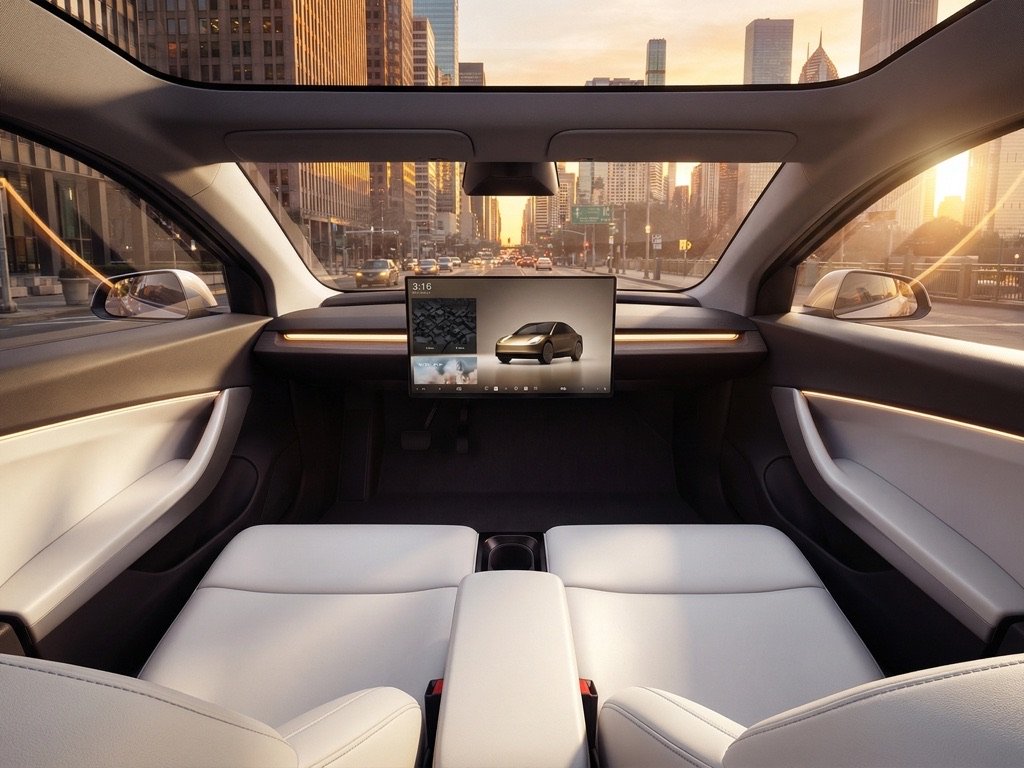
As the automotive industry pivots toward fully autonomous mobility in 2026, newly revealed cabin architecture details highlight a drastic departure from conventional vehicle interiors. Official company disclosures confirm that the dedicated Cybercab robotaxi eliminates the steering wheel, accelerator pedal, and traditional instrument cluster entirely. This design ethos transforms the vehicle cockpit into a streamlined lounge space optimized exclusively for passenger comfort and seamless operational utility.
The centerpiece of this minimalist dashboard architecture is a massive central touchscreen display that governs all primary vehicle interactions and occupant controls. Engineering data indicates that the cabin layout maximizes interior space while maintaining strict structural safety standards for high-density urban transit. By removing driver-centric hardware, the vehicle establishes a brand-new benchmark for purpose-built autonomous fleet transportation across global commercial markets.
Eradication of Traditional Driver Controls
The absolute elimination of manual steering equipment marks a pivotal milestone in autonomous vehicle production. Official company disclosures reveal that the front bulkhead has been engineered without a steering column, brake lines, or pedal assembly mounts. This structural shift allowed designers to push the dashboard back significantly, creating unprecedented legroom for two front-row passengers while reducing total assembly complexity and manufacturing expense.
Regulatory filings emphasize that passive occupant protection systems have been entirely redesigned to compensate for the missing steering wheel airbag module. Advanced passenger airbags now deploy from seamless channels integrated directly across the lower upper-dashboard assembly. Industry analysts note that this wrap-around airbag configuration provides superior head and chest protection, meeting stringent safety criteria established for driverless vehicles operating on public roads.
Central Command and Infotainment Specifications
Positioned dead-center on the flush dashboard surface is a high-resolution 20.5-inch landscape touchscreen display. According to engineering data, this custom display panel utilizes advanced anti-reflective coating technology and operates at ultra-high frame rates for fluid responsiveness. Occupants utilize this single interface to set destinations, alter climate parameters, track route progression, and access localized media content during their autonomous journeys.
Climate control functionality is completely integrated behind the seamless dashboard fascia, eliminating visible plastic vents or physical adjustment dials. Official company disclosures document an indirect air distribution system that utilizes hidden electronic vanes to sweep airflow silently throughout the cabin geometry. Ambient strip lighting embedded below the dashboard lip provides intuitive visual feedback, changing hue to indicate temperature adjustments or vehicle status updates.
Cabin Architecture and Material Innovations
The physical dashboard structure itself features a single sweep of lightweight, high-durability composite materials across the entire vehicle width. Industry analysts point out that eliminating physical switches, stalks, and instrument housings dramatically lowers warranty repair costs and simplifies mass vehicle assembly. The resulting aesthetic resembles an elegant, low-profile shelf that visually expands the cabin width while providing structural rigidness during crash events.
To support heavy commercial utility in ride-hailing fleets, cabin surfaces are covered in stain-resistant, fully recycled synthetic materials. Engineering data reveals that the smooth dashboard panel can be sanitized rapidly between passenger trips using automated UV sterilization systems or manual surface wipes. This emphasis on durable, easy-to-clean architecture ensures long-term operational readiness under continuous daily usage in demanding urban taxi environments.
Autonomous Interface and Passenger Telematics
The human-machine interface running on the dashboard display provides real-time telematics tailored specifically to ride-hailing passengers. Official company disclosures state that the screen renders a three-dimensional environment visualization powered by the vehicle's onboard vision processing suite. Passengers can observe surround-vehicle detection, optical lane mapping, and predicted path trajectories, which enhances consumer confidence in the driverless navigation system during complex maneuvers.
Directly beneath the lower edge of the central dashboard console reside dual high-output inductive wireless charging pads for mobile devices. Engineering data highlights the inclusion of multi-zone directional speakers built directly into the dash structure, delivering targeted audio to each passenger without requiring bulkier traditional door panels. High-speed cellular telematics ensure continuous cloud connectivity for real-time ride tracking and fleet management operations.
Production Roadmap and Market Integration
The extreme simplification of the dashboard assembly directly supports aggressive unit economics aimed at sub-thirty-thousand-dollar manufacturing targets. Industry analysts highlight that removing mechanical linkages, switches, and redundant wiring harnesses cuts cabin assembly time by more than forty percent. These cost reductions are critical for enabling low per-mile transport tariffs, allowing fleet operators to offer highly competitive pricing against traditional human-driven taxi networks.
Regulatory filings in multiple jurisdictions confirm that validation testing for the steering-wheel-free interior configuration is progressing ahead of schedule. Crash safety simulations demonstrate that the reinforced dashboard structure effectively absorbs frontal impact energy while maintaining cabin structural integrity. Comprehensive regulatory approvals remain on track to facilitate initial commercial fleet deployment across selected metropolitan markets throughout the 2026 calendar year.
Market feedback surrounding the radically simplified dashboard layout indicates strong consumer curiosity and rapid acceptance of autonomous seating paradigms. Industry analysts project that as passenger familiarity with driverless rides increases, legacy automakers will face immense pressure to adopt similar stripped-down interior architectures. The elimination of human operational controls represents a point of no return for future interior design standards across autonomous platforms.
Ultimately, the Cybercab minimalist dashboard encapsulates a broader structural shift from driver-centric engineering to pure passenger-centric vehicle architecture. Official company disclosures underline that every component, surface, and digital interface within the dashboard has been optimized for reliability, safety, and operational longevity. As full-scale production scales up in 2026, this uncluttered cockpit setting stands as a defining symbol of autonomous electric transportation.