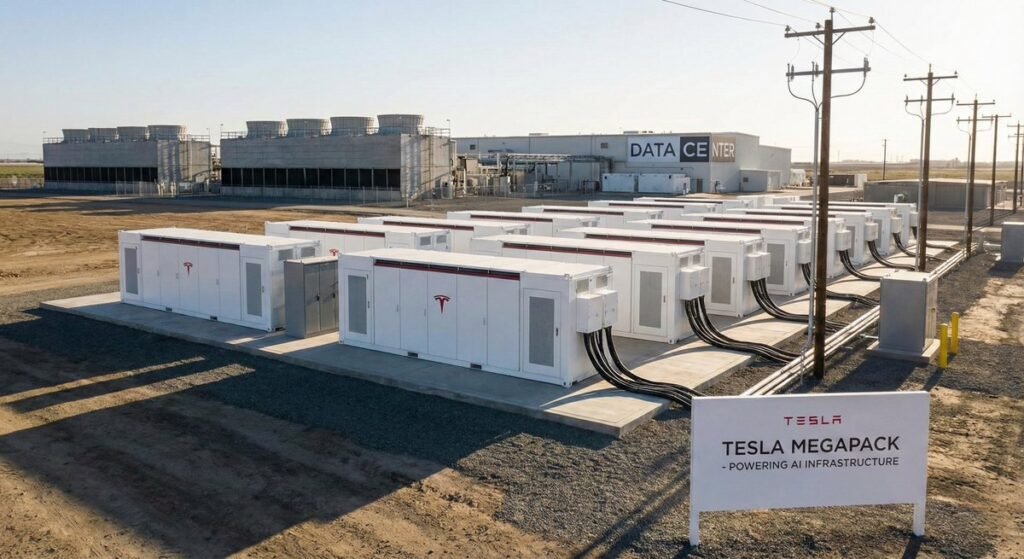
Tesla reported unprecedented financial performance within its commercial energy sector, setting a new historical revenue record for the division in early 2026. Official company disclosures reveal that stationary energy storage operations have surpassed previous projections, generating billions in quarterly receipts. This operational milestone underscores the rapid diversification of the company beyond automotive manufacturing into utility-scale electrical grid transformation.
The surge in commercial revenue stems primarily from the accelerated deployment of utility-scale Megapack units across North America, Europe, and Asia. Engineering data highlights significant improvements in assembly efficiency, enabling higher delivery rates while simultaneously reducing production costs per kilowatt-hour. Consequently, commercial energy storage has transformed into one of the fastest-growing and highest-margin business lines within the corporate portfolio.
Unprecedented Commercial Energy Expansion
Financial figures published in regulatory filings confirm that the energy segment now accounts for a substantial percentage of total corporate income. Industry analysts calculate that storage revenue expanded at a triple-digit annualized rate throughout the preceding twelve months. High operational leverage at dedicated manufacturing facilities has allowed gross margins for energy products to consistently exceed automotive hardware profit margins.
Major electric utility providers are increasingly contracting for multi-gigawatt-hour installations to stabilize aging power grids and integrate variable renewable assets. Industry analysts note that long-term service agreements bundled with energy hardware purchases are creating dependable, recurring revenue streams. These multi-year operational contracts further consolidate commercial market share while ensuring continuous long-term cash generation for the division.
Deployment volumes reached historic highs during the latest quarter, driven by massive project commissioning in grid-constrained regions. Official company disclosures indicate that installed capacity expanded by tens of gigawatt-hours year-over-year, fulfilling a massive backlogged order book. Demand continues to outpace output despite massive operational scaling, reflecting an urgent global transition toward decentralized battery backup networks.
Technological Breakthroughs and Grid Integration
Technological upgrades introduced into the 2026 hardware architecture have substantially increased energy density per footprint square meter. Engineering data demonstrates that advanced thermal management systems have extended operational lifespans and reduced lifetime maintenance overhead for commercial clients. These technical enhancements allow utility operators to extract greater output while occupying significantly smaller physical parcels of real estate.
Software optimization has played an equally crucial role in driving higher financial yields for commercial storage deployments. The proprietary Autobidder platform utilizes real-time machine learning algorithms to execute high-frequency energy trading on regional wholesale markets. Industry analysts emphasize that this automated monetization software grants battery asset owners superior financial returns compared to traditional stationary energy installations.
Safety standards across the commercial product lineup have reached new benchmarks through enhanced internal pack monitoring architectures. Engineering data indicates that localized isolation systems and improved cell-level thermal barriers have drastically reduced system downtime and risk profiles. Consequently, major commercial insurance carriers have reduced coverage premiums for facility operators, further driving enterprise adoption globally.
Market Drivers and Regulatory Support
Global climate policy mandates and regional grid resilience initiatives continue to accelerate enterprise battery storage adoption across key international markets. Regulatory filings show that governmental incentives for zero-emission energy infrastructure have shortened project payback periods significantly for commercial clients. These regulatory catalysts encourage industrial users to replace carbon-intensive peaker plants with large-scale lithium iron phosphate storage complexes.
Commercial and industrial enterprises are increasingly deploying localized microgrids to insulate manufacturing facilities against grid instability and brownouts. Industry analysts observe that heavy energy consumers are installing dedicated storage capacity to avoid peak demand pricing penalties from utility providers. This shift toward localized energy independence represents a rapidly expanding commercial revenue stream outside of traditional utility supply agreements.
The financial viability of stationary storage systems now compares favorably against traditional natural gas peaking facilities across major transmission corridors. Engineering data confirms that large battery arrays offer near-instantaneous response times to grid frequency drops, outperforming fossil-fuel alternatives in system reliability. This performance advantage is leading grid operators to routinely select battery infrastructure over conventional gas turbines for system stability.
Supply Chain Scaling and Manufacturing Capacity
Manufacturing expansion at specialized Megafactory sites has cleared critical production bottlenecks that previously constrained corporate revenue potential. Official company disclosures highlight that dual-location production in California and Shanghai has enabled continuous output scaling to meet international demand. Streamlined logistics operations have dramatically reduced transit timelines, allowing rapid site delivery and quicker revenue recognition on completed installations.
Long-term procurement agreements for raw materials and battery cells have shielded the commercial energy division from volatile commodity markets. Regulatory filings reveal strategic supply partnerships that ensure predictable cell availability and cost structures for upcoming production schedules. Secure component pipelines allow the manufacturing organization to maintain stable delivery targets regardless of macroeconomic supply disruptions.
Long-Term Outlook for Energy Operations
The expansion of the energy division is rapidly transforming the long-term enterprise valuation structure of the entire corporation. Industry analysts project that commercial storage operations will contribute a progressively dominant share of corporate net earnings throughout the remainder of the decade. This strong performance validates corporate strategy aimed at building a fully integrated clean energy ecosystem spanning generation, storage, and mobility.
As electric vehicle adoption drives grid demand to historical levels, utility-scale storage infrastructure will remain vital for grid stability. Official company disclosures indicate ongoing investments in next-generation manufacturing technology to expand capacity further by late 2026. The sustained momentum in commercial energy storage underscores the transition toward an electrified economy backed by massive stationary battery networks.