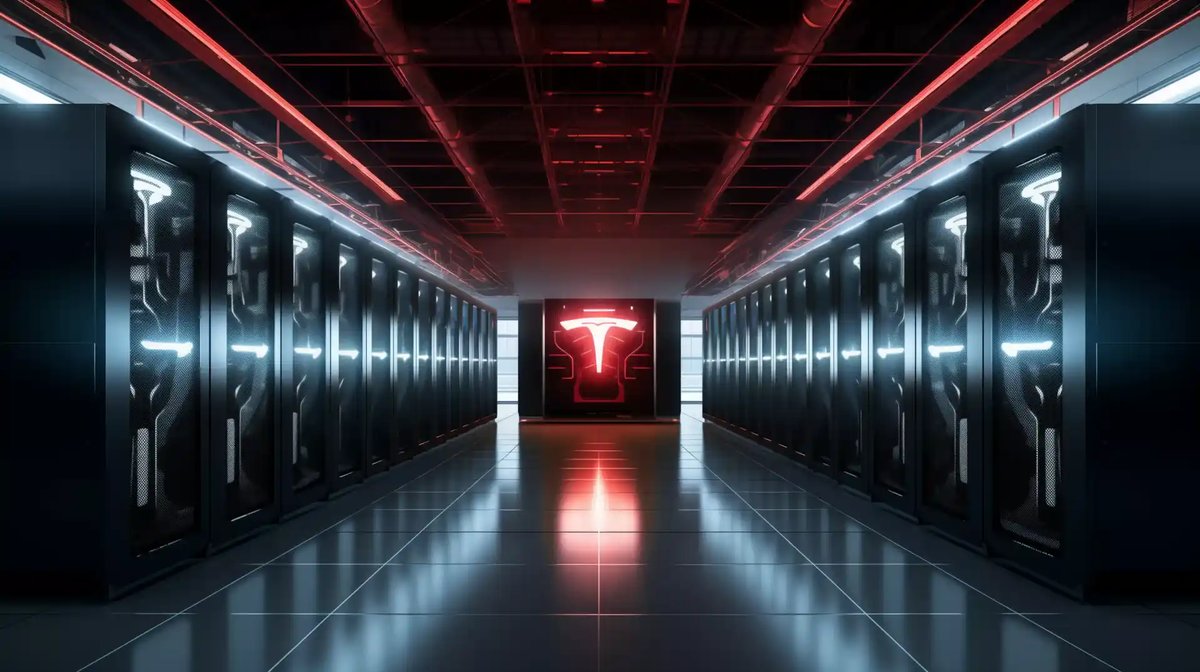
Tesla has officially initiated the next expansion phase of its custom Dojo supercomputer cluster, dramatically amplifying its high-performance compute capabilities for autonomous vehicle training. According to official company disclosures, the upgraded facility integrates thousands of proprietary D2 microchips designed specifically for processing massive vision-based video datasets. This architectural leap aims to significantly compress neural network training cycles for the automaker’s fully autonomous vehicle fleet throughout 2026.
The operational enhancement positions the computing center among the most powerful artificial intelligence training environments in the world. Engineering data reveals that the newly deployed compute tiles achieve unprecedented interconnect bandwidth, eliminating traditional data bottlenecks between individual training nodes. Consequently, the enlarged cluster allows developers to ingest exabytes of real-world driving footage gathered from millions of active vehicles seamlessly.
Architecture and Hardware Milestones
Recent regulatory filings indicate that the hardware expansion relies heavily on advanced system-on-wafer packaging technology. By integrating compute power directly across whole wafers rather than separate discrete chips, the system delivers orders of magnitude higher data throughput. Industry analysts note that this approach drastically reduces physical space requirements while maximizing energy performance across the entire server array.
Official company disclosures confirm that the custom-designed silicon incorporates specialized vector processing units optimized exclusively for video parsing and temporal transformer models. Unlike general-purpose graphics processing units, these custom acceleration engines discard unnecessary legacy instruction sets. This narrow architectural focus enables the hardware to execute complex spatial intelligence calculations with minimal power loss.
Furthermore, engineering data highlights a modular cluster design that allows seamlessly hot-swapping individual compute trays without disrupting ongoing training jobs. The redundancy engineered into the power delivery system ensures ninety-nine point nine percent cluster uptime during heavy execution loads. This operational stability is critical for training foundation models that require several weeks of continuous calculations.
Scaling Full Self-Driving and Robotaxi Neural Networks
The primary driver behind the massive compute expansion is the accelerated deployment of end-to-end neural networks across the vehicle fleet. Industry analysts report that training unified artificial intelligence models—which process raw photons into vehicle control actions directly—demands exponential compute growth. The upgraded cluster provides the precise raw computational power required to resolve edge-case driving behaviors at scale.
According to official company disclosures, the expanded system enables automated simulation generators to construct hyper-realistic virtual environments for training. These synthetic scenarios expose digital vehicle agents to rare environmental conditions, complex urban intersections, and erratic pedestrian actions. By blending real-world fleet video with generative simulation, engineering teams can rapidly validate safety parameters before releasing wireless updates.
Regulatory filings highlight that achieving fully autonomous robotaxi commercialization hinges directly on proving statistical safety superiority over human drivers. The expanded computational infrastructure allows for continuous, automated retraining loops that iterate on incoming disengagement metrics within hours. This compressed iteration cycle significantly shortens the timeline required to satisfy stringent regulatory safety thresholds worldwide.
Energy Infrastructure and Thermal Efficiency Solutions
Operating a supercomputing environment of this unprecedented scale presents monumental power delivery and thermal management challenges. Engineering data indicates that the facility incorporates an advanced direct-to-chip liquid cooling architecture capable of dissipating intense thermal loads. This closed-loop liquid system maintains optimal silicon operating temperatures while dramatically reducing the energy overhead typical of air-cooled data centers.
To support the massive megawatt demands of the installation, local utility regulatory filings confirm the installation of dedicated microgrid infrastructure. The site pairs massive stationary energy storage batteries directly with high-capacity solar generation arrays to balance peak electrical loads seamlessly. This hybrid energy setup prevents sudden regional grid draws during intensive compute bursts and reinforces operational sustainability goals.
Industry analysts note that thermal stability directly correlates with compute reliability and long-term silicon degradation rates in supercomputers. By maintaining tight thermal tolerances across millions of compute cores, the custom enclosure extends chip operational lifespans significantly. Consequently, capital efficiency improves as component replacement intervals stretch out over multi-year operational cycles.
Financial Investments and Strategic Compute Roadmap
Official company disclosures emphasize that sustained capital expenditure in proprietary computing hardware forms the bedrock of long-term software revenue strategies. Management projects that the financial investment in custom silicon yields significantly lower total cost of ownership compared to purchasing off-the-shelf third-party chips. This financial autonomy insulates long-term autonomy roadmaps from supply chain constraints and semiconductor price spikes.
Financial regulatory filings outline plans for additional cluster expansions planned through the end of the decade. The long-range compute strategy anticipates scaling aggregate training capacity beyond tens of exaflops to accommodate humanoid robotics workloads alongside automotive neural nets. This multi-purpose compute deployment allows software algorithms trained on automotive physics to cross-pollinate into general robotics models.
Industry analysts conclude that control over both hardware manufacturing and software development creates a formidable moat against legacy vehicle manufacturers. As autonomous driving transitions from experimental software to scaled commercial deployment, compute infrastructure becomes the primary metric of technological velocity. By expanding its custom cluster, the company secures its capability to iterate neural networks faster than competitors.