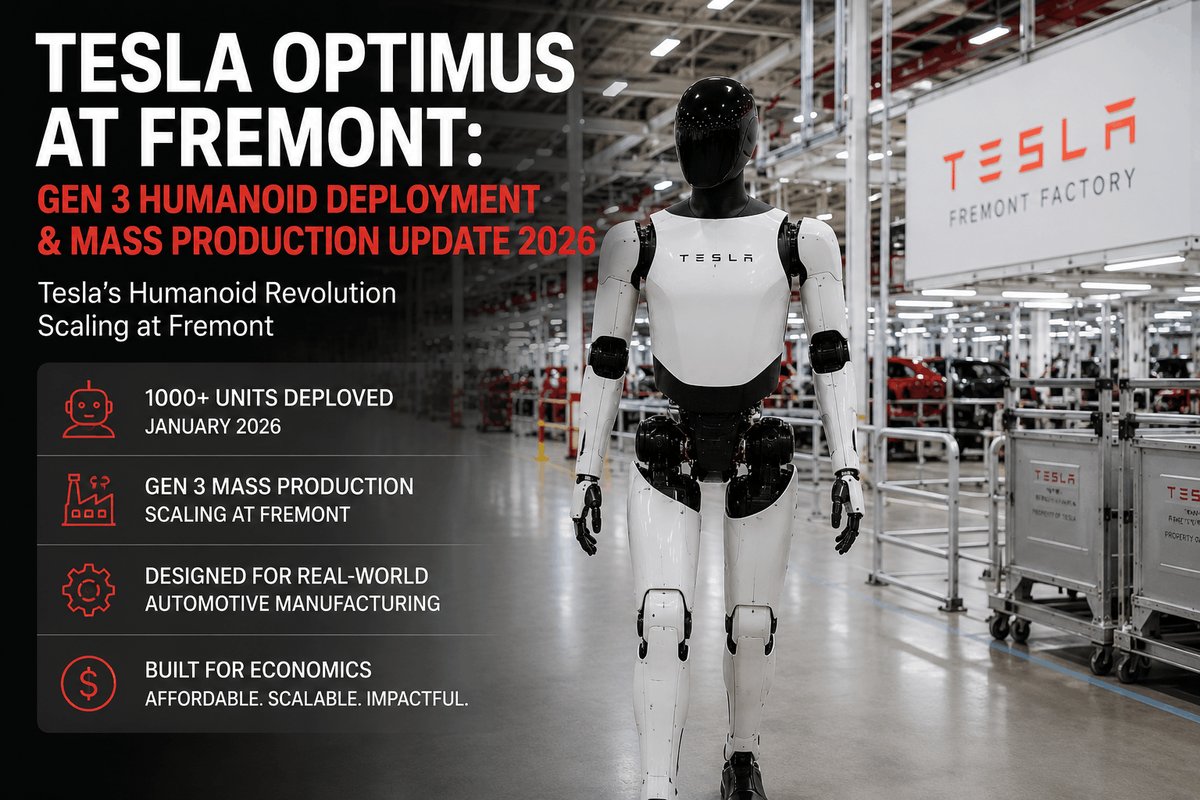
Official company disclosures published in early 2026 confirm that Tesla has initiated pilot factory integration trials for the Optimus Generation 3 humanoid robot. Deployed directly onto high volume automotive assembly lines, the advanced autonomous platform is currently performing complex subassembly tasks alongside human workers. This operational milestone marks the transition of the humanoid robotics program from isolated laboratory testing to active industrial manufacturing validation.
Engineering data indicates that the Generation 3 unit features entirely redesigned tactile sensors, higher torque electromechanical actuators, and a lighter structural frame. These hardware upgrades enable the robot to manipulate delicate battery cell interconnects and secure structural fasteners with sub-millimeter precision. Early performance metrics demonstrate a sixty percent improvement in cycle times compared to previous internal prototypes evaluated during late 2025.
Operational Integration and Cell Production
According to official company disclosures, the trial phase focuses primarily on battery module assembly and heavy component staging within the Gigafactory network. The Optimus units operate continuously during standard shifts, handling autonomous material transport and precision placing without safety cage isolation. Industry analysts note that operating directly within existing human workflows provides crucial edge-case training data for the central neural network powering the platform.
The integration of vision-based spatial awareness allows Optimus Gen 3 to adapt dynamically to shifting production speeds and unexpected line bottlenecks. Rather than relying on fixed pre-programmed paths, the system interprets its surroundings in real time using end-to-end neural networks. Industry analysts emphasize that this flexibility reduces line modification costs by eliminating the specialized robotic enclosures historically required for industrial automation equipment.
Regulatory filings reveal that initial safety certifications for close proximity human collaboration were secured prior to launching the pilot program. Built-in force-feedback sensors immediately halt actuator movement upon detecting unexpected resistance, ensuring workplace safety standards are rigorously maintained. Facility safety audits conducted over the past quarter report zero contact incidents or operational disruptions resulting from the humanoid robot deployments.
Hardware Innovations and Dexterity Upgrades
Engineering data highlights substantial structural improvements in the Gen 3 hands, which now incorporate twenty-two degrees of freedom per hand. Customized micro-actuators embedded directly within the wrist assembly allow the robot to handle fine wire harnesses and metallic clips effortlessly. Furthermore, palm-mounted tactile arrays provide real time surface texture and thermal feedback, drastically minimizing component damage during high speed installation sequences.
Power management has also seen a major architecture overhaul, with internal energy storage density increasing by twenty-five percent. Official company disclosures indicate that an integrated custom battery pack housed within the torso supports up to eight hours of continuous heavy-duty operation. Advanced regenerative braking within the joint actuators reclaims kinetic energy during downward movements, further extending operational endurance throughout grueling factory shifts.
Compute capabilities are driven by dual onboard neural processing units running custom spatial artificial intelligence models. Engineering data reveals that onboard chipsets analyze high resolution multi-camera feeds at one hundred twenty frames per second, calculating joint trajectories instantly. This localized compute architecture eliminates reliance on external cloud servers, preventing latency spikes that could jeopardize precision manufacturing tasks or worker safety.
Production Scaling and Supply Chain Impact
Industry analysts project that successful completion of the current factory trial will clear the path for full-scale commercial manufacturing by late 2026. Internal target metrics suggest an initial annual production volume of ten thousand units dedicated strictly to internal factory deployment across global facilities. Scaling up internal usage first allows the manufacturing ecosystem to mature before expanding supply to external industrial customers.
Supply chain monitoring indicates that dedicated production lines for custom actuators and harmonized gear drives are already operating in high-volume facilities. By designing more than eighty percent of the robot's physical components in-house, production costs are falling rapidly toward target thresholds. Regulatory filings indicate capital expenditure allocations have shifted significantly toward automated assembly lines tailored specifically for humanoid robot fabrication.
The reduction in overall component complexity has lowered unit assembly time by nearly forty percent relative to the Generation 2 model. Industry analysts report that simplified structural casting and modular wire routing enable rapid field repairs and simplified preventative maintenance routines. These manufacturing refinements are essential for achieving the long-term unit cost targets necessary for widespread industrial adoption across global markets.
Financial Outlook and Market Implications
Industry analysts anticipate that deploying humanoid robots at scale will drastically alter long-term capital intensity models within automotive manufacturing. By lowering overall assembly overhead and accelerating vehicle throughput, factory margins could expand substantially over the next three fiscal years. Official company disclosures emphasize that initial capital efficiency gains will be reinvested directly into expanding autonomous software development and battery production capacity.
The economic implications extend far beyond the EV sector, establishing a new benchmark for general-purpose industrial automation equipment. Regulatory filings indicate that commercial agreements with third-party logistics firms and heavy manufacturing partners are currently under preliminary review. Industry analysts expect commercial customer deliveries to begin in early 2027, provided current gigafactory pilot metrics meet internal reliability and yield benchmarks.
As the pilot trial progresses through its final evaluation phase, real-world operational data continues to refine the underlying neural models. Engineering data gathered across millions of physical movement cycles directly enhances fleet-wide performance through automated over-the-air firmware updates. The successful factory trial demonstrates that general-purpose humanoid robots are rapidly evolving from visionary experimental prototypes into indispensable tools for modern manufacturing.