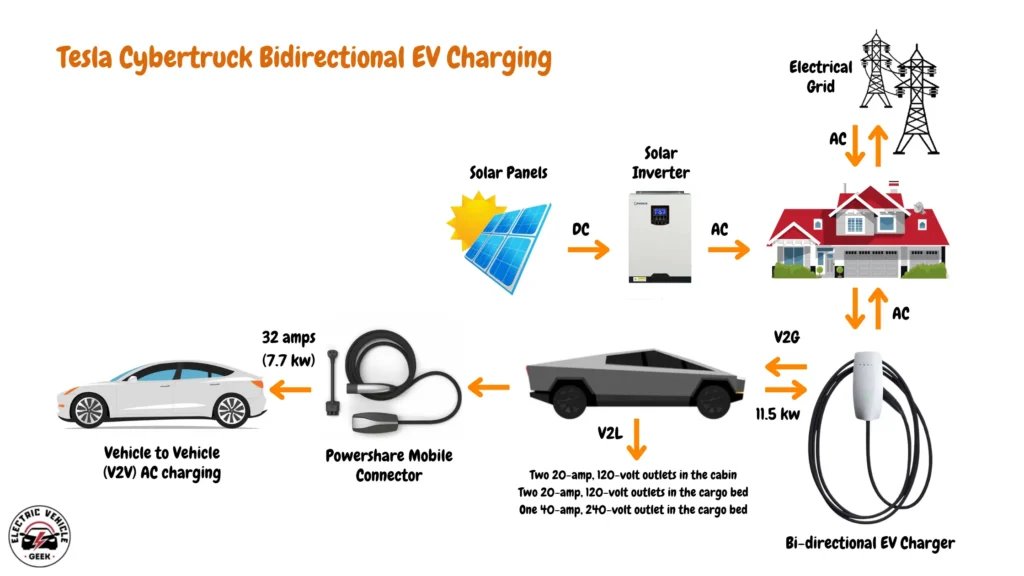
Tesla has officially launched its long-anticipated vehicle-to-grid power protocol across its latest EV lineup, marking a pivotal shift in global energy management. Official company disclosures confirm that the new bi-directional architecture enables passenger vehicles to seamlessly export electricity back to residential homes and municipal energy grids. This system turns millions of electric vehicles into distributed storage nodes capable of stabilizing modern electrical grids during peak demand hours.
The standardized protocol utilizes onboard silicon-carbide power electronics designed to handle sustained bi-directional electricity transfer without excessive thermal stress. Engineering data indicates the technology supports both alternating current export through home wall chargers and high-voltage direct current transmission via commercial charging hubs. By standardizing this communication framework, the automaker resolves longstanding hardware incompatibilities that previously hampered widespread vehicle-to-grid deployment across North America and Europe.
Architecture and Power Conversion Dynamics
At the core of this system lies an upgraded onboard power electronics suite that converts stored direct current into utility-grade alternating current with exceptional efficiency. According to engineering data, the overall round-trip power conversion efficiency achieves an impressive ninety-two percent rating under typical residential loads. This minimizes energy losses during discharge cycles, ensuring that vehicle owners maximize financial returns when feeding power back into local energy networks.
Software orchestration occurs natively within the driver mobile app, allowing users to establish precise reserve limits for daily driving needs. Regulatory filings highlight that automated algorithms monitor real-time wholesale electricity prices to trigger grid exports exclusively during peak pricing windows. Consequently, vehicle owners can automatically sell excess energy back to regional utilities when electricity rates skyrocket, dramatically reducing total cost of vehicle ownership over time.
Hardware integration is streamlined through the company’s third-generation home charging infrastructure, which now incorporates necessary isolation switches for off-grid backup. Industry analysts note that this native synergy allows residential setups to transition into island mode within milliseconds during unexpected grid outages. The system functions as a high-capacity whole-home battery backup, capable of sustaining standard household electricity demands for several consecutive days without engine noise or fuel exhaust.
Regulatory Approvals and Grid Operator Synergies
Securing universal utility approval required stringent compliance with evolving international grid interconnect standards, including IEEE 1547-2018 and UL 1741 SB regulations. Regulatory filings demonstrate that the proprietary control protocol meets all required anti-islanding safety parameters, preventing hazardous back-feeding onto utility lines during maintenance procedures. This certification path accelerates utility adoption, allowing regional grid operators to integrate electric vehicle fleets directly into active energy balancing programs.
Major energy providers across California, Texas, and Western Europe have already initiated aggregated virtual power plant projects utilizing this bi-directional protocol. Official company disclosures reveal that participating fleet owners receive financial compensation directly through utility bill credits or direct monthly payouts. Industry analysts project these utility programs could generate hundreds of megawatts of flexible capacity, eliminating the need for expensive fossil-fuel peaker plants during extreme weather events.
Battery Longevity and Degradation Safeguards
To address owner concerns regarding accelerated battery degradation, the protocol incorporates advanced thermal monitoring and real-time state-of-health tracking algorithms. Engineering data confirms that bi-directional power throughput is constantly modulated based on current cell temperatures and battery state-of-charge levels. By avoiding rapid deep-discharge cycles, the intelligent management system maintains long-term pack health and minimizes electrochemical strain during energy export routines.
The power management software applies different operational profiles depending on whether the vehicle contains lithium iron phosphate or nickel manganese cobalt battery chemistries. Official company disclosures indicate that LFP-equipped models are permitted to engage in higher frequency daily cycling due to their superior degradation resistance. Conversely, nickel-rich battery variants utilize conservative power caps designed to protect cathode structure while still contributing essential capacity during critical grid emergencies.
Reassurance for consumers comes via updated vehicle drivetrain and battery warranties that explicitly cover bi-directional grid export operations under standard terms. Regulatory filings reveal that warranty coverage remains fully intact provided grid exports do not exceed established annual megawatt-hour throughput thresholds. This policy shift removes a major historical barrier to consumer adoption, building trust among owners skeptical of auxiliary battery usage.
Industry Standardization and Competitive Landscape
While competing automakers have relied on fragmented third-party protocols, this standardized bi-directional architecture offers a unified framework across both hardware and software. Industry analysts suggest that rival original equipment manufacturers will face mounting pressure to adopt similar open-access communication standards. By delivering an integrated solution, the electric vehicle manufacturer strengthens its competitive moat while setting a high operational benchmark for alternative vehicle-to-everything implementations.
The global rollout relies heavily on over-the-air software updates delivered to compatible vehicle models built over the past eighteen months. Engineering data confirms that hardware components installed in recent production runs were pre-configured for bi-directional capabilities, awaiting regulatory greenlights. As software unlocks these features, millions of existing electric vehicles worldwide will gain immediate access to vehicle-to-home and vehicle-to-grid operational modes without retrofit costs.
Long-Term Market Impact and Infrastructure Scalability
Commercial fleet operators stand to gain significant economic advantages by deploying large groups of bi-directional electric vehicles in centralized depots. Industry analysts calculate that commercial logistics fleets could offset up to thirty percent of overall charging expenditures by participating in automated grid stabilization services overnight. This economic incentive accelerates commercial fleet electrification while simultaneously relieving stress on localized electrical distribution substations.
Looking ahead, widespread adoption of vehicle-to-grid technology is projected to dramatically reshape global energy infrastructure over the next decade. Official company disclosures project that aggregated vehicle batteries could eventually provide gigawatt-hours of rapid-response power storage to municipal energy grids. This shift provides grid operators with an unprecedented level of flexibility, accelerating the global transition toward clean, renewable power generation networks.