
New York City To Add 600 Curbside EV Charging Stations
The Growing Crisis of Urban Gas Deserts
For decades, owning an internal combustion vehicle in a major metropolitan center has grown increasingly frustrating as traditional refueling options steadily diminish. Industry filings and transportation metrics reveal a persistent decline in retail gas stations across the United States. While fuel outlets were once ubiquitous landmarks, economic pressures and shifting real estate valuations have triggered a nationwide contraction of conventional gas infrastructure.
Data compiled by energy trade groups shows that retail fuel outlets dropped from 200,000 locations in 1994 to 168,000 in 2004. Updated regulatory disclosures noted a further decline to 160,000 sites by 2011, with Federal Highway Administration data registering just 145,000 active retail gas stations by 2021. This sustained downward trajectory has led to the rapid emergence of urban "gas deserts."
To survive, remaining fuel operators have consolidated, frequently co-locating fuel pumps with quick-serve restaurants and expanded convenience stores. Concurrently, electric vehicle charging providers have aggressively claimed new retail ground. Major national restaurant chains, including prominent breakfast and fast-casual brands like Waffle House, Bojangles, and Cracker Barrel, are actively integrating public electric charging stations into their parking facilities, signaling a structural transition in consumer refueling habits.
Surging Urban Car Ownership Meets Shrinking Refueling Hubs
Urban centers face an acute challenge because exorbitant property values and space constraints make traditional gas stations financially unviable. In New York City, demographic data shows that vehicle ownership rose by 12.1% between 2012 and 2023, expanding the local vehicle fleet from roughly 1.85 million to over 2.07 million registered automobiles despite constrained municipal footprint boundaries.
Paradoxically, while the driver population expanded, the physical infrastructure supporting gasoline-powered cars plummeted dramatically. Urban research metrics indicate that New York City housed approximately 1,100 functional retail gas stations in 2002. By 2023, that figure fell to just 700 operational locations—representing a steep 37 percent reduction in accessible neighborhood fueling points over two decades.
Expanding NYC Curbside Charging by 600 Units
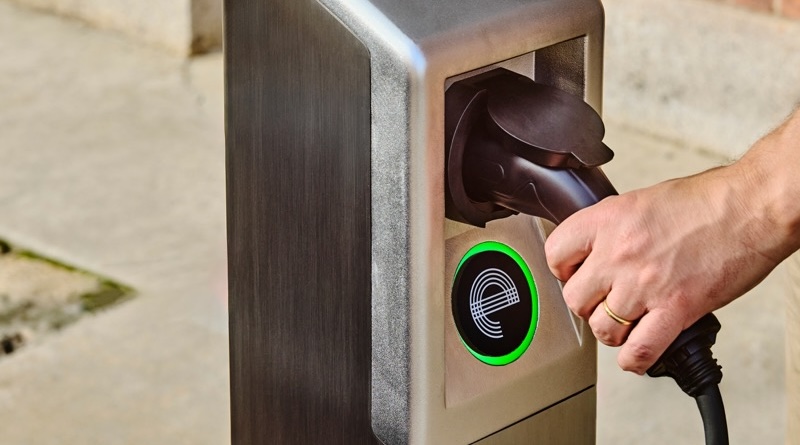
To counter the loss of traditional pumps and accelerate transportation decarbonization, municipal leaders are leaning into micro-infrastructure solutions. Following a successful pilot program featuring 88 Level 2 charging ports, the New York City Department of Transportation announced a major deployment that will install 600 additional curbside EV charging stations, bringing the total municipal curbside network to nearly 700 units.
High-density urban environments rarely possess the vacant acreage required for expansive multi-port charging hubs with large parking lots. Curbside infrastructure leverages existing street corridors, utilizing minimal sidewalk space while tapping into adjacent electrical grids. This modular approach allows cities to seamlessly integrate vehicle charging directly into residential blocks without disrupting established neighborhood layouts or acquiring land.
The city’s Department of Citywide Administrative Services has formalized a three-year contract with specialized charging firm "it's electric" to carry out the physical installation and operational rollout. This public-private partnership aims to solve the persistent charging barrier faced by urban drivers who lack off-street parking, private garages, or dedicated driveways needed for overnight vehicle charging.
Targeting High-Need Neighborhoods and Fleet Drivers
The expanded curbside deployment purposefully targets neighborhoods with heavy concentrations of drivers licensed by the Taxi and Limousine Commission. Furthermore, municipal planning documents emphasize equitable infrastructure distribution, directing new chargers toward lower-income residential districts that have historically been overlooked by private sector electric vehicle network investments and commercial charging developers.
Initial rollout phases will span across all five boroughs. Targeted areas include Soundview and Unionport in the Bronx; Rego Park, Forest Hills, and Far Rockaway in Queens; and Red Hook, Carroll Gardens, and Bedford-Stuyvesant in Brooklyn. Additional installations will take place along Manhattan’s Upper West Side and Washington Heights, alongside Stapleton on Staten Island.
Providing accessible curbside charging is essential for supporting professional ride-hailing and taxi operators transitioning to battery-electric vehicles. By situating chargers directly within residential neighborhoods where high-volume drivers live, the city reduces working-class driver downtime, eliminates long detours to commercial charging centers, and establishes a foundation for full fleet electrification under municipal zero-emission mandates.
Environmental and Public Health Imperatives
Beyond driver convenience, replacing traditional retail gas stations with curbside electric charging yields quantifiable public health dividends. Environmental health studies, including comprehensive epidemiology research conducted in Canada, link living near operational gas stations to heightened risks of volatile organic compound exposure and childhood leukemia, making the removal of neighborhood fuel pumps a public health gain.
Curbside electric vehicle chargers also actively mitigate localized air pollution by cutting unnecessary vehicle idling and miles traveled. Drivers searching for scarce gas stations often circle urban blocks or wait in long idling queues at remaining pump locations. Electric curbside infrastructure distributes power points locally, curbing neighborhood tailpipe emissions in densely populated residential zones.
As the automotive landscape shifts away from internal combustion engines, New York City’s curbside expansion serves as a blueprint for metropolitan adaptation. By repurposing curb space to replace vanishing gas stations, cities can modernize their transportation infrastructure, meet equity goals, and build resilient urban mobility networks suited for an electrified future.
