
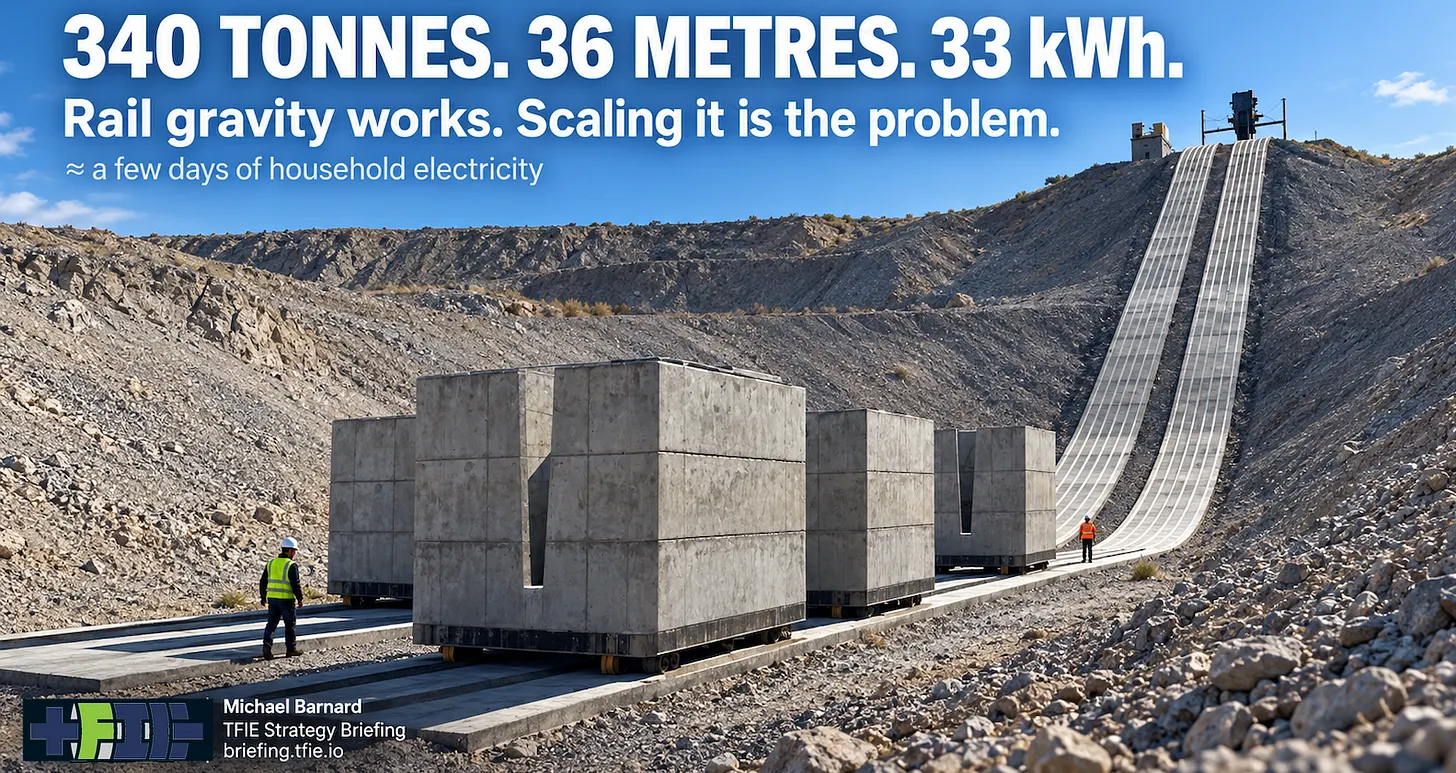
Nevada Rail Gravity Storage Trials Reveal Key Grid Limits
Recent operations at the Gamebird Pit demonstration facility in Nevada have shed clear light on the physical and economic boundaries of rail-based gravity energy storage. Developed by ARES North America, the system uses heavy rail cars moving up and down steep terrain to store and release grid electricity. However, performance data highlights the intrinsic challenges facing solid-mass mechanical designs.
Technical disclosures from government research laboratories reveal the stark math governing the Nevada pilot. The system features a pair of massive rail vehicles weighing approximately 340 tonnes climbing a steep 55 percent grade. Driven by a stationary motor and chain assembly across roughly 36 metres of elevation, the immense mechanical apparatus yields only about 33 kilowatt-hours of gross stored gravitational energy.
The outcome aligns precisely with basic physics principles dictating that potential energy is the product of mass, gravity, and height. While releasing hundreds of tonnes of mass rapidly down an incline can generate several megawatts of transient power, total energy capacity remains severely constrained by short vertical climbs. Generating meaningful megawatt-hours requires far greater elevation or absurdly massive physical inventories.
Scaling Up Reveals Massive Infrastructure Demands
To evaluate commercial viability, analysts modeled a hypothetical facility providing 20 megawatts of continuous power over a 20-hour duration. Even when granting the system an optimistic vertical drop of 400 metres—more than eleven times the height of the Nevada test site—the project requires holding 400 megawatt-hours of energy to support long-duration grid balancing requirements.
Field trials at Gamebird Pit did demonstrate one notable mechanical evolution: replacing conventional funicular cables with heavy chain-drive architectures. This design sidesteps traditional cable force limitations, allowing heavier individual car loads to move up steep slopes. Yet overcoming cable stress does not resolve the broader structural challenge of managing vast physical mass across decades of operation.
Once scaling requirements are integrated, solid-mass storage ceases to resemble simple ballast rolling along tracks. Storing hundreds of thousands of tonnes of mass demands custom-built heavy rail vehicles, expansive upper and lower yards, stationary drive mechanisms, complex transfer apparatuses, and robust control units. Facilities must also include redundant pathways to maintain energy access when individual vehicles undergo routine service.
Geotechnical Realities and Site Selection Dilemmas
Building such a system requires constructing an industrial heavy-rail manufacturing, concrete-forming, and rock-crushing enterprise directly at every project site. Operators must maintain this specialized heavy machinery over multi-decade operational cycles. The ongoing capital expenditure and maintenance burden quickly offset any perceived financial savings derived from using inexpensive concrete or local aggregate as energy storage ballast.
Operating inside an active gravel quarry like Gamebird Pit provides immediate access to existing roads, disturbed industrial ground, and onsite aggregate. However, mining pits rarely offer high vertical drops. To maximize energy density, commercial projects must target mountain faces with hundreds of metres of elevation change, where nearby aggregate, heavy transport access, and high-voltage transmission lines are seldom available together.
Finding suitable topography requires navigating a narrow intersection of engineering and environmental conditions. Ideal locations require steep slopes, stable geotechnical foundations, adjacent heavy industrial infrastructure, available grid interconnections, and space for massive staging yards at both top and bottom elevations. Ideal geography for gravity rail storage remains exceptionally rare across global energy markets, limiting deployment potential.
How Pumped Hydro and Batteries Outpace Mechanical Mass
Closed-loop pumped hydroelectric energy storage relies on the exact same gravitational physics but utilizes a far more efficient material-handling architecture. Fluid water flows naturally through shared subterranean conduits into unlined reservoirs. Millions of tonnes of water sit in open basins without requiring dedicated vehicle chassis, wheel bearings, axle assemblies, or complex multi-lane track switching networks for every increment of mass.
Water automatically conforms to terrain and flows seamlessly through common turbine units. If a single pump-generator requires routine maintenance, the remaining water volume stays fully accessible to alternative generating assets. In contrast, mechanical rail storage risks trapping stored energy behind damaged tracks or failing car assemblies, creating operational single points of failure across the grid storage yard.
Concurrently, rapidly falling costs and expanding energy densities for utility-scale lithium-ion battery installations make mechanical alternatives increasingly difficult to justify. Battery enclosures deliver compact, high-efficiency storage with minimal physical footprint and zero mechanical wear items like steel wheels or heavy chains, delivering vastly higher energy density per square metre of land occupied.
The Economic Outlook for Heavy Solid Mass Storage
Proponents market solid-mass gravity storage for multi-hour and multi-day duration needs where chemical batteries face economic limits. However, technical assessments indicate that the massive upfront civil engineering costs, high equipment intensity, and ongoing mechanical maintenance undermine any theoretical cost advantages over long operational lifetimes. The physical reality of moving heavy rock simply fails to deliver competitive economics.
As power grids seek reliable long-duration energy storage to integrate variable renewable generation, the Nevada demonstrator provides a definitive case study in energy density limits. Moving solid mass uphill on rails remains a fascinating mechanical exercise, but fundamental physics and complex supply chains ensure that fluid media and chemical cells will continue to dominate grid-scale storage.
