
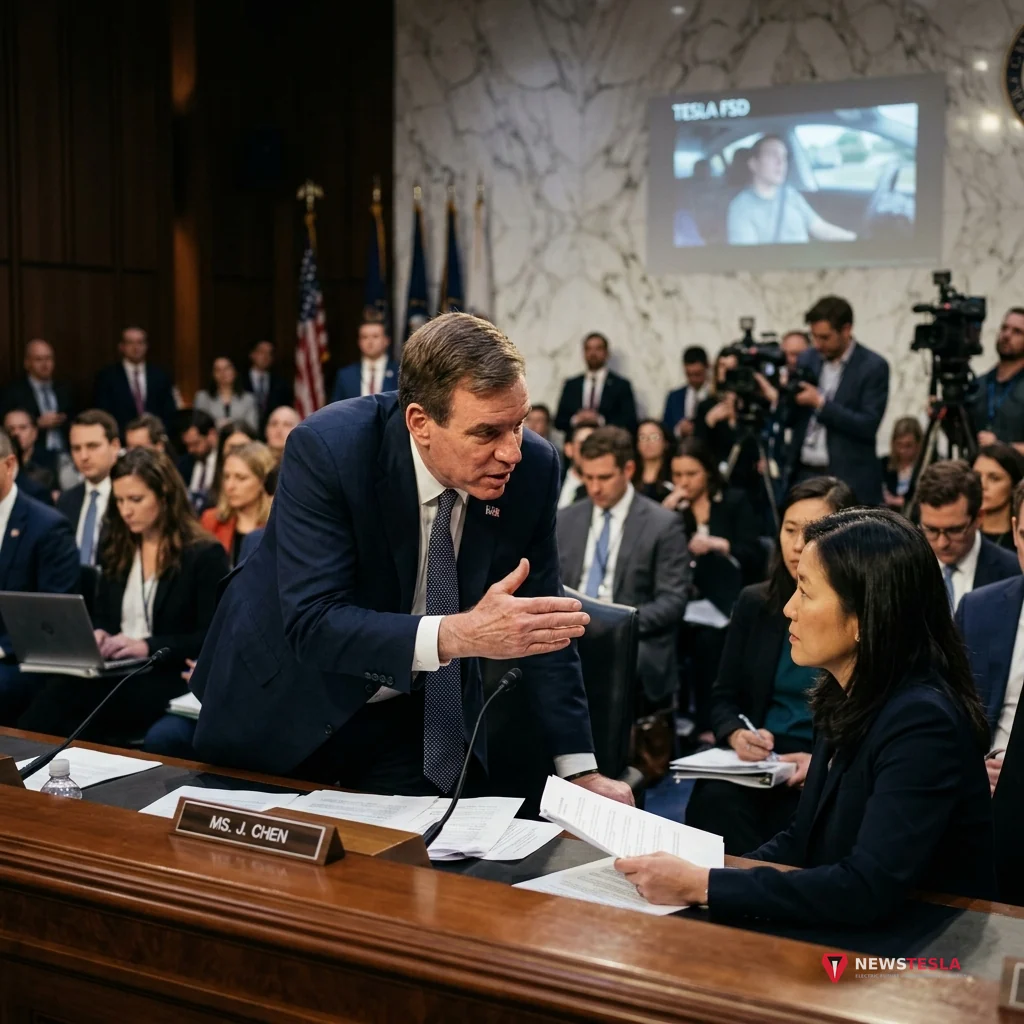
US Lawmaker Demands DOT Probe Tesla FSD Over Sleeping Drivers
Federal oversight of advanced driver-assistance software has returned to the national spotlight following renewed regulatory pressure from Capitol Hill. A prominent lawmaker is demanding that the U.S. Department of Transportation detail its concrete regulatory strategy regarding persistent driver monitoring failures in electric vehicles equipped with Full Self-Driving capabilities across American highways.
The high-profile inquiry follows recent investigative disclosures revealing dozens of video recordings that capture motorists apparently fast asleep behind the wheel of moving vehicles. These alarming instances have intensified critical questions about whether existing vehicle safety safeguards adequately enforce required human oversight and prevent driver misuse under real-world operating conditions.
Lawmaker Demands Answers on Driver Supervision
Representative Raja Krishnamoorthi, a senior Illinois Democrat, formally issued an official letter to Transportation Secretary Sean Duffy on September 9. The detailed correspondence requests comprehensive responses to five specific technical and regulatory questions regarding federal oversight, establishing a firm deadline of September 30 for the agency to deliver its findings.
The inquiry directly addresses a growing disconnect between official vehicle operational requirements and real-world consumer behavior. Official manufacturer manuals explicitly state that the software suite requires continuous, active human supervision. However, recent investigative reports identified at least 43 separate video clips showing drivers completely asleep, with 17 of those instances recorded in 2024 alone.
Lawmakers argue that the widespread prevalence of these online videos indicates a systemic breakdown in vehicle safety protocols. Despite official disclaimers that the software does not render vehicles fully autonomous, drivers repeatedly operate the technology without maintaining situational awareness, creating severe hazards for surrounding traffic on public roadways.
Software Prompts Under Scrutiny for Encouraging Risks
A central point of contention highlighted in the congressional letter is the specific messaging displayed on vehicle dashboards when driver fatigue is identified. In-car displays have been documented displaying prompts such as "Drowsiness detected. Stay focused with FSD," which safety advocates argue sends a highly contradictory and dangerous signal to impaired operators.
The letter forcefully contends that this user interface design actively encourages motorists to rely on automated driving features precisely when their cognitive abilities are compromised. Rather than instructing the vehicle to safely disengage or pull over, the software implies that automated systems can compensate for human exhaustion, directly violating basic safety engineering principles.
Industry disclosures and regulatory filings note that promotional messaging on social media platforms has frequently emphasized arriving at destinations refreshed when utilizing advanced driver-assist features. Critics maintain that this marketing narrative fosters a false sense of capability, subtly encouraging drivers to lower their vigilance during long highway journeys.
Federal Investigation Nears Potential Recall Decision
The congressional pressure directly intersects with an ongoing federal safety investigation into automated driving systems. The National Highway Traffic Safety Administration previously escalated its safety evaluation into a formal engineering analysis, designated as EA26002, which currently encompasses roughly 3.2 million vehicles equipped with Full Self-Driving software across the country.
An engineering analysis represents the final procedural step before federal regulators either close an active investigation or mandate an official vehicle safety recall. The ongoing federal probe was upgraded following multiple recorded crashes occurring in reduced-visibility conditions, including incidents that resulted in at least one confirmed fatality and multiple severe injuries.
Regulatory disclosures reveal that initial software updates delivered to address visibility hazards may have proven insufficient. Safety regulators noted that voluntary software modifications previously issued by the manufacturer would have potentially prevented only three of the nine critical collision incidents thoroughly evaluated during the agency’s preliminary technical assessment.
Technical Flaws in Driver Monitoring Hardware
The letter highlights significant engineering vulnerabilities in the optical cabin-monitoring hardware designed to track driver engagement. Automotive safety analysts have repeatedly demonstrated that cabin-mounted optical cameras can be easily bypassed using simple physical obstructions, such as placing a folded paper bill or tape directly over the interior camera lens.
Furthermore, optical monitoring systems frequently fail to track eye movement accurately when vehicle occupants wear dark or polarized sunglasses, or when drivers defeat steering wheel torque sensors using cheap aftermarket accessories. These widely documented workarounds allow drivers to fool internal safety algorithms while completely relinquishing physical control of moving vehicles.
Independent safety experts argue that current monitoring design choices prioritize feature uptime over mandatory driver compliance. Rather than forcing the vehicle to execute a controlled pull-over maneuver when supervision checks fail, the software architecture permits continuous operation, inviting drivers to record reckless behavior for online clout.
Regulators Face Deadline for Clear Action
Representative Krishnamoorthi has requested that federal regulators clarify whether they are actively analyzing driver inattention data collected from crashes recorded since January 1, 2024. The letter specifically asks the agency to evaluate cabin camera efficacy and define the precise technical findings that would trigger a mandatory safety recall.
While congressional letters do not automatically force immediate administrative policy shifts, this tight deadline places significant public pressure on the Department of Transportation. As the deadline arrives, industry observers are watching closely to determine whether federal regulators will finally mandate stricter driver-monitoring standards across all semi-autonomous vehicles.
