
Dense-Fluid Pumped Hydro Works But Faces Major Scaling Limits
A Breakthrough Demonstration in Grid-Scale Storage
Energy storage innovators often struggle to move beyond digital renderings and laboratory bench tests, but a recent real-world pilot has turned theoretical physics into physical machinery. At a dedicated test facility in Cornwood, Devon, engineers successfully constructed upper and lower reservoirs, laid specialized piping, installed pumps and turbines, and circulated hundreds of cubic meters of proprietary high-density fluid uphill to generate electricity upon release.
The test platform reached its full design rating of 500 kilowatts, providing tangible proof that dense-fluid pumped hydro functions in a closed mechanical loop. Rather than relying on optimistic component extrapolations, the facility demonstrated real power delivery. However, moving a heavy fluid uphill to drive a turbine is only the first hurdle in the broader challenge of commercial energy storage.
The Physics and Promise of High-Density Fluids
The fundamental attraction of high-density fluid hydro lies in core gravitational physics. By using a proprietary mineral-rich fluid that is approximately two and a half times denser than water, the system yields significantly more potential energy per unit of volume or vertical drop. This enhanced energy density theoretically allows developers to build smaller storage reservoirs or utilize lower topographies.
Advocates argue this density advantage creates siting opportunities in geography where conventional pumped storage is unviable. Lower hills and smaller land footprints could theoretically unlock projects closer to industrial load centers or renewable generation hubs. Engineering documentation confirms that the physical principles hold true, but achieving spatial efficiency introduces complex chemical and material trade-offs that standard water-based projects completely avoid.
Operational Reality and Initial Efficiency Metrics
Translating fluid density into long-duration energy storage requires sustained discharge, which proved challenging during initial testing. Official government demonstrator reports indicate the facility was originally designed to run for four hours at full capacity. However, manufacturing constraints regarding the proprietary high-density fluid restricted available inventory, yielding roughly 15 minutes of full-power discharge during completed testing runs.
System measurements recorded a baseline round-trip efficiency of 59 percent prior to accounting for unmeasured parasitic loads, such as fluid agitation and auxiliary equipment power. While these figures represent reasonable benchmark performance for a first-of-a-kind pilot project, they highlight the substantial gap between achieving short-duration power output and delivering economic long-duration grid balancing.
The Supply Chain Bottleneck for Weighting Minerals
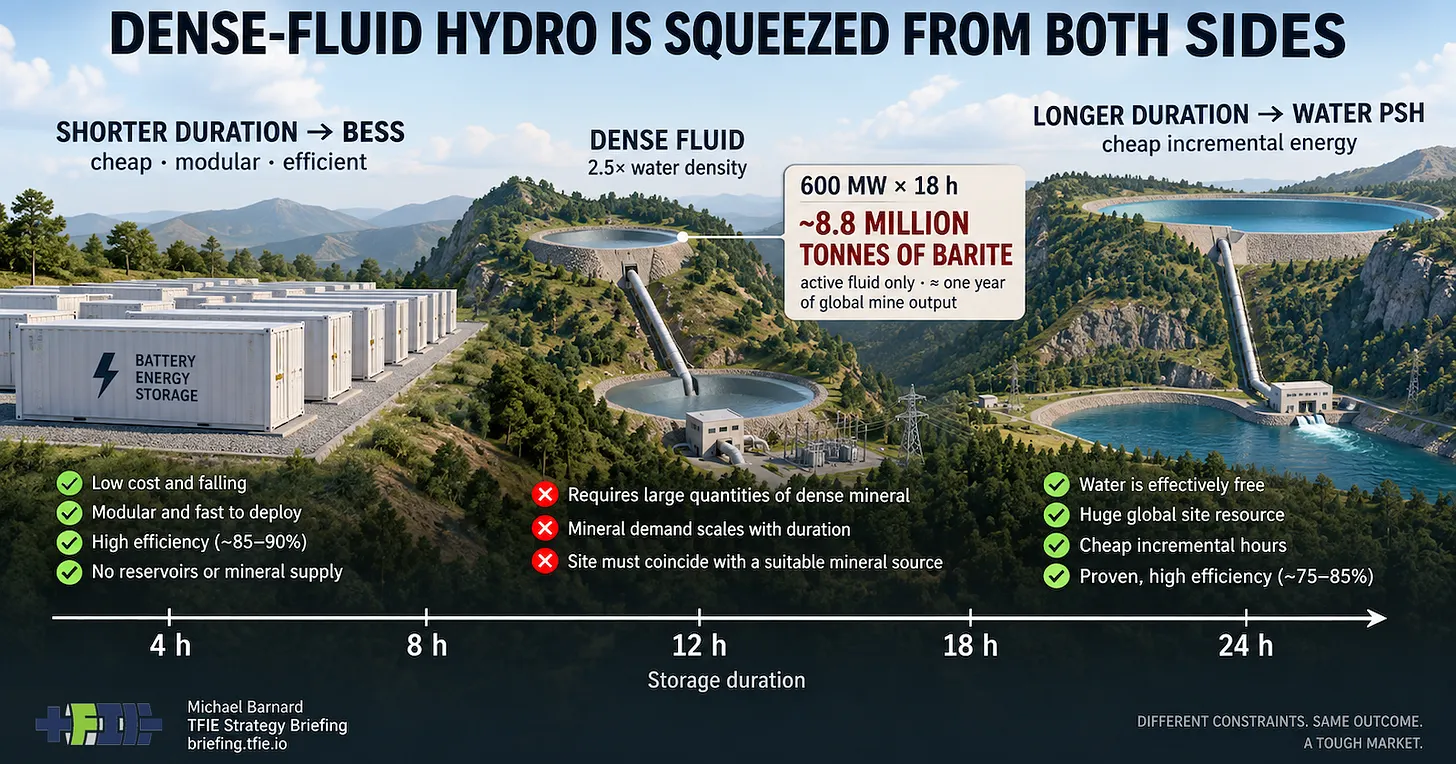
The core economic challenge emerges when scaling storage duration from minutes to commercial multi-hour requirements. Because energy capacity scales directly with total fluid volume, extending duration at fixed power requires proportionally massive quantities of weighting minerals. Patent disclosures indicate that formulations often rely heavily on barite, a mineral historically mined primarily for drilling fluids in oil operations.
Analyst estimates reveal that a commercial-scale facility rated at 600 megawatts for 18 hours of duration would require roughly 8.8 million tonnes of barite for its active fluid alone. To put that figure in perspective, a single utility-scale installation would demand a volume of mineral equivalent to total global annual barite extraction, before considering inactive reserves or processing losses.
This immense material requirement creates a profound supply chain bottleneck. Sourcing millions of tonnes of processed minerals introduces massive upfront capital costs, commodity price exposure, and carbon-intensive logistics. Unlike water, which is chemically stable and freely available, specialized high-density fluid must be continuously manufactured, finely milled, kept homogeneous, and carefully managed to prevent settling or systemic degradation.
Competing Against Natural Water and Existing Sites
These supply chain dynamics force dense-fluid storage to compete directly against conventional closed-loop pumped hydro, which relies on an abundant, non-proprietary medium. Water requires no specialized supply chain, zero formulation costs, and poses no chemical contamination risks if contained properly. The historical assumption that conventional pumped storage is severely constrained by suitable geographic sites is also increasingly challenged by modern geographical mapping.
Academic research from international energy institutes has identified roughly 616,000 potential off-river closed-loop sites worldwide, representing over 23,000 terawatt-hours of theoretical storage capacity. While only a small fraction of these sites will ever be developed, the sheer abundance of natural topography suggests that a global shortage of suitable hills is not the primary limiting factor for long-duration energy storage expansion.
Furthermore, expanding high-voltage electrical transmission infrastructure often provides a far more cost-effective solution than deploying complex, mineral-heavy storage media near load centers. Transporting clean electricity from steep, ideal natural terrain via existing or expanded power corridors remains an established, economically predictable alternative to manufacturing synthetic heavy fluids for flat terrain applications.
The Path Forward for Alternative Hydro
The physical success at Devon proves that dense-fluid pumped hydro is a functional engineering reality rather than a speculative concept. The technical team successfully managed heavy fluid dynamics, turbomachinery interaction, and loop containment under test conditions. Yet, proving mechanical viability is fundamentally distinct from establishing an economically competitive grid storage architecture across gigawatt-hour scales.
As energy markets demand longer discharge durations to backstop intermittent renewables, novel storage technologies must demonstrate clear cost advantages over conventional alternatives. Dense-fluid systems face a steep climb to prove that fluid density gains outweigh the material extraction costs and supply constraints of bulk weighting minerals. Without significant breakthroughs in low-cost fluid chemistry, commercial deployment may remain constrained.
