
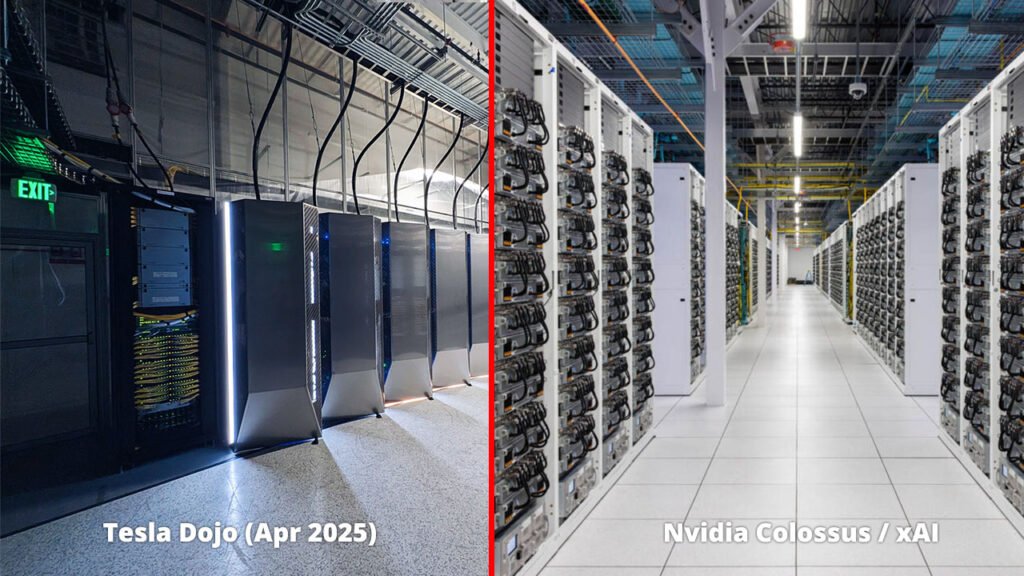
Tesla has initiated a massive expansion of its custom AI Dojo supercomputer cluster, dramatically elevating its centralized neural network training capacity to new heights. According to official company disclosures, the expanded Texas-based compute center now houses thousands of proprietary processor tiles operating in unified synchronization. This infrastructural leap aims to rapidly accelerate the processing of real-world vision data collected across millions of active customer vehicles globally.
Scaling Compute Infrastructure for Next-Generation Neural Networks
The core of this enhancement relies on updated System-on-Wafer architecture, which bridges hundreds of individual D2 silicon chips into seamless computing nodes. Engineering data indicates that the new configuration significantly reduces interconnect bottleneck issues that traditionally limit massive parallel processing clusters. Consequently, raw data transfer rates between computational units have doubled compared to prior deployment phases, allowing seamless end-to-end model ingestion.
Every day, video feeds from millions of customer vehicles flow into the centralized pipeline to refine autonomous driving models. Recent regulatory filings show that the facility’s expanded data ingestion pipelines can now digest petabytes of high-resolution video streams in near real-time. By training algorithms on raw video clips rather than compressed frames, the system learns nuanced road behaviors with unprecedented contextual accuracy.
Breakthrough Performance Metrics and Silicon Architecture
The expanded cluster has pushed total computational capacity past major exaflop thresholds, creating one of the most powerful dedicated AI clusters worldwide. Official company disclosures reveal that the scaling milestone was achieved ahead of internal targets for early 2026. This compute density enables the artificial intelligence division to iterate complex neural network architectures in days rather than months, speeding up feature deployment cycles.
To support such dense power draw, engineers integrated specialized liquid-cooling loops directly onto the custom silicon arrays. Engineering data indicates that this custom cooling infrastructure maintains optimal thermal performance even under full peak workload conditions. This design minimizes thermal throttling while simultaneously improving electrical efficiency per compute unit by over thirty percent compared to off-the-shelf server platforms.
Furthermore, the specialized silicon eliminates unnecessary legacy hardware abstraction layers found in generic graphics processors. Industry analysts note that tailoring chip microarchitecture specifically to machine learning tensor operations maximizes performance efficiency per watt. As a result, training cost per floating-point operation has declined substantially, giving the electric vehicle pioneer a distinct structural margin advantage.
Accelerated Training for Robotaxi and Full Self-Driving
The expanded computational cluster is directly tasked with training next-generation Full Self-Driving (FSD) vision models. According to official company disclosures, the latest software iterations rely entirely on end-to-end neural networks where video goes in and vehicle control commands come out. The massive compute expansion reduces training latency, allowing engineers to release broader feature updates to testing fleets faster.
Resolving complex urban corner cases remains a primary focus of the expanded Dojo hardware deployment. Engineering data highlights how thousands of synthesized edge-case driving scenarios are evaluated alongside real-world fleet recordings every hour. This dual training paradigm prepares the autonomous driver model to safely navigate unpredictable weather, construction zones, and erratic pedestrian behaviors across global markets.
Beyond automotive autonomy, the Dojo cluster has begun supporting training models for the Optimus humanoid robot. Industry analysts report that sharing hardware architecture between vehicle vision and robotic actuation reduces software overhead across product lines. The unified training methodology allows spatial recognition and motor planning improvements to benefit both driverless vehicle fleets and factory automation systems simultaneously.
Strategic Energy Integration and Data Center Expansion
Operating a supercomputer cluster of this magnitude requires robust electrical infrastructure and localized power balancing. Regulatory filings confirm that large Megapack energy storage units have been installed directly adjacent to the primary compute facility. This utility-scale battery integration buffers against grid instability, preventing expensive training runs from being interrupted by external electrical disruptions.
The facility also leverages massive onsite solar installations and automated load-shifting software to actively manage peak electrical consumption. Engineering data demonstrates that intelligent power control reduces operational energy overhead during high-cost utility demand periods. By coordinating compute intensive training workloads with renewable generation, the data center maintains continuous operation while strictly adhering to local sustainability standards.
Industry Implications and Autonomy Benchmark
Tesla’s commitment to custom silicon sets it apart from rival automakers that depend entirely on third-party graphics processors. Industry analysts note that in-house hardware integration provides complete control over chip design, software stacks, and scaling timelines. This independence mitigates supply chain bottlenecks and allows custom hardware optimizations that generic third-party artificial intelligence accelerators cannot replicate.
Financial markets have increasingly shifted toward valuing automotive companies based on software execution and autonomous services rather than manufacturing volumes alone. Regulatory filings indicate that capital expenditures earmarked for artificial intelligence cluster expansions now represent a major portion of annual research investments. Analysts believe this aggressive compute expansion positions the manufacturer to lead commercial driverless network deployments.
As autonomous software performance continues to improve, the role of centralized supercomputing clusters will grow increasingly vital. Official company disclosures emphasize that further scaling stages are already scheduled for construction throughout late 2026 and into 2027. The expansion of Dojo establishes a formidable technical barrier to entry for competing automotive brands striving to achieve full vehicle autonomy.
