
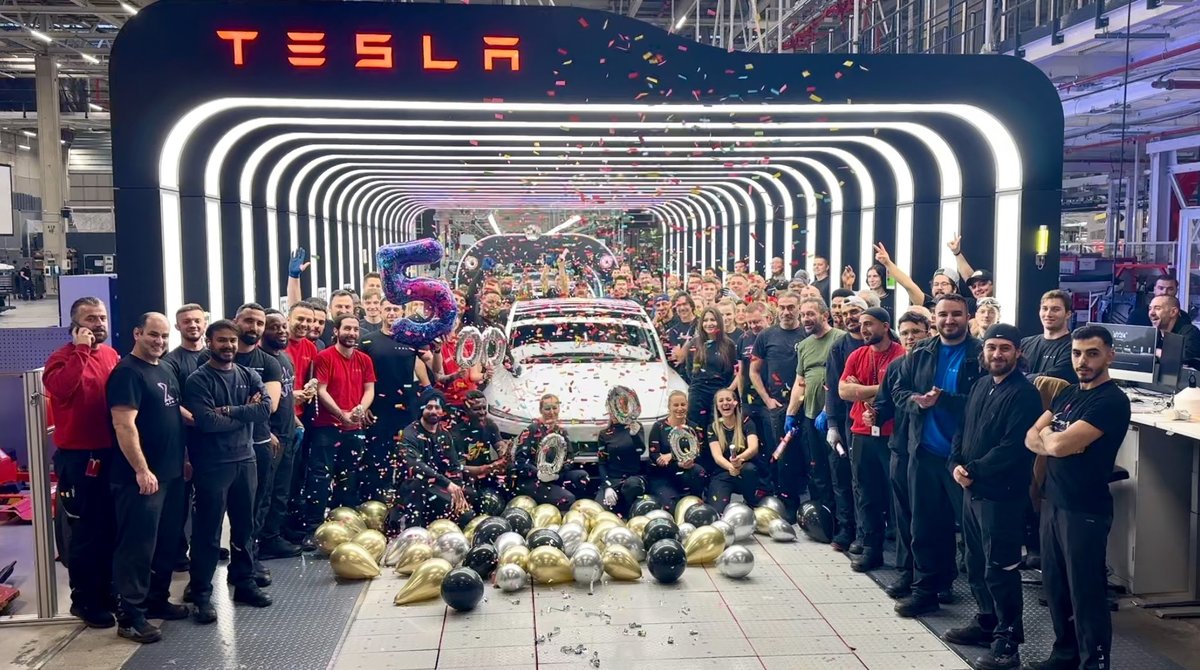
Tesla has officially expanded its manufacturing footprint in Grünheide, securing the operational readiness required to produce one million electric vehicles annually. Official company disclosures confirm that the massive complex has successfully integrated new production lines to handle this unprecedented volume. This milestone establishes Giga Berlin as the largest automotive manufacturing facility in Germany by output capacity, surpassing traditional legacy plants across the European continent.
The rapid expansion reflects a significant acceleration in local manufacturing capabilities following years of modular construction and environmental permitting. Engineering data indicates that line efficiency has increased markedly, allowing the assembly facility to maintain high output rates while reducing overall cycle times per vehicle. Industry analysts note that this operational surge aligns directly with long-term regional delivery goals designed to serve growing European demand.
Achieving this scale required extensive infrastructure upgrades, including additional press shops, automated body lines, and expanded paint facility operations. Regulatory filings show that environmental compliance monitoring systems were simultaneously upgraded to ensure full adherence to strict local sustainability benchmarks. With these installations complete, the facility is now capable of producing both high-volume crossover vehicles and upcoming next-generation platform models.
Expansion Milestones and Regulatory Approvals
The journey toward the one-million-vehicle threshold involved navigating complex administrative processes across the state of Brandenburg. Regulatory filings reveal that local authorities granted final environmental approvals after multi-stage public consultations and rigorous ecological impact assessments. Official company disclosures emphasize that sustainable water management practices and renewable energy integration were key prerequisites for securing these critical expansion permits.
Factory infrastructure now encompasses expanded rail logistics hubs directly connected to the main regional transport networks. Engineering data shows that dedicated rail shipping minimizes highway freight congestion, lowering logistics emissions while accelerating finished vehicle transit across continental Europe. Industry analysts highlight that integrated supply chains of this nature provide a distinct cost advantage over international import methods previously utilized by competitors.
Local employment figures have scaled dramatically alongside physical infrastructure additions to support round-the-clock shift schedules. Official company disclosures report that the facility now employs thousands of skilled technicians, software engineers, and automated assembly specialists. This labor growth underscores a broader industrial transformation within Eastern Germany, turning the region into a central powerhouse for advanced clean technology manufacturing.
Advanced Manufacturing and Battery Production
Central to the facility's massive output potential is the integration of advanced gigacasting technology across main structural assembly lines. Engineering data demonstrates that utilizing massive front and rear single-piece die-castings reduces component complexity, eliminating hundreds of individual parts and welds. Industry analysts suggest that these structural simplifications drastically improve manufacturing speed while enhancing vehicle chassis rigidity and overall crash safety.
The onsite battery cell and pack manufacturing units have also reached full operational synergy with vehicle assembly lines. Official company disclosures indicate that localized battery assembly significantly reduces dependency on overseas component shipments, streamlining the entire vehicle build sequence. Engineering data reveals that higher energy density pack designs produced on-site offer improved efficiency and thermal performance for European driving conditions.
Automation plays a pivotal role in maintaining consistent assembly quality across all three active manufacturing shifts daily. Regulatory filings confirm that hundreds of newly deployed robotic units perform high-precision tasks ranging from automated paint application to structural adhesive placement. Industry analysts observe that this high degree of automation ensures tight quality tolerances even as production volumes reach historic peak capacities.
Supply Chain and Regional Economic Impact
Scaling up to a million-unit capacity has generated a powerful ripple effect across the European automotive supplier ecosystem. Engineering data highlights increased reliance on regional tier-one suppliers for stampings, interior trims, and power electronics components. Industry analysts point out that localized sourcing mitigates geopolitical supply chain risks while supporting thousands of indirect manufacturing jobs throughout neighboring industrial districts.
Logistics operators have adapted by building specialized staging areas and high-volume charging infrastructure adjacent to the factory campus. Official company disclosures confirm that electric heavy-duty transport trucks handle short-range component transfers between regional suppliers and main receiving docks. Regulatory filings demonstrate that this electrified logistics network forms a critical component of the site’s comprehensive net-zero operational framework.
European Market Dominance and Competitor Response
The expansion to one million units significantly alters the competitive landscape for zero-emission passenger vehicles across Western Europe. Industry analysts project that local volume production will drive down consumer delivery lead times and lower freight surcharges for prospective buyers. Engineering data suggests that localized manufacturing flexibilities enable faster market adaptations when updated trim configurations or technological enhancements are introduced.
Legacy European automakers are currently re-evaluating their own electrification roadmaps to contend with Giga Berlin’s immense scale. Regulatory filings from competing manufacturers indicate accelerated investments in factory retooling and localized battery joint ventures to protect market share. Industry analysts argue that the intense volume competition in Germany is forcing an industry-wide push toward greater cost efficiency and rapid platform innovation.
With Giga Berlin operating at peak annual capacity, the facility serves as a blueprint for high-volume clean vehicle manufacturing globally. Official company disclosures project that sustained output at this scale will solidify long-term profitability while accelerating the transition to sustainable energy across the continent. Engineering data confirms that further iterative factory optimizations will continue to enhance throughput efficiency in the coming years.
