
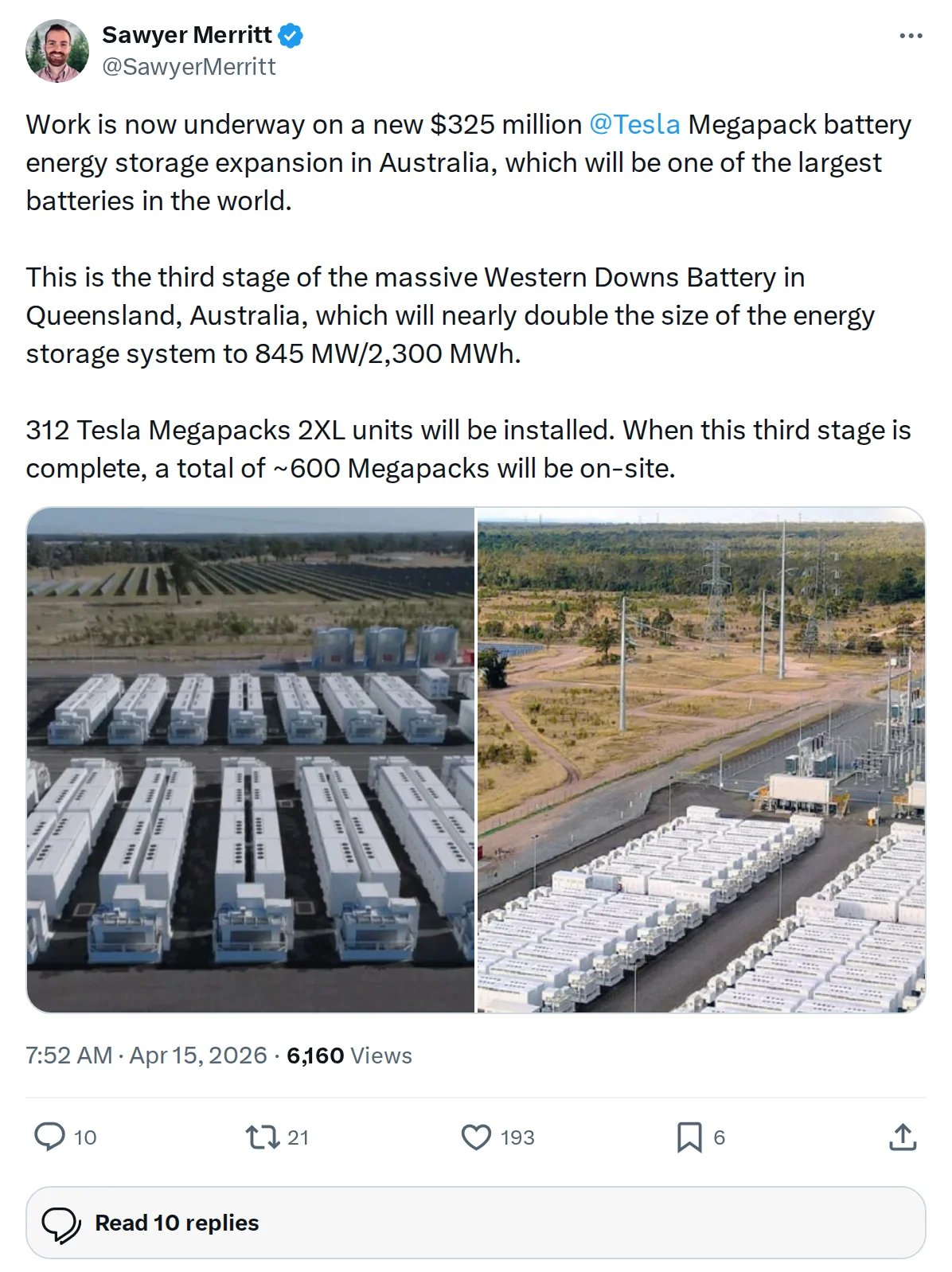
Australia has cemented its position as the world leader in utility-scale energy storage adoption, driven by unprecedented deployments of the Tesla Megapack system throughout 2026. National grid operators are replacing aging coal infrastructure with high-density battery arrays to capture vast solar reserves. According to official company disclosures, Megapack shipments to the Asia-Pacific region have surged to record levels, with Australian projects absorbing over forty percent of global export volume this year.
The rapid expansion is highlighted by landmark installations across New South Wales, Victoria, and Queensland, where multi-gigawatt-hour facilities are now online. Engineering data indicates these facilities provide instantaneous backup power, reducing network curtailment during periods of intense renewable generation. By deploying localized megawatt-class blocks, energy retailers are successfully buffering grid fluctuations, preventing regional blackouts during summer peak demand cycles while reducing reliance on expensive natural gas peaker plants.
Accelerating Grid Stabilization Across States
Utility providers rely heavily on Megapack units to supply Frequency Control Ancillary Services, stabilizing grid sub-second response times across the National Electricity Market. Regulatory filings demonstrate that battery storage assets responded three times faster to sudden generator trips than conventional thermal units over the past twelve months. This rapid response capability has significantly lowered systemic operating costs while enhancing overall power grid resilience across interconnected eastern states.
Integrating massive battery reserves alongside remote utility solar farms has unblocked severe transmission bottlenecks in rural regions. Infrastructure managers report that stored energy captured during noon solar peaks is now dispatched seamlessly into metropolitan centers during evening load spikes. Consequently, rural renewable developers are experiencing dramatically reduced curtailment rates, allowing previously stranded solar assets to generate steady revenue throughout full operational cycles.
Transitioning from two-hour to four-hour standard storage configurations represents a major technical evolution for Australian energy installations in 2026. Industry analysts emphasize that longer duration storage offers energy operators greater flexibility when balancing prolonged wind droughts or extended heatwaves. Furthermore, these enlarged capacity blocks provide critical black-start capabilities, enabling thermal or hydro plants to restart safely following catastrophic grid disruptions or extreme weather events.
Engineering Upgrades and Supply Chain Velocity
Engineering data reveals that thermal management enhancements within late-model Megapack units have improved cycle efficiency under harsh desert temperatures exceeding forty-five degrees Celsius. Advanced liquid-cooling systems maintain optimal cell chemistry temperatures, minimizing thermal degradation over extended operational lifespans. Additionally, factory-integrated lithium iron phosphate cells eliminate cobalt dependencies, offering enhanced safety profiles while reducing capital cost requirements per kilowatt-hour of delivered storage capacity.
Streamlined ocean freight logistics and dedicated terminal handling in Australian ports have drastically reduced project commissioning timelines from months to mere weeks. Official company disclosures indicate that pre-assembled, turn-key cabinet designs arrive fully wired and tested directly from specialized manufacturing facilities. Consequently, site civil works are minimized, allowing Australian utility engineering crews to focus primary resources on high-voltage grid connections and automated system calibration.
Central to Australia's energy transformation is the deployment of machine-learning energy trading software alongside Megapack hardware assets. According to industry analysts, Tesla's Autobidder platform executes real-time algorithmic trades across spot electricity markets with sub-second precision. This automated bidding engine captures extreme price volatility spikes, maximizing asset profitability while simultaneously providing wholesale price relief to end consumers during periods of peak market stress.
Financial Impact and Market Dynamics
Private capital investment in Australian battery energy storage systems reached unprecedented highs throughout the first half of 2026. Institutional investors are drawn to predictable revenue streams generated by combined frequency control services and spot market arbitrage. Financial models published in regulatory filings highlight payback periods dropping below six years for large-scale Megapack installations, prompting major superannuation funds to accelerate capital allocation toward utility energy projects.
Despite growing competition from alternative BESS vendors, market share data confirms Tesla retains a dominant market position across Australia. Industry analysts attribute this sustained dominance to vertically integrated manufacturing, proven software reliability, and extensive real-world performance history across diverse climate zones. Alternative hardware providers continue to face supply chain constraints and software integration hurdles, allowing established platforms to secure multi-gigawatt pipeline contracts through late 2027.
Federal and state regulatory frameworks have adjusted rapidly to accommodate high-volume battery storage integration within national transmission networks. Updated compliance frameworks streamline connection approvals for projects incorporating grid-forming inverter technology. Official company disclosures verify that late-model Megapack hardware fully supports synthetic inertia functions, satisfying stringent Australian Energy Market Operator stability requirements without requiring supplementary physical synchronous condensers.
Future Outlook and Renewable Integration
Looking toward the end of the decade, storage requirements across Australia are expected to triple as remaining coal facilities complete planned retirement schedules. Renewable energy developers are already securing expanded land parcels designated for multi-stage battery installations totaling tens of gigawatt-hours. Industry analysts project that scale economies achieved in 2026 will drive further system cost declines, cementing utility battery storage as the primary backstop for national clean energy grids.
In tandem with power grid installations, utility storage blocks are increasingly deployed alongside high-power electric vehicle charging hubs along transcontinental highways. Engineering data highlights that co-locating Megapack units with ultra-fast charging plazas mitigates local grid stress while enabling megawatt-level charging speeds for heavy commercial electric trucks. This dual-use strategy strengthens rural grid stability while accelerating the electrification of freight transport corridors across remote regions.
As global power sectors observe Australia’s rapid grid transition, the nation stands as a definitive blueprint for large-scale renewable integration. The combination of high solar exposure, retiring fossil infrastructure, and aggressive battery storage deployment creates a real-world testing ground for future global utility markets. Through continued engineering refinements and software optimization, Megapack technology remains central to delivering a reliable, zero-emission Australian power network.
