
Tesla Full Self-Driving Will Now Take Control To Prevent Crashes
A New Paradigm in Active Vehicle Safety
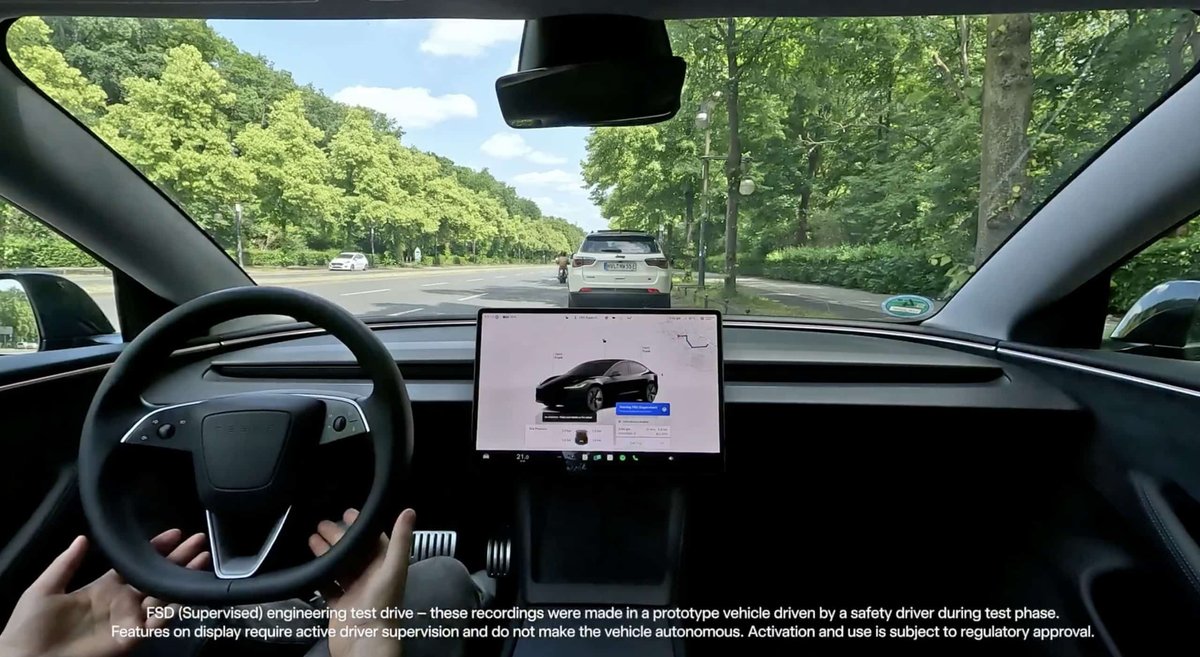
Tesla is expanding automotive safety by introducing an autonomous override system in its latest software update. The release of Full Self-Driving Supervised version 14.3.9 introduces an active safety layer capable of overriding manual control during imminent collisions. Official company communications indicate this mechanism acts as a critical safeguard when manual driving inputs or traditional emergency braking prove insufficient.
This deployment marks a fundamental shift in advanced driver-assistance architectures. Autonomous software previously required explicit activation by human drivers, remaining passive during manual vehicle operation. Under the updated architecture, the vehicle continuously monitors surrounding environment data in the background, leveraging its deep-neural vision stack to anticipate severe hazards and execute evasive maneuvers without prior human intervention.
Industry analysts note this shift transitions automated driving technology from a convenience feature into a proactive safety system. By maintaining background environmental awareness, the software scans for operational anomalies and crash risks. If the vehicle determines a high-severity collision is unavoidable through standard braking alone, it takes command to execute evasive actions, protecting vehicle occupants.
How Automatic Collision Evasion Works
At the core of this release is a feature known as Automatic Collision Evasion. Standard Automatic Emergency Braking systems function primarily by applying heavy braking force in a straight line. While effective at reducing impact velocity, straight-line deceleration frequently fails to prevent crashes when stopping distances are inadequate or when threats approach from lateral angles.
In contrast, the updated active safety system utilizes full spatial control to avoid hazards dynamically. By analyzing real-time video feeds, the vehicle determines whether combining steering, braking, and acceleration can forge an alternative path around an obstacle. If the software calculates a safer trajectory exists, such as steering onto a road shoulder, it executes the maneuver automatically.
Following an emergency intervention, the vehicle avoids stopping abruptly in active travel lanes whenever possible. Instead, the software evaluates surrounding traffic to maintain vehicle stability. Once the immediate hazard is resolved and the vehicle is secure, cabin alerts notify the driver through auditory and visual cues, requesting an immediate return to manual vehicle control.
Addressing Driver Distraction and Accidental Disengagement
Beyond physical hazard avoidance, the update addresses common human operational errors that lead to highway collisions. Cabin camera monitoring plays an integral role in evaluating driver state. Technical documentation reveals the system continuously tracks driver gaze and posture to detect severe distraction or physical disengagement while operating the vehicle manually.
If cabin cameras detect extreme driver distraction, such as reaching into the back seat or looking away from the road, the safety layer elevates intervention sensitivity. Should an obstacle suddenly appear while the driver is visually unengaged, the autonomous system immediately intervenes to navigate the threat, mitigating risks stemming from momentary human inattention.
The software update also resolves issues surrounding accidental system disengagement. In prior versions, minor manual steering inputs could inadvertently turn off automated assistance moments before a critical event. Under the new architecture, if an unintentional disengagement leaves the vehicle vulnerable, the background vision stack re-engages automatically to finish executing safety maneuvers.
The Technical Distinction Between AEB and Active Evasion
Moving from basic collision mitigation to active neural evasion represents a technical evolution in active vehicle safety. Traditional emergency braking relies on deterministic radar or optical sensors to trigger linear braking. Legacy systems are intentionally restricted from making automatic steering adjustments to prevent erratic vehicle behavior caused by false sensor readings or object misclassifications.
Tesla’s updated architecture relies on an end-to-end neural network trained on massive real-world driving datasets. This framework allows the vehicle to process multi-axis trajectory solutions in milliseconds. Rather than reacting solely to distance thresholds, the system models spatial outcomes around the vehicle, executing controlled evasive turns while maintaining vehicle traction.
Automotive technology experts emphasize that successful evasion relies heavily on accurate environmental perception. Because evasive maneuvers involve active steering changes, the vehicle must accurately map adjacent lanes and physical boundaries simultaneously. End-to-end artificial intelligence models process these multi-lane variables faster than traditional rule-based active safety software.
Safety Implications and Driver Responsibility
Despite these autonomous emergency capabilities, regulatory disclosures confirm that the vehicle remains classified as a supervised driver-assist system. Human operators remain legally responsible for vehicle operation at all times. Corporate guidance emphasizes that automatic emergency evasion serves as a secondary safety shield rather than a replacement for attentive human driving.
Operational access to this active safety layer requires compatible hardware alongside an active self-driving subscription or software purchase. As the software rolls out, industry observers remain focused on false-positive intervention rates. A major development challenge involves ensuring the system avoids unprompted evasive steering during non-emergency situations caused by minor visual misinterpretations.
If real-world performance demonstrates low false-positive rates and consistent reliability, this software update could establish a broad industry benchmark for active vehicle safety. Transforming self-driving software into a continuous background guardian allows vehicles to actively mitigate human error, marking a notable step forward in automated accident prevention technology.
