
Integrating Starlink LEO Networks Into Zimbabwe Fibre Grid
The Evolutionary Leap From Mazowe Earth Station to LEO Constellations
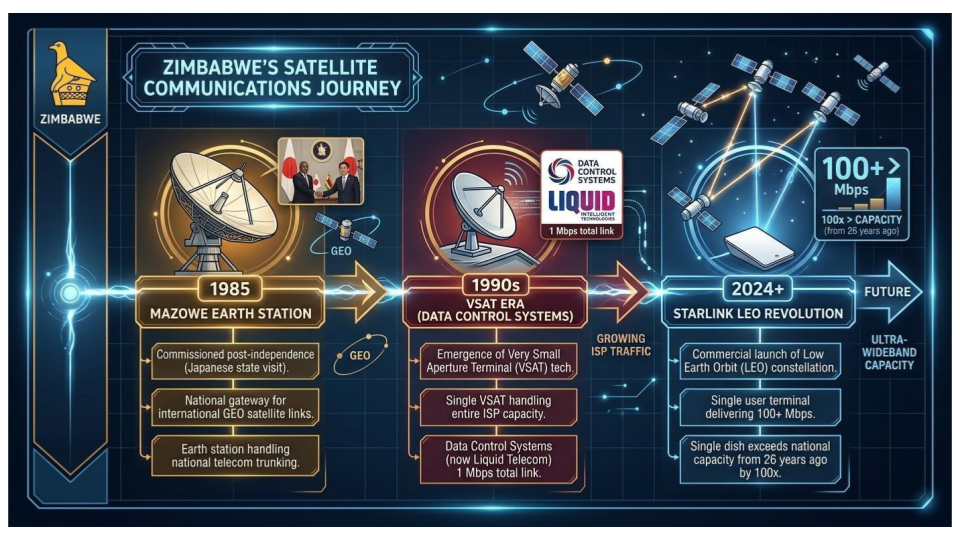
Zimbabwe’s satellite telecommunications landscape has reached a pivotal juncture, transitioning from traditional geostationary systems toward low-latency, High-Throughput Satellite (HTS) constellations. The national journey began following an official state visit to Japan, which led to the establishment of the country’s primary earth station hub at Mazowe in 1985. For decades, Mazowe served as the sole terrestrial gateway for international voice and data links via Geostationary Earth Orbit satellites.
As consumer and enterprise bandwidth requirements expanded, Very Small Aperture Terminal (VSAT) systems marked the next operational milestone. Early commercial deployments relied on a single VSAT terminal to process the entire international traffic load for Data Control Systems, the entity that later evolved into Liquid Intelligent Technologies. This setup delivered an aggregate trunk connection of just 1 Mbps, illustrating the narrow pipeline supporting early regional internet access.
Today, individual residential and commercial users consume vastly more bandwidth than the total aggregate national capacity available during the late twentieth century. Industry filings reveal that modern Low Earth Orbit (LEO) user terminals deliver throughput exceeding Zimbabwe’s entire 1999 international capacity by a factor of 100. This shift highlights how rapidly satellite architectures have evolved to meet modern enterprise demands across Southern Africa.
Navigating Latency Challenges and Bottlenecks in Regional Satellites
Starlink officially introduced commercial satellite services within Zimbabwe on 6 September 2024, attracting immediate interest from remote communities and enterprises. Initial performance benchmarks reflected low regional network loads, delivering fast download speeds and moderate response times. However, by September 2026, substantial regional subscriber adoption created periodic bandwidth throttling during peak operational hours, highlighting the urgent need for local routing optimizations.
Without direct landing infrastructure within the country, satellite traffic currently routes through distant ground stations located in neighboring nations. This reliance on remote gateways adds operational complexity and introduces international transport overhead. Consequently, user performance degrades during heavy traffic periods, as international transit hops dilute the inherent low-latency benefits provided by low-altitude satellite constellations.
To eliminate bandwidth bottlenecks and stabilize network performance, telecommunications regulatory disclosures point to a comprehensive twelve-month infrastructure roadmap. This strategic plan prioritizes the construction of domestic gateway teleports and a dedicated Point of Presence (PoP) in Harare. Establishing local landing stations will stabilize connection throughput and bring domestic latencies under 20 milliseconds, transforming regional user experience.
Spectrum Allocation and Q/V Band Licensing Requirements
Implementing local ground infrastructure requires an advanced approach to spectrum management and network architecture. To support high-capacity feeder links between LEO satellite arrays and terrestrial networks, operators must secure expanded frequency allocations. Regulatory filings indicate that high-frequency allocations in the Q/V bands are necessary alongside conventional Ku and Ka band allocations to handle dense gateway communications seamlessly.
Q/V band frequencies offer the ultra-wide bandwidth necessary to manage multi-gigabit uplink and downlink operational volumes between orbiting constellations and ground teleports. Establishing these links ensures that the high throughput generated by hundreds of visible LEO satellites lands efficiently without congesting standard enterprise bands. This framework builds a resilient trunking system capable of supporting heavy data traffic nationwide.
Synergy With Zimbabwe’s High-Capacity Terrestrial Fibre Backbone
Connecting new Starlink teleports directly into a central Harare PoP relies heavily on Zimbabwe’s extensive optical fibre infrastructure. Liquid Intelligent Technologies forms a foundational layer in this integration matrix, operating over 26,000 kilometers of fibre within the country. Linking the satellite PoP into Liquid’s core cross-border terrestrial network ensures resilient routing across the wider Southern African regional footprint.
Further network synergy comes from the equal-investment public-private partnership between PowerTel and Paratus Zimbabwe. This enterprise has deployed a high-capacity Dense Wavelength Division Multiplexing (DWDM) fibre network, starting with an active 800 Gbps link between Plumtree and Bulawayo. Leveraging PowerTel’s powerline-based servitude and Paratus’ continental network, the system scales up to 10 Tbps, connecting Zimbabwe, Botswana, and Zambia.
National operator TelOne is also executing major backbone capacity expansions across key border transit links, such as the Kazungula corridor to Zambia and Botswana and the Beitbridge route to South Africa. Driven by surging demand for high-capacity 100G+ optical wavelengths, TelOne’s expanding network provides high-availability terrestrial transport for traffic arriving from domestic LEO ground stations.
Complementing these routes, DFA Zimbabwe constructed a 1,500-kilometer open-access optical fibre backbone running along national railway servitudes from Beitbridge through Bulawayo, Harare, and Mutare. Developed through an $18 million partnership with BCS Group and Dandemutande, this DWDM network supplies local service providers with redundant wholesale backhaul, improving cross-border links into South Africa, Botswana, Zambia, and Mozambique.
Future-Proofing Southern Africa Connectivity via Global Networks
Looking beyond national borders, the upcoming integration of Starlink’s gateway network aligns with massive international subsea projects like the Google Umoja cable system. Umoja establishes an essential overland terrestrial path running from East Africa through Southern Africa, connecting landlocked countries directly to global oceanic cable networks. Merging satellite gateways with this overland route creates an ultra-redundant telecommunications ecosystem.
By coupling low-earth orbit satellite arrays with deep domestic fibre grids, Zimbabwe is building a resilient, high-speed telecommunications framework. The planned twelve-month rollout of local gateway teleports, Q/V band spectrum management, and a centralized Harare PoP will finalize this transformation. Ultimately, this integrated hybrid architecture positions Zimbabwe as a vital telecom transit hub for the entire region.
