
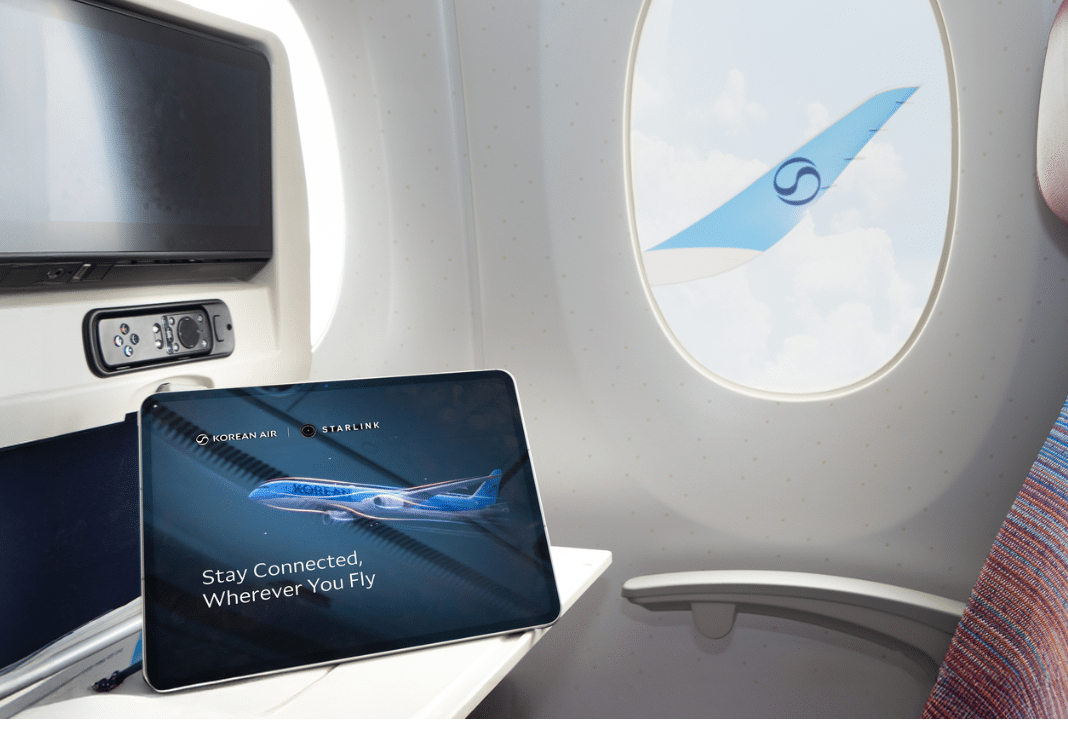
Korean Air Launches Free Starlink Internet On Select Flights
Korean Air is set to elevate its long-haul passenger experience by launching complimentary SpaceX Starlink satellite internet services starting September 15. The flag carrier of South Korea will provide high-speed connectivity free of charge to all passengers onboard select widebody aircraft. This strategic move signals a major shift in how international airlines approach in-flight digital services, transitioning from legacy paid Wi-Fi models to seamless high-bandwidth streaming experiences.
According to industry disclosures, the implementation leverages Starlink's low-Earth orbit constellation to deliver fiber-like speeds directly to commercial airliners. Traditional geostationary satellite systems often suffer from high latency, restricting usage to basic messaging or slow web browsing. In contrast, Starlink’s advanced constellation enables passengers to experience low latency and high data throughput, matching ground-based broadband capabilities while flying across oceanic routes.
To kick off the service, Korean Air completed hardware retrofits on four initial widebody aircraft. The launch fleet consists of three Airbus A350-900 jetliners and a single Boeing 777-300ER, each fitted with specialized satellite receivers. These four newly modified aircraft are scheduled to re-enter active revenue service next week, bringing low-latency satellite internet connectivity directly to long-haul travelers across major international corridors.
Widebody Fleet Retrofits and Initial Route Coverage
The newly equipped aircraft will immediately deploy across key international routes departing from Korean Air’s primary hub at Incheon International Airport near Seoul. Destinations include high-density corridors connecting South Korea to North America, Europe, and major commercial hubs in Southeast Asia. Passengers traveling along these key routes will be the first to experience unrestricted broadband access across ocean crossings without incurring extra service fees.
Engineering teams completed the initial hardware integrations under strict aviation safety standards. Mounting the satellite receivers onto the fuselages of the Airbus A350-900 and Boeing 777-300ER platforms required precise structural modifications and aerodynamic optimization. Airline technical reports indicate that the retrofitted systems underwent ground testing and flight trials to ensure complete signal reliability without interfering with crucial onboard avionics and flight control networks.
Strategic Fleet Integration Plan Through 2027
Korean Air plans to progressively expand Starlink internet capabilities across its entire long-haul and medium-haul fleet over the coming years. Industry filings show that the company aims to complete the full fleet rollout schedule by the end of 2027. This ambitious timeline positions the carrier as an early adopter of next-generation low-Earth orbit satellite technology within the competitive Asia-Pacific aviation landscape.
To minimize operational disruptions and optimize retrofitting costs, Korean Air is integrating receiver installations into pre-scheduled aircraft maintenance cycles. Technicians will mount the necessary antenna hardware and interior Wi-Fi distribution nodes during routine annual checks and heavy mid-life service overhauls. This phased approach allows the airline to maintain regular flight schedules while steadily increasing the percentage of connected aircraft in active service.
By utilizing existing maintenance windows, the airline avoids taking aircraft out of revenue service purely for technological upgrades. Industry analysts note that this measured rollout strategy protects passenger capacity and route stability while allowing technical teams to streamline installation workflows. As additional widebody and narrowbody jets undergo scheduled overhauls, the coverage footprint will expand predictably toward complete fleet modernization by 2027.
High-Speed Capabilities and Cabin Etiquette Policies
Once airborne, all passengers across all seating classes will enjoy complimentary access without requiring special subscription packages. The low-latency connection easily supports demanding internet applications, including high-definition video streaming, online multiplayer gaming, cloud computing platforms, and high-speed web browsing. Travelers can seamlessly work on remote enterprise software or stream live entertainment directly to their personal devices throughout long transpacific or transatlantic flights.
While data access remains virtually unlimited, Korean Air has established clear digital usage rules to preserve passenger comfort. Airline directives explicitly restrict voice and video calls over internet protocols across all cabin sections. By blocking services like VoIP and video conferencing tools, the airline aims to prevent ambient noise disruptions, maintaining a tranquil cabin environment for rest and relaxation during long-distance travel.
Inside the cabin, advanced dual-band Wi-Fi access points distribute signal bandwidth evenly throughout passenger rows. The onboard architecture dynamically allocates throughput, preventing individual high-bandwidth users from degrading network performance for others. Tech filings confirm that the onboard equipment can simultaneously handle hundreds of active device connections, ensuring stable download speeds for every passenger streaming media or checking corporate emails simultaneously.
Transitional In-Flight Wi-Fi Options for Travelers
During the multi-year transition period, passengers flying on aircraft that have not yet undergone the Starlink retrofit will retain access to legacy system options. Korean Air’s existing paid in-flight Wi-Fi service will remain operational across non-modified planes. Travelers on those flights can continue purchasing session-based internet passes to maintain basic messaging and browsing capabilities until their specific aircraft completes its scheduled hardware upgrade.
The adoption of free, high-speed satellite connectivity reflects a growing trend among global carriers seeking to differentiate their premium passenger experience. By eliminating paywalls and data caps on in-flight Wi-Fi, Korean Air joins an elite group of international airlines offering true high-speed broadband in the skies. Competitors in the Asia-Pacific region will face increasing pressure to upgrade their legacy satellite contracts to match this new standard.
As Starlink's orbital constellation expands and more commercial airlines adopt low-Earth orbit satellite internet, long-haul air travel is undergoing a fundamental digital transformation. Korean Air’s decision to offer free, high-bandwidth connectivity across its global network sets a new benchmark for passenger expectations. With the initial rollout commencing on September 15, international travel across major global flight routes is becoming seamlessly connected.
