
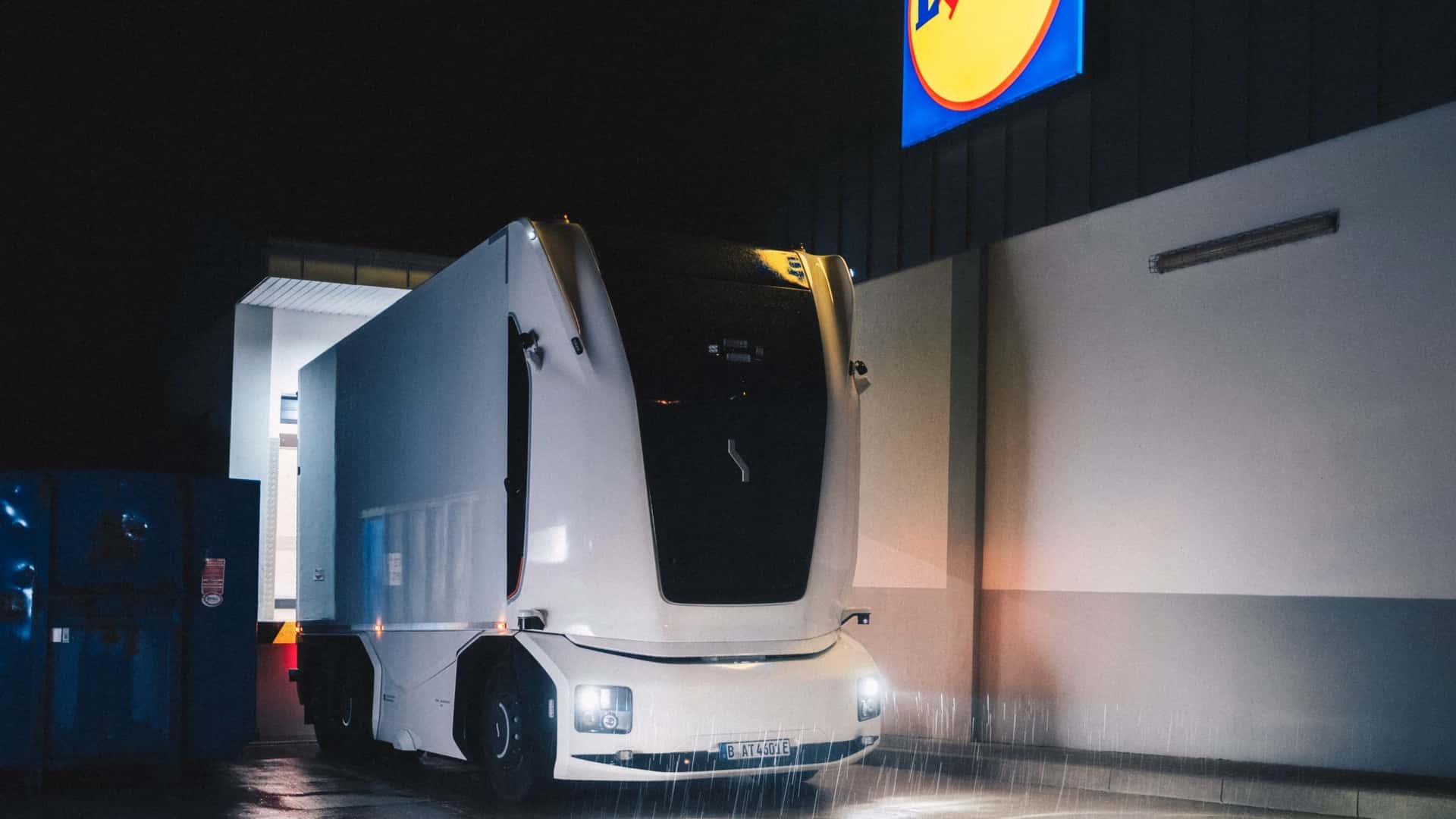
Lidl Deploys First Driverless Autonomous Truck In Germany
European retail logistics has reached a historic milestone as supermarket giant Lidl deployed Germany's first driverless, cab-less heavy transport vehicle onto public roads. Engineered by Swedish freight technology firm Einride, the autonomous electric pod operates without a traditional windshield, steering wheel, or onboard safety driver. This landmark move marks a significant transition from controlled test tracks to active commercial delivery duty on open public infrastructure.
The deployment represents a major shift in how consumer retail networks manage supply chains. By integrating fully autonomous electric vehicles into daily distribution workflows, companies aim to increase operational uptime while dramatically reducing tailpipe emissions. The launch serves as a real-world proving ground for cab-less autonomous vehicles working alongside conventional traffic, setting the stage for wider automated freight adoption across Europe.
Navigating Germany's Strict Regulatory Approval
Securing permission to operate a driverless truck on public roads required navigating one of the most rigorous automotive validation frameworks globally. Germany's Federal Motor Transport Authority, known as the KBA, granted Einride a first-of-its-kind official permit following extensive safety assessments. The authorization confirms that the Level 4 autonomous vehicle satisfies strict functional safety standards and can operate dependably in unsegregated public traffic environments.
Achieving regulatory clearance from German authorities provides a high-level endorsement of the technology's underlying safety architecture. Autonomous vehicle developers view Germany's regulatory framework as a global baseline for autonomous vehicle safety compliance. Obtaining full operational approval here allows tech operators to validate their software systems under complex traffic rules, providing a solid springboard for expansion into adjacent European transport corridors.
Sensor Suite and Remote Teleoperation Tech
The cab-less electric pod relies on an advanced sensor array to navigate complex driving environments without human physical presence. Built by specialized contract manufacturing partners in the Netherlands, the vehicle is equipped with nine high-resolution external cameras, six radar modules, and four Lidar sensors. This multi-layered perception stack generates a continuous 360-degree environmental map, allowing internal computing platforms to detect obstacles and react instantly.
While the vehicle operates fully autonomously under SAE Level 4 parameters without an onboard driver, human oversight remains integral to the operational safety structure. Remote operators monitor vehicle telemetry and video feeds from centralized management hubs. These operators do not steer or drive the truck during normal operation, but they can execute low-speed maneuvers up to four miles per hour to resolve edge-case scenarios or manage precise loading dock positioning.
Real-World Operational Scope and Route Nuances
The initial commercial operational profile focuses on scheduled freight runs between a major regional distribution facility and a retail store location in Edermünde. Operating five days per week across a single daily shift, the autonomous pod delivers roughly 45 cargo pallets per day. This initial pilot demonstrates how automated logistics can be seamlessly integrated into high-volume grocery retail distribution networks without disturbing store operations.
Industry filings and operational mapping details indicate that this inaugural route spans a short distance of less than one mile between connected facility gates. While limited in total distance, navigating public asphalt between adjacent facilities presents real-world variables, including pedestrian crossings, traffic signals, and non-autonomous commercial traffic. Navigating these public road elements delivers critical operational data needed to refine autonomous driving algorithms.
Logistics planners view this focused single-segment run as the foundational step toward broader commercial deployment patterns. Future expansion plans include transitioning the short point-to-point shuttle into a multi-stop route model, often referred to as a milkrun. Expanding the autonomous pod's operational design domain will allow the system to service multiple nearby retail points within a single contiguous logistics loop.
Solving Driver Shortages and Scaling Fleet Logistics
Beyond showcasing technical innovation, introducing cab-less autonomous electric transport addresses structural pressures facing the broader freight industry. Commercial transportation operators across Europe face chronic shortages of qualified commercial truck drivers, which threatens supply chain resiliency. Automated transport platforms provide consistent, predictable capacity for repetitive short-haul distribution tasks, freeing human drivers for more complex regional haul routes.
The environmental benefit of replacing heavy diesel delivery vehicles with battery-electric autonomous units aligns directly with corporate decarbonization commitments. Electric cab-less trucks minimize energy consumption by eliminating the weight, climate control systems, and structural framing required for human cabs. Optimized driving algorithms further reduce energy expenditure, maximizing battery efficiency across daily operational cycles while reducing overall operating expenditures.
Future Outlook for Autonomous Freight Networks
The successful integration of autonomous delivery pods in Germany reinforces a broader trend toward commercial vehicle automation. Einride currently manages a connected fleet of roughly 200 electric transport vehicles leased to multinational commercial enterprise clients across Europe and North America. Validating cab-less operations under real-world commercial conditions validates the viability of recurring subscription-based transport-as-a-service models for enterprise freight shippers.
Following the successful deployment in Edermünde, discussions are already underway with Lidl's parent organization, Schwarz Group, to explore expanding autonomous freight services across additional facility nodes. As regulatory agencies establish standardized pathways for driverless commercial vehicles, autonomous freight transport is poised to move from localized commercial pilots into wide-scale industrial deployment across global supply networks.
