
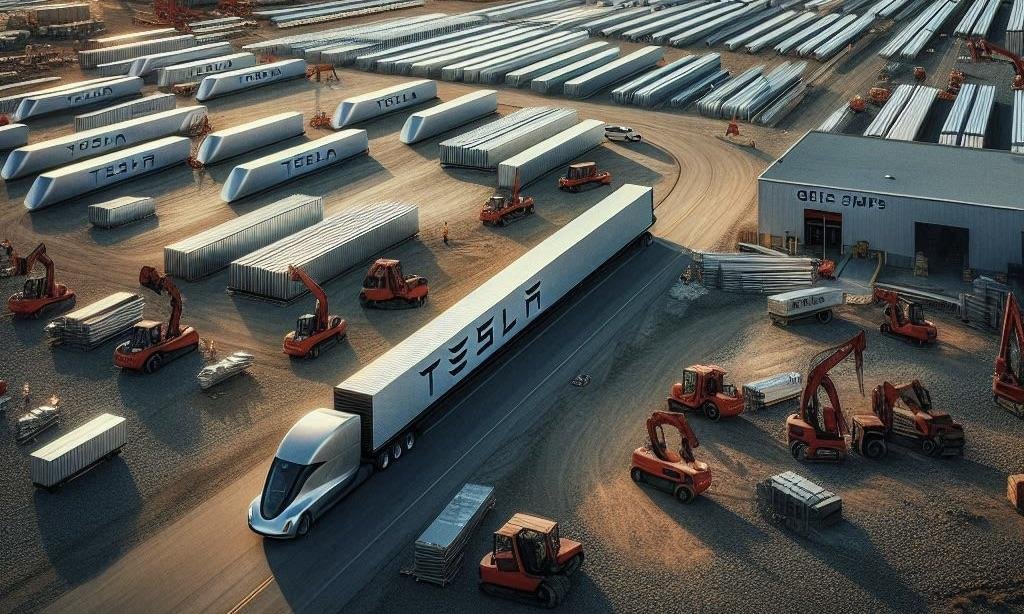
Tesla is entering a critical operational phase at Gigafactory Nevada as the dedicated manufacturing facility for the Tesla Semi prepares for full-scale commercial execution in 2026. According to official company disclosures, the purpose-built factory expansion represents a multi-billion-dollar investment designed to transition the Class 8 electric truck from low-volume pilot builds to high-density assembly lines. This milestone marks a major step forward for commercial transport electrification across North America.
Recent regulatory filings indicate that structural completion of the massive facility extension has enabled the installation of advanced powertrain tooling and automated chassis assembly systems. Engineers are currently commissioning specialized equipment engineered specifically to handle the structural scale and heavy component integration required for long-haul transport vehicles. The facility integration ensures that battery packaging, drive units, and final vehicle assembly occur seamlessly under one continuous roof.
Factory Expansion and Manufacturing Infrastructure
The interior manufacturing layout incorporates advanced robotics customized for heavy-vehicle fabrication, departing significantly from traditional diesel truck manufacturing methodologies. Official company disclosures reveal that the automated sub-assembly lines utilize precision high-load carriers to transport giant frame components across automated welding stations. This high-density floor plan minimizes footprint delays while maximizing daily throughput, allowing the plant to achieve unprecedented assembly velocities for commercial Class 8 vehicles.
Crucial to the manufacturing schedule is the direct synchronization with adjacent battery manufacturing lines located within the broader Nevada complex. Engineering data shows that dedicated cell processing pathways feed specialized high-voltage packs straight into the Semi assembly pipeline, reducing logistical friction and material transport overhead. This localized component supply loop safeguards production continuity and isolates the manufacturing process from potential global supply chain disruptions.
Factory tooling testing has transitioned from individual station checks to integrated line trial runs throughout early 2026. According to industry analysts, these operational trials are designed to validate cycle times, stress-test robotic calibration, and ensure safety compliance across every stage of construction. The ongoing validation phase provides necessary data to optimize assembly speeds before high-volume commercial manufacturing opens to fill accumulating enterprise fleet orders.
Production Milestones and Output Trajectory
The phased ramp-up strategy outlines a progressive manufacturing expansion designed to scale output systematically throughout the year. Regulatory filings indicate that initial low-rate production will steadily accelerate during the second quarter of 2026, establishing stable quality benchmarks before shifting into maximum capacity operations. Plant managers are focusing heavily on worker ergonomics and automated quality verification protocols to maintain strict safety standards during rapid scaling.
Long-term capacity plans project an annual production capability reaching up to 50,000 units once all manufacturing lines reach peak operation. Industry analysts note that attaining this scale will position the Sparks facility as the largest dedicated electric Class 8 manufacturing plant in the world. Initial delivery batches are earmarked for key logistics partners who have completed multi-year real-world fleet testing under diverse highway operations.
To support this aggressive output curve, component suppliers are scaling up domestic manufacturing of specialized silicon-carbide inverters and heavy-duty thermal management modules. Engineering data confirms that these heavy-duty components undergo rigorous thermal cycling and strain testing before shipment to Giga Nevada. Synchronized supplier schedules ensure that line slowdowns are minimized as daily vehicle output targets escalate through subsequent quarters.
Fleet Logistics and Commercial Market Impact
Early deployment data from operational fleets demonstrates that real-world efficiency gains are driving strong commercial demand among major freight operators. According to official company disclosures, enterprise fleets operating pilot units have documented significant energy savings compared to conventional diesel alternatives over long-distance routes. These proven operational metrics have encouraged commercial freight buyers to finalize larger commitment orders for mid-2026 and early 2027 deliveries.
Total cost of ownership analysis continues to serve as the primary catalyst for commercial fleet adoption across the freight industry. Industry analysts emphasize that lower maintenance overhead, combined with lower per-mile electricity costs, offers transport operators a rapid return on initial capital expenditure. As volume production reduces unit manufacturing costs, the purchase price parity against traditional internal combustion semi-trucks becomes increasingly competitive.
The commercial viability of the vehicle depends heavily on the simultaneous rollout of high-power Megawatt Charging System infrastructure along strategic freight corridors. Official company disclosures confirm that dedicated charging networks capable of delivering over one megawatt of continuous power are being deployed at major depot nodes. This infrastructure growth ensures that long-haul fleets can maintain operational uptime without compromising delivery schedules across key shipping lanes.
Regulatory Compliance and Technological Edge
Stringent regional zero-emission mandates for medium and heavy-duty vehicles are accelerating transport operator timelines for fleet decarbonization. Regulatory filings highlight how federal tax credits and state-level clean truck incentives substantially lower early adoption barriers for commercial fleet managers. The Giga Nevada production ramp arrives precisely as logistics companies face tightening emission caps and regulatory pressures across major North American distribution hubs.
From an architectural standpoint, the latest production iteration features upgraded power electronics and refined battery pack structural integration. Engineering data reveals that weight reduction measures applied to the chassis frame have successfully optimized payload capacity while maintaining structural durability under severe load stress. These ongoing technical refinements ensure that production vehicles meet strict heavy-haul requirements without sacrificing total vehicle driving range.
The completion and scaling of Giga Nevada represents a decisive turning point in the global effort to electrify heavy transport logistics. Industry analysts conclude that establishing dedicated, high-volume production for Class 8 electric trucks proves the economic and technical feasibility of zero-emission freight shipping. As output ramps toward full design capacity, the facility will fundamentally redefine standard logistics practices for commercial haulers worldwide.
