
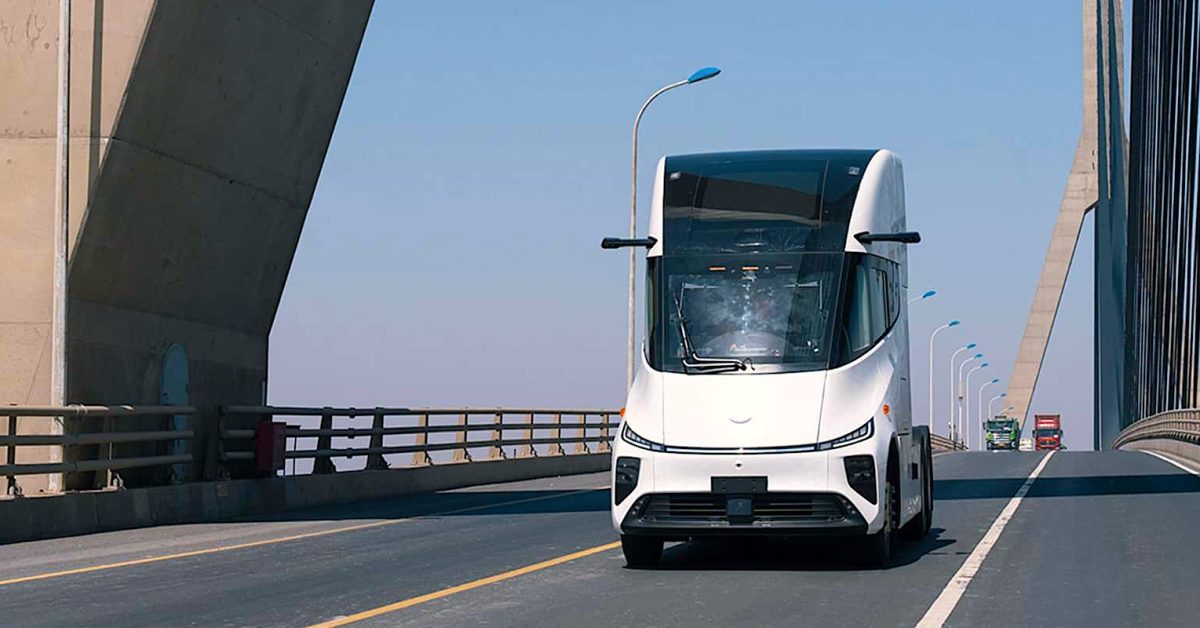
Windrose Open Sources Electric Semi CAD Files For Free Repair
In a major move that challenges traditional automotive intellectual property practices, electric commercial vehicle startup Windrose has made industry history by releasing complete CAD models for its flagship heavy-duty truck. Company founder and Chief Executive Officer Wen Han announced the release of detailed engineering blueprints covering 1,023 individual components of the X9D01 base model, which forms the core structural foundation of the Windrose E700 Class 8 electric semi-truck.
The public release features the interactive Windrose 3D Viewer alongside downloadable design files available without cost to engineers, fleet operators, and independent repairers. By providing unrestricted access to the complete geometric blueprints of its zero-emission heavy hauler, the young manufacturer aims to eliminate long-standing skepticism regarding third-party service support, component sourcing, and routine vehicle maintenance throughout the operational lifespan of commercial fleets.
A Radical Shift in Commercial Electric Vehicle Serviceability
Class 8 commercial trucks are capital-intensive heavy assets designed to operate continuously for upwards of fifteen years under severe working conditions. When fleet managers evaluate vehicles from newly established electric vehicle manufacturers, a primary operational concern centers around long-term supply chain viability. Traditional industry responses to queries regarding component availability decades into the future have historically relied on corporate assurances rather than concrete technical solutions.
Windrose addresses this systemic risk directly by providing exact engineering geometry to the public domain. Industry analysts note that fleet buyers frequently hesitate to adopt zero-emission vehicles from emerging brands due to worries over orphan hardware if a manufacturer alters its business model or faces financial distress. Releasing production CAD models establishes an unprecedented precedent, guaranteeing that vehicle owners possess the technical means to maintain operational fleets independently.
Solving the Long-Term Parts Longevity Dilemma for Fleets
Publishing parametric engineering data allows commercial fleet maintenance facilities and local fabrication shops to manufacture replacement parts on demand. Rather than waiting on international shipping lines or specialized OEM distribution networks, technicians can use the digital blueprints to machine custom mounting brackets, fold body panels, or fabricate structural cross-members using standard industrial computer numerical control equipment and universal metalworking tools.
This open strategy serves as an effective insurance policy against the structural industry risks that have affected several early-stage electric vehicle makers over recent years. If component supplies become constrained or original equipment support shifts, third-party workshops can continue servicing chassis hardware and battery enclosures. Independent engineering evaluations confirm that retaining precise structural specifications significantly extends the functional service lifecycle of electric commercial vehicles.
Technical Depth Behind the Open-Access CAD Release
Unlike typical public design releases that rely on simplified boundary representation formats, Windrose published native PRT files totaling 3.54 gigabytes of uncompressed engineering data. Standard neutral exports such as STEP or JT files only capture static outer surfaces, stripping away critical manufacturing information. Native files retain the full feature tree, including sketch constraints, driving dimensions, parametric relations, and the precise historical order of construction.
Preserving internal parametric data is essential for machine shops attempting to reproduce components accurately years down the line. A workshop modifying or remanufacturing a component requires the original design intent rather than basic volumetric shapes. Accessing driving dimensions ensures that fabricators understand material tolerances, structural stress distribution, and mechanical mating constraints, minimizing fitting errors during high-precision component replacements in field service environments.
The digital download package extends far beyond standalone components to include a comprehensive assembly hierarchy. Regulatory disclosures reveal that the dataset details 1,920 parent-child relationships organized across 97 sub-assemblies. The complete release includes a detailed bill of materials manifest listing standardized part numbers, primary mechanical systems, and per-vehicle usage quantities, giving technicians an exhaustive structural schematic of the entire vehicle architecture.
Redefining Fleet Ownership Rights and Independent Repair
The permissive licensing policy established by Windrose offers broad rights for component replacement, routine maintenance, and aftermarket modification without requiring licensing fees or corporate approval. Independent mechanics and third-party parts manufacturers receive explicit permission to replicate structural and mechanical components. This proactive stance aligns with right-to-repair regulations currently expanding across North American and European markets, bypassing traditional administrative hurdles.
However, the enterprise maintains clear legal boundaries regarding complete vehicle reproduction and commercial mass manufacturing. While part fabrication for ongoing maintenance remains fully unencumbered, commercial production of entire vehicles built from the published CAD files requires formal negotiation and licensing agreements. Company representatives emphasized that while custom component fabrication is entirely free, complete vehicle manufacturing requires structured dialogue to preserve safety standards.
The Broader Impact on the Commercial EV Market
Executive statements published alongside the CAD release highlighted a core operational philosophy that commercial vehicles should naturally outlive the immediate support capacity of their original manufacturers. Company leadership stated that true long-term reliability requires decoupling vehicle longevity from direct corporate responsiveness. By granting operators complete technical autonomy, the manufacturer seeks to build lasting trust among risk-averse logistics operators transitioning away from diesel power.
As the commercial transportation sector accelerates toward decarbonization, Windrose's radical transparency model could force established legacy truck manufacturers to reconsider their proprietary software and parts monopolies. By demonstrating that open serviceability strengthens customer confidence without compromising core business goals, this release sets a compelling new benchmark for software, hardware, and service transparency across the global electric trucking industry.
