
Europe Exceeds SAF Target But Faces Critical Supply Challenges
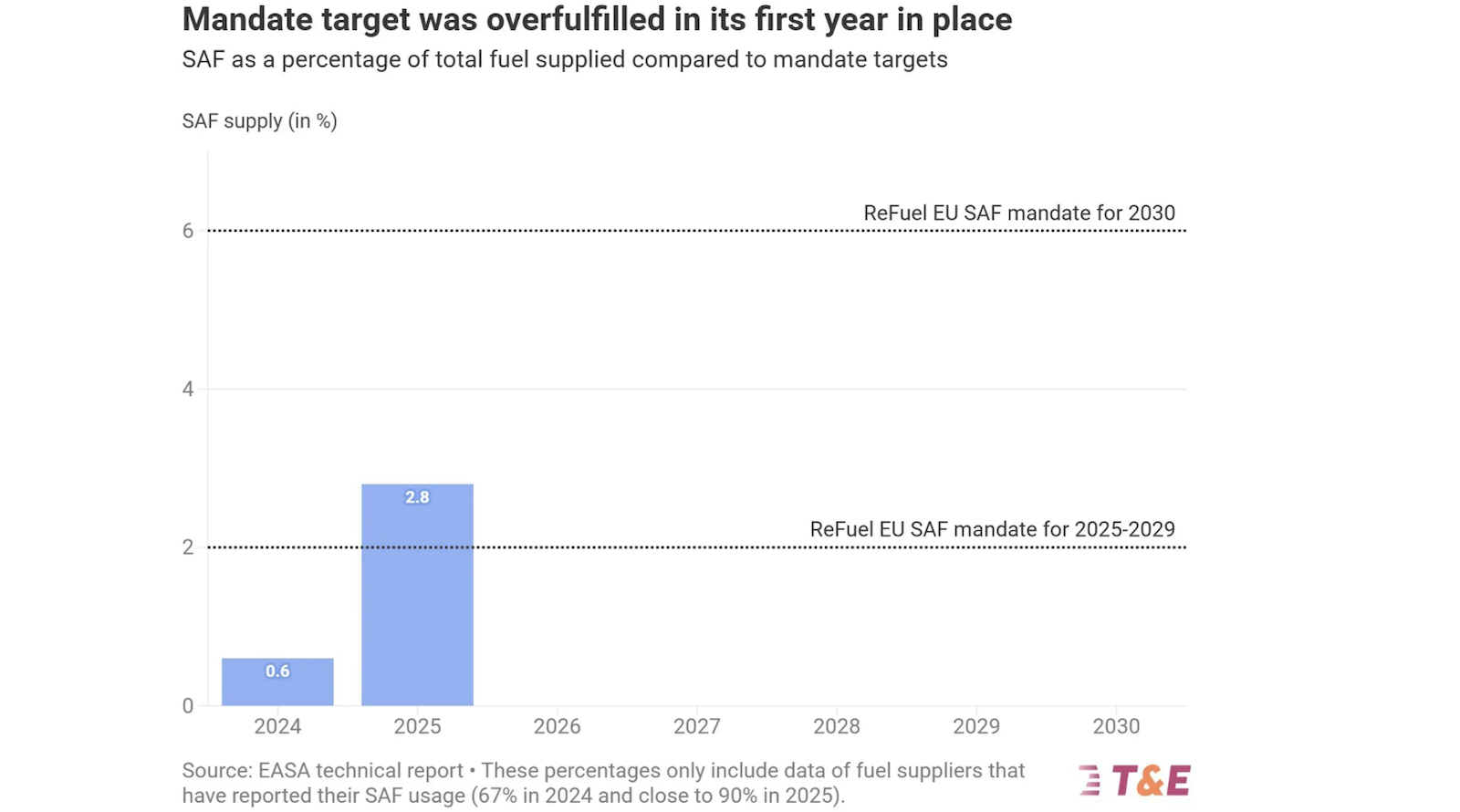
The first full picture of Europe’s sustainable aviation fuel market reveals a major milestone for international climate policy. According to official technical reports detailing 2025 aviation data, the European Union’s mandatory 2% Sustainable Aviation Fuel target under the ReFuelEU Aviation initiative was not only achieved but comfortably exceeded in its inaugural year of implementation.
Approximately 1.1 million tonnes of Sustainable Aviation Fuel were delivered to European airports throughout 2025, accounting for roughly 2.8% of the total aviation fuel pool. This represents a dramatic surge from the 0.6% market share recorded in 2024, demonstrating that clear, legally enforceable mandates can rapidly alter airline purchasing behavior and accelerate low-carbon fuel integration.
Despite this early victory, regulatory filings highlight deep structural vulnerabilities within the continent’s long-term decarbonization strategy. While overall volume targets were surpassed, the current market relies disproportionately on low-hanging, bio-based feedstocks rather than scalable synthetic fuel technologies. Analysts warn that without immediate policy intervention, this reliance could stall future climate progress.
European Aviation Surpasses Initial Clean Fuel Benchmarks
The surge in supply volume reflects immediate compliance across the European aviation sector under the ReFuelEU regulatory framework. Mandating minimum blending ratios forced airlines and fuel suppliers to secure binding off-take agreements well in advance. Consequently, major regional aviation hubs expanded their storage and blending infrastructure to handle increased clean fuel throughput seamlessly.
However, the composition of this supplied fuel reveals an overwhelming dependence on the hydroprocessed esters and fatty acids pathway. Nearly all sustainable aviation fuel supplied across European airports originates from HEFA processing, which converts waste oils and fats into drop-in synthetic paraffinic kerosene through high-pressure hydrogen treatment.
Used cooking oil remains the dominant feedstock powering European aviation, accounting for roughly 80% of the total sustainable fuel supply. Regulatory disclosures indicate that relying heavily on finite waste streams exposes the market to severe supply chain bottlenecks, price volatility, and heightened fraud risks regarding feedstock origins and sustainability credentials.
Heavy Reliance on Imported Waste Feedstocks Raises Red Flags
Beyond used cooking oil, the regional market has seen a sharp increase in secondary bio-feedstocks. Category 3 animal fats now account for approximately 11% of the European aviation fuel mix, while Palm Oil Mill Effluent has surged to roughly 6%. Diverting these raw materials from existing chemical and agricultural sectors risks shifting emissions elsewhere.
Geopolitical dependencies further complicate the European supply landscape. Official disclosures show that while 84% of sustainable jet fuel is refined within European borders, 85% of the raw feedstocks are imported from international suppliers, up from 69% the previous year. Asian markets, particularly China, remain the primary exporters of these imported waste oils.
Policy experts emphasize that building a long-term aviation decarbonization model on imported, highly contested waste streams is inherently unsustainable. Relying on foreign biomass creates severe exposure to international trade disruptions, while regulatory scrutiny surrounding supply chain authenticity continues to intensify across global energy monitoring bodies.
The Synthetic Fuel Bottleneck and Missing Investment Decisions
To achieve long-term net-zero goals, European aviation must transition toward synthetic aviation fuels, commonly known as e-SAF. Produced by combining green hydrogen with captured carbon dioxide, synthetic fuels offer scalable decarbonization without competing for limited land or organic waste resources, making them critical for long-term climate targets.
Yet, the latest technical disclosures expose a complete standstill in commercial-scale synthetic fuel deployment across the continent. While regulatory assessments identify around 60 synthetic fuel development projects across European jurisdictions, not a single facility has reached a Final Investment Decision. Project pipelines remain entirely theoretical without confirmed capital backing.
This investment freeze threatens upcoming statutory targets set by European regulators. Industry projections indicate that if announced synthetic fuel projects fail to secure capital commitments rapidly, fuel suppliers will struggle to meet mandatory synthetic blending quotas scheduled for later this decade, potentially facing severe regulatory non-compliance penalties.
Securing Capital to Unlock Commercial-Scale Synthetic Fuels
The lack of capital allocation stems primarily from high upfront capital expenditures and market uncertainties. Constructing commercial power-to-liquid production plants requires massive capital investments in renewable electricity generation, hydrogen electrolyzers, and direct air capture systems, resulting in significantly higher production costs compared to conventional jet fuel or basic bio-feedstocks.
To overcome this financial bottleneck, financial analysts stress the urgent need for targeted de-risking mechanisms. Implementing government-backed off-take guarantees, contract-for-difference schemes, and specialized public investment funds could provide institutional investors with the long-term revenue certainty required to approve final investment decisions for high-capacity manufacturing facilities.
Regulatory Stability as a Catalyst for Aviation Decarbonization
Policy leaders also stress that maintaining the integrity of established mandates is crucial for investor confidence. Diluting dedicated synthetic fuel sub-targets would remove market momentum, whereas preserving strict regulatory targets while expanding public co-investment will ensure European aviation successfully transitions from fragile waste reliance to scalable, domestic zero-emission fuels.
