
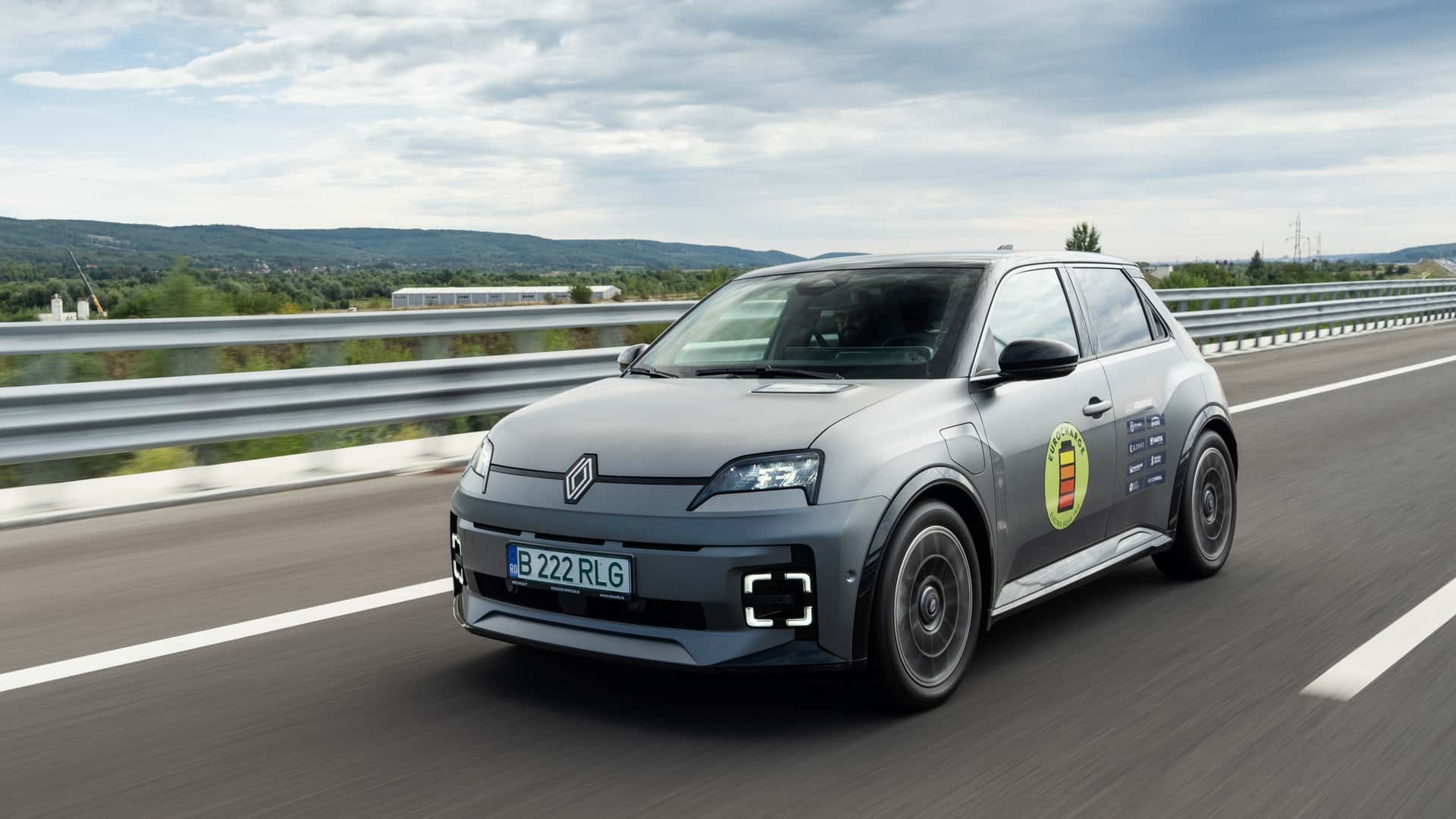
Renault 5 EV Matches Official WLTP Range in Mountain Drive
The modern electric vehicle market has long been dominated by a simple consumer assumption: compact hatchbacks belong strictly in urban environments. Larger batteries, heavy curb weights, and sweeping range figures are usually reserved for high-priced crossovers. However, recent real-world endurance tests across rugged topography have demonstrated that lightweight engineering can overturn these traditional limitations.
During an intensive cross-country evaluation through Eastern Europe, the newly released Renault 5 Roland Garros edition completed a challenging 309-kilometer (192-mile) route without requiring a single charging stop. The journey pushed the compact electric vehicle far beyond standard city limits, routing it across dramatic mountain elevation changes and mixed-speed roadways.
The performance highlighted a crucial evolution in compact electric vehicle dynamics. Rather than rapidly draining its battery pack on steep inclines, the vehicle demonstrated exceptional energy conservation. Telemetry logged during the drive suggests that modern thermal management and regenerative braking allow smaller city cars to handle demanding road trips far better than previously thought.
Conquering the Carpathian Crests
The test route stretched from Pitești to Alba Iulia, taking the subcompact vehicle across the Transalpina pass in the Carpathian range. Reaching peak altitudes of 2,145 meters (7,037 feet), the elevation profile presented a tough stress test for energy consumption, which is traditionally considered the nemesis of battery-electric vehicle range.
Drivers maintained standard road speeds without resorting to extreme hypermiling techniques. Approximately 18 percent of the trip involved high-speed motorway driving at 130 km/h (80.7 mph), alongside secondary national roads capped at 90 km/h (56 mph). This provided an uncompromised mix of real-world driving conditions rather than ideal laboratory parameters.
Ambient temperatures remained mild throughout the drive, fluctuating between 10°C and 25°C (50°F–77°F). These favorable environmental conditions allowed the high-voltage powertrain to operate near optimal thermal efficiency, minimizing auxiliary power draw from cabin climate control and setting up ideal conditions to evaluate the car's underlying platform efficiency.
Real-World Efficiency and Telemetry
Telemetry logged during the test revealed an impressive average energy consumption rate of just 12.7 kWh per 100 kilometers. Converted to North American efficiency metrics, this equates to roughly 4.9 miles per kilowatt-hour. For an electric hatchback traversing high-altitude mountain terrain and highway stretches, such figures represent top-tier energy management.
The tested Renault 5 relies on a usable net battery capacity of 52 kWh, drawn from a gross capacity of roughly 55 kWh. Dividing this net energy capacity by the observed consumption figure yields a calculated total range of 409 kilometers (254 miles) under identical mixed driving conditions.
Remarkably, this calculated real-world distance matches the vehicle’s official WLTP rating of 410 kilometers almost perfectly. Production EVs rarely match lab-certified targets during steep mountain climbs and fast highway driving, making the hatchback’s ability to mirror its official range claim on an open road trip exceptionally notable.
The Dynamics of Mountain Energy Recovery
Key to the vehicle’s endurance was the interplay between heavy energy expenditure during ascents and energy recovery during descents. While ascending over 2,000 meters consumed significant high-voltage charge, subsequent downslopes allowed the regenerative braking system to feed substantial kinetic energy back into the lithium-ion battery cells.
Modern electric vehicle architectures rely heavily on continuous kinetic capture software. By harvesting energy along extended downhill grades, the hatchback effectively neutralized much of the efficiency penalty incurred during the initial alpine climb. This equilibrium enabled the car to preserve its remaining state of charge for flat highway stretches.
Automotive analysts note that lightweight compact vehicles benefit disproportionately from kinetic recovery compared to heavy electric SUVs. Lower overall curb weight reduces rolling resistance during cruising phases, ensuring that energy harvested during downhill stretches translates directly into extended highway driving range rather than merely pushing excess vehicle mass.
Powertrain Options and Platform Scalability
The tested vehicle featured the flagship powertrain configuration, pairing the 52 kWh battery pack with a single front-mounted electric motor producing 148 horsepower. This combination delivers brisk acceleration while maintaining low power consumption, proving that compact electric motors can offer engaging road dynamics without compromising long-distance efficiency.
Beyond this high-spec variant, technical disclosures detail additional battery options for diverse market needs. Buyers can opt for a smaller 40 kWh battery providing 315 kilometers (196 miles) of WLTP range, or an upcoming entry-level 36.5 kWh lithium iron phosphate (LFP) pack offering up to 305 kilometers (190 miles).
Redefining Compact Electric Mobility
The results of this mountain endurance test carry positive implications for the broader EV market. For years, range anxiety has pushed automakers to install massive, heavy batteries in passenger vehicles. The Renault 5 demonstrates that optimized aerodynamics and weight reduction can deliver real-world usability without resort to excessive battery sizing.
Ultimately, modern subcompact electric cars no longer need to be restricted to urban commutes or short errands. By proving that a modest 52 kWh battery can conquer over 300 kilometers of challenging mountain passes without intermediate charging, compact EVs solidify their position as capable primary vehicles for long-distance travel.
