
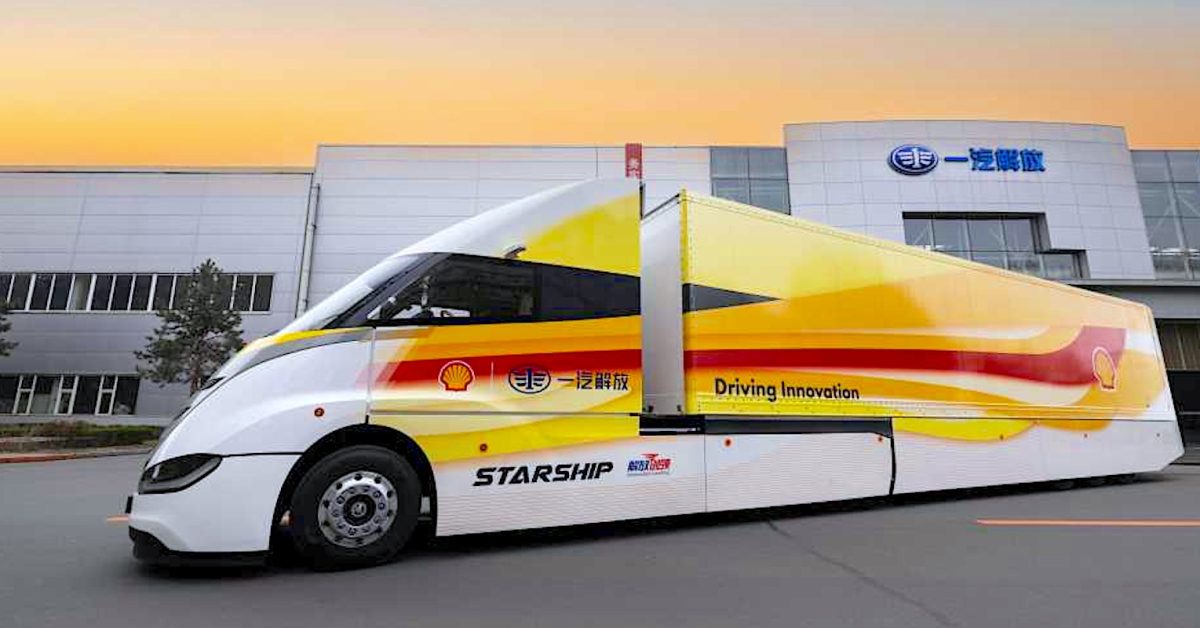
Shell And FAW Test Immersion Cooled Electric Semi Battery
As the global freight industry shifts toward zero-emission powertrains, heavy-duty electric trucks face significant engineering hurdles regarding heat management during high-stress operations. Transporting heavy payloads over steep grade changes requires massive power output, which generates intense heat within battery systems. Standard cooling methods often struggle to maintain uniform temperatures across large packs during these prolonged periods of extreme demand.
To address these thermal limitations, energy titan Shell’s chemical division has teamed up with Chinese commercial vehicle manufacturer FAW to pioneer a fluid-based cooling solution. The joint venture has integrated an advanced thermal management system into the Starship 3.0 concept semi-truck, also known as the Starship Hybrid. The collaboration represents a major push toward optimizing energy density and reliability in long-haul commercial transport applications.
Unlike conventional electric vehicle thermal architectures that rely on indirect cooling plates or external coolant loops, this system submerges the battery cells directly. The technology utilizes an electrically insulating dielectric fluid designed to envelope each individual cell completely. By surrounding the cells with fluid, the system transfers heat away from critical internal components far more effectively than traditional air or indirect-liquid cooling solutions can manage.
Rigorous Validation and Industry Certification
Engineering teams have advanced the project beyond computer modeling into actual road testing, achieving several critical validation milestones. According to recent regulatory disclosures and industry filings, the immersion-cooled battery pack has successfully completed industry-standard testing required for on-road vehicle certification. Moving past baseline safety qualifications allows the engineering team to focus entirely on endurance testing and real-world durability evaluations under commercial workloads.
FAW has subjected the Starship Hybrid to grueling operational cycles designed to simulate the harsh realities of heavy trucking. The evaluation regimen subjects the battery architecture to sustained high-power fast charging alongside rapid discharge cycles during maximum acceleration. Commercial vehicles operate under far higher duty cycles than passenger vehicles, making continuous thermal stability essential for keeping fleet assets functional without premature cell degradation.
Addressing the development progress, Wang Jianyu, President of the Commercial Vehicle Development Institute of FAW, emphasized the critical nature of thermal architecture. He noted that as commercial transport demands greater operating efficiency, higher power output, and faster charging rates, robust thermal control becomes paramount. By pairing vehicle engineering with specialized cooling technology, the joint effort aims to bring heavy electric trucks closer to widespread commercial viability.
Measurable Performance Gains on Steep Grades
Initial testing data from road trials reveals significant performance benefits derived from maintaining optimal cell temperatures. In performance benchmark reports, the immersion-cooled system demonstrated an extraordinary 98 percent increase in maximum gradability. Gradability measures a commercial truck's capability to climb steep inclines while hauling full payload weights, serving as a primary benchmark for power delivery under continuous heavy load conditions.
Beyond raw power output during steep climbs, the specialized thermal fluid delivered measurable improvements in overall energy consumption. Testing showed a 0.8 percent gain in energy efficiency over conventional cooling methods. While a single-digit efficiency bump might sound minor, across millions of fleet miles, even fractional efficiency gains translate to thousands of kilowatt-hours saved and lower operational costs for logistics management companies.
The most impactful finding for transport operators lies in battery longevity and pack durability predictions. Thermal stress remains the leading cause of premature lithium-ion cell degradation in commercial electric vehicles. Engineers estimate that by eliminating localized hotspots within the module, the immersion system can extend total battery lifespan by up to 32 percent compared to traditional cold-plate architectures currently deployed across the industry.
Technical Dynamics of Immersion Fluid Cooling
The technical foundation of this technology rests on the synthetic thermal fluid engineered specifically for high-voltage battery enclosures. Because the liquid possesses high dielectric strength, it prevents short circuits while coming into direct contact with electrical terminals and cell walls. This direct contact maximizes the surface area available for heat transfer, preventing localized thermal spikes that degrade active battery chemistries over extended usage cycles.
Direct fluid contact also significantly mitigates thermal runaway risks, which remains a primary safety priority for heavy commercial transport platforms. If a single cell experiences a failure event, the surrounding non-flammable thermal fluid rapidly absorbs and disperses the extreme thermal energy. This localized heat dissipation prevents propagation to adjacent cells, effectively containing internal faults before catastrophic battery fires can initiate within the vehicle chassis.
Furthermore, enhanced cooling capabilities unlock faster charging speeds without compromising long-term pack health. High-power megawatt chargers generate immense heat within battery packs during rapid top-off stops. By efficiently sweeping away thermal loads during peak charging intervals, immersion technology allows commercial rigs to utilize maximum charge rates for longer durations, dramatically reducing downtime at charging depot locations.
Global Debut at IAA Transportation
Industry observers will get a firsthand look at the breakthrough hardware during the upcoming IAA Transportation trade show in Hannover, Germany. FAW TRUCKS plans to showcase the Starship Hybrid concept at its official exhibition booth, alongside physical samples of the immersion-cooled battery modules. The event will serve as a global platform to demonstrate how thermal fluid technology scales to heavy commercial transport.
The collaboration between an energy chemical producer and a major truck manufacturer underscores a growing industry trend toward deep co-engineering. As commercial fleets transition away from diesel power, specialized fluid thermal management will likely play a pivotal role in enabling heavy-duty electric trucks to match the range, durability, and operational uptime traditional transport logistics require.
