Factorial Partners With Mitsui Kinzoku On Solid-State Technology
Solid-state battery innovator Factorial Energy has formed a strategic alliance with Japanese material manufacturer Mitsui Kinzoku to accelerate the industrial production of solid-state battery technology. The partnership combines Factorial’s proprietary Solstice cell architecture with Mitsui Kinzoku’s specialized sulfide-based solid electrolyte production capabilities. This effort addresses one of the primary obstacles facing next-generation electric vehicle batteries: scaling up manufacturing reliably and economically.
The alliance marks another critical step toward commercializing all-solid-state cells capable of transforming the electric mobility landscape. By leveraging Mitsui Kinzoku’s chemical synthesis expertise, Factorial aims to establish a resilient supply chain for critical electrolyte materials. Industry filings indicate that the integration will focus on refining electrolyte processing to ensure that high-volume production maintains stringent quality control and high operational yields across automated production facilities.
Accelerating the Scale-Up of All-Solid-State Batteries
Factorial has developed two distinct technology platforms: Factorial Electrolyte System Technology (FEST) and the fully solid-state Solstice platform. While FEST provides a near-term bridge using semi-solid formulations, Solstice represents the ultimate goal of complete solid-state architecture. The partnership with Mitsui Kinzoku specifically positions Solstice at the core of an industry-wide commercialization effort, uniting specialized material science with cell manufacturing.
According to Factorial Chief Executive Officer Siyu Huang, solving the complex technical hurdles of next-generation energy storage requires extensive collaboration across global supply chains. Company statements emphasize that single entities cannot solve mass-production challenges in isolation. By pairing proprietary cell engineering with advanced Japanese material synthesis, Factorial seeks to construct the manufacturing foundation necessary to transition experimental solid-state cells into standard commercial automotive components.
Key Electrolyte Breakthroughs and Industrial Synergy
Mitsui Kinzoku brings formidable industrial heritage to the collaboration as a dominant supplier of ultra-thin copper foil, controlling roughly 90 percent of the global semiconductor market for that material. Beyond its metal processing operations, the Japanese firm has developed A-SOLiD, an argyrodite sulfide solid electrolyte engineered specifically for high-performance battery cells. Production of this critical material will take place at a specialized manufacturing plant located in Saitama, Japan.
Sulfide-based solid electrolytes are widely regarded by battery chemists as superior for high-power applications due to their exceptional ionic conductivity compared to oxide or polymer alternatives. However, handling sulfide compounds at scale requires strict atmospheric management and precise synthesis. Mitsui Kinzoku’s mass-production capabilities offer Factorial a stable supply of high-grade argyrodite electrolyte, ensuring uniform performance across thousands of large-format automotive cells.
High Performance Benchmarks Driving Automotive Interest
Performance metrics for the Solstice platform highlight significant advantages over conventional liquid-electrolyte lithium-ion technology. Technical documentation reveals that Solstice achieves an energy density of up to 450 watt-hours per kilogram (Wh/kg). This performance represents an approximate 80 percent increase in energy density compared to top-tier commercial lithium-ion cells, enabling significantly longer driving ranges without increasing vehicle weight.
In addition to enhanced energy storage, Solstice cells demonstrate impressive thermal stability, remaining structurally and operationally stable at ambient temperatures reaching 194 degrees Fahrenheit (90 degrees Celsius). This enhanced thermal threshold significantly reduces the reliance on heavy liquid cooling loops in electric vehicles. Consequently, automotive designers can streamline battery pack architectures, saving structural weight and improving overall vehicle energy efficiency.
Real-World Validation Across Major Automotive Brands
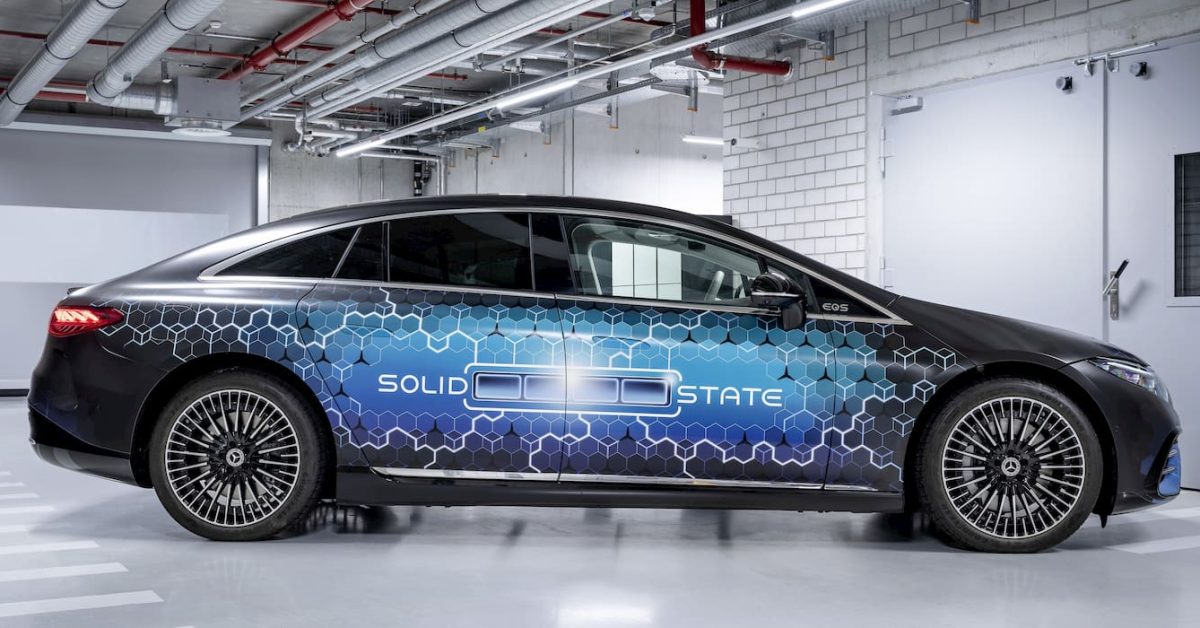
Factorial has established strong relationships with several major global automakers, including Mercedes-Benz, Stellantis, and Hyundai Motor Group. In testing conducted with Mercedes-Benz, a modified EQS prototype achieved a driving range exceeding 745 miles (1,200 kilometers) on a single charge utilizing Factorial’s 106-Ah solid-state cells. This milestone demonstrated the real-world feasibility of high-density solid-state cells operating under standard driving conditions.
Similarly, testing conducted alongside Stellantis evaluated Factorial’s 77-Ah FEST cells installed in a Dodge Charger Daytona prototype vehicle. Regulatory disclosures show these cells delivered an energy density of 375 Wh/kg across more than 600 charge-discharge cycles. The test cells also demonstrated a 4C discharge rate and accepted ultra-fast charging from 15 percent to 90 percent capacity in just 18 minutes.
Furthermore, the cells maintained operational capability across extreme climate environments ranging from -22 degrees Fahrenheit (-30 degrees Celsius) to 113 degrees Fahrenheit (45 degrees Celsius). Such environmental resilience addresses consumer concerns regarding cold-weather performance drops in legacy electric vehicles. Commercial interest has extended beyond passenger vehicles, with Factorial securing initial commercial orders for aerospace applications and specialized vehicle programs.
Commercialization Timeline and Future Industry Impact
To expand its global manufacturing footprint, Factorial signed a memorandum of understanding with South Korean battery producer SK On. This strategic deal aims to integrate Factorial’s solid-state cell designs into SK On’s extensive international manufacturing facilities. SK On currently supplies batteries to major automakers such as Ford, Volkswagen, and Hyundai, offering Factorial immediate access to high-volume automotive production lines.
Additional financial support has arrived from strategic investors including POSCO Future M and IQT, backing Factorial’s expansion into aerospace, defense, and robotics markets. A collaboration with Karma Automotive was also launched to initiate the first commercial solid-state battery program in the United States. These combined efforts reflect a multi-industry strategy to commercialize solid-state power systems across diverse high-performance sectors.
Analyst reports suggest that initial automotive deployment of Factorial’s solid-state technology could occur as early as 2027. Early applications are expected to target premium, luxury, and high-performance electric vehicles where higher energy density commands a price premium. As manufacturing scales and supply chain integration matures, solid-state architecture is projected to trickle down into mass-market electric vehicle segments over the coming decade.
