
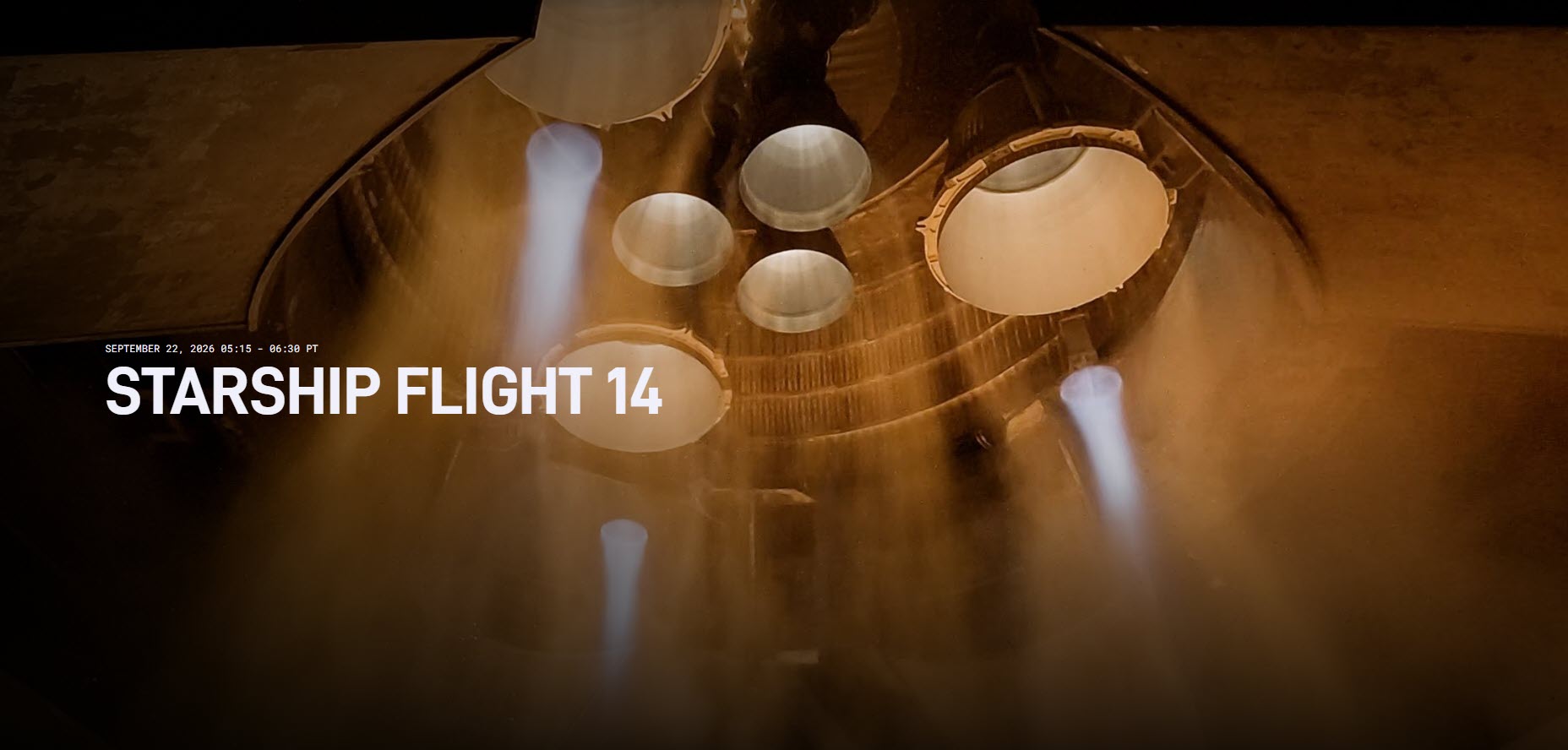
SpaceX Targets Orbital Milestone With Starship Flight 14
SpaceX has officially slated September 22 for the upcoming launch of Starship Flight 14, marking a pivotal transition in the development of the world's largest rocket. Operating out of the Starbase facility in South Texas, the launch window will open at 7:15 a.m. Central Time. This ambitious mission represents a dramatic shift from experimental testing to true orbital operations.
While previous testing phases focused primarily on low-altitude suborbital trajectories, Flight 14 aims to achieve sustained Earth orbit for the first time. For space transport analysts, this transition underscores the platform’s readiness to move beyond initial atmospheric reentry demonstrations toward long-duration operational missions. Achieving orbit represents the critical hurdle required before initiating deep-space logistics and lunar architecture missions.
A New Epoch in Heavy-Lift Spaceflight
Across its initial 13 flight tests, SpaceX used Starship to refine super-heavy lift dynamics, stage separation protocols, and thermal protection systems. Each of those early missions operated on strict suborbital paths, culminating in planned atmospheric burns over oceanic target areas. Flight 14 breaks that paradigm by demonstrating the vehicle’s ability to remain stable in low-Earth orbit for extended durations.
According to regulatory filings and mission parameters, launch controllers will have a 75-minute operational window to clear the massive vehicle for liftoff. If weather conditions or telemetry checks require a brief hold, secondary launch windows are expected to align with orbital mechanics over the following days. Flight operations will be closely monitored by global maritime and aviation authorities due to the expanded trajectory.
The Flight Profile: Six Orbits Around Earth
Flight 14 will push the Upper Stage, known simply as Ship, into an elliptical orbit resting roughly 275 kilometers above the Earth's surface. Unlike earlier tests that lasted approximately 65 minutes, this mission is planned as an extended ten-hour operational test. During this timeframe, Ship is scheduled to complete six full circumnavigations of the globe before initiating its deorbit burn.
The altered orbital profile also necessitates a brand-new landing site for the spacecraft's controlled reentry phase. Previous missions concluded with high-speed oceanic splashdowns in the Indian Ocean off the coast of Western Australia. For Flight 14, SpaceX will target a precise landing zone in the Pacific Ocean west of Chile, reflecting the updated orbital inclination and extended flight timeline.
Operationalizing Next-Generation Starlink Payloads
Beyond achieving full orbital trajectory, Flight 14 marks a momentous milestone as the vehicle carries its first operational satellite payload. Encapsulated within the upper stage payload bay are 26 next-generation Starlink V3 satellites. This event follows Flight 13, which tested payload deployment mechanics using mass simulator test articles that subsequently destroyed themselves during atmospheric reentry.
SpaceX currently maintains an active orbital constellation exceeding 11,000 communications satellites in low-Earth orbit. However, none of the units currently transmitting broadband signals utilize the expanded, high-throughput V3 design. The deployment of these operational V3 satellites signifies the formal commencement of Starship's primary commercial mission: expanding global internet bandwidth with unprecedented deployment efficiency.
Reentry Diagnostics and Thermal Protection Testing
In a clever engineering move, three of the newly integrated Starlink V3 satellites feature specialized outward-facing optical sensors. These onboard cameras will be deployed to continuously photograph Ship's thermal protection system during orbital transit. This live visual diagnostic data will provide ground controllers with critical imagery of heat shield tile integrity prior to atmospheric entry.
Mastering heat shield durability remains one of the most technical challenges in making Starship rapidly reusable. By gathering high-resolution imagery in space, telemetry engineers can identify tile degradation or structural anomalies caused by launch vibration. This data will be instrumental in finalizing future heat shield designs ahead of targeted landing tower recoveries.
Super Heavy Trajectory and Mission Strategy
While Ship completes its multi-hour journey around the globe, the Super Heavy booster will follow a separate, abbreviated flight path. Approximately seven minutes after initial ignition and successful stage separation, the massive first-stage booster will execute a controlled return. Rather than attempting a terrestrial landing, Super Heavy will target a soft splashdown in the Gulf of Mexico.
SpaceX has successfully executed catch recoveries using Starbase’s mechanical tower arms on three previous occasions with Super Heavy. However, flight engineers have opted out of tower capture attempts for both stages on Flight 14. Prioritizing payload deployment and orbital insertion mechanics allows the team to reduce operational risk while focusing entirely on mission-critical orbital validation.
Industry analysts view Flight 14 as the definitive turning point in Starship’s evolution from an experimental prototype to a commercial workhorse. Achieving reliable orbital insertion and payload deployment paves the way for future Artemis lunar lander missions and uncrewed Mars precursor launches. As September 22 approaches, all eyes remain focused on South Texas for this historical aerospace milestone.
