
Tesla Expands Predictive Supercharger Data to Android Auto
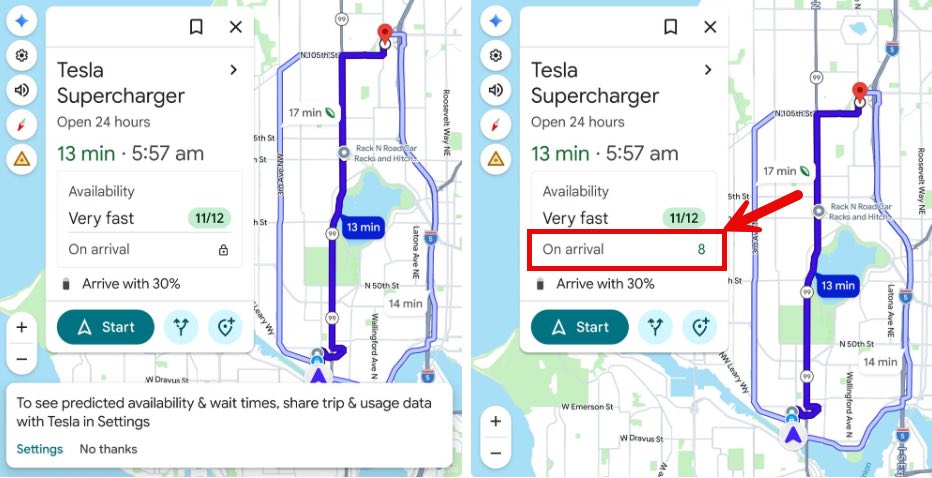
Tesla has officially expanded its predictive Supercharger availability feature to Android Auto, allowing a significantly broader population of electric vehicle drivers to plan long-distance trips with greater precision. This update builds upon recent software enhancements that integrated live charging station data into third-party navigation platforms. By projecting predicted stall availability directly onto vehicle infotainment screens through smartphone mirroring, non-Tesla EV owners gain critical visibility into network congestion before arriving at charging hubs.
The rollout reflects Tesla’s ongoing transition from a proprietary closed-loop charging ecosystem toward a universal utility infrastructure for the electric vehicle industry. As more automakers adopt the North American Charging Standard, providing smooth navigation integration becomes paramount. With Android Auto powering the display interface in millions of vehicles, this update addresses one of the most persistent operational pain points for drivers: unexpected delays caused by fully occupied charging stations.
Bridging the Gap Between Real-Time and Predictive EV Charging
Traditional EV navigation applications typically display static or instantaneous stall occupancy data, showing only how many plugs are vacant at the exact moment of inquiry. While useful, real-time metrics often prove unreliable during long highway trips. A station displaying four open stalls might easily become fully saturated during the thirty minutes a driver takes to reach the site, leading to unexpected queues and extended travel times.
Tesla’s forecasted availability technology resolves this discrepancy by calculating projected occupancy rates based on estimated arrival times. By evaluating existing route trajectories, historical usage patterns, and real-time station throughput, the navigation system predicts how many stalls will actually be open when the vehicle pulls into the lot. This forward-looking metric enables drivers to adjust their routing decisions well in advance, optimizing travel schedules.
Expanding Beyond Native Systems to Smartphone Projection
This technological enhancement follows an initial release tailored specifically for vehicles featuring built-in Google operating systems. Earlier software updates enabled live and forecasted Supercharger metrics for select vehicle platforms with integrated Google Maps architecture. However, expanding this capability to Android Auto dramatically scales accessibility, bringing advanced routing intelligence to a vast selection of mainstream vehicles that rely on smartphone projection rather than native vehicle operating software.
Through Android Auto, drivers can access these advanced metrics without requiring proprietary automaker apps or manual workarounds. The seamless interface updates on the dashboard display, offering route-integrated charging options that automatically recalculate based on forecasted traffic and station demand. Industry observers note that democratizing access to this telemetry represents a crucial step in normalizing cross-brand infrastructure usage as charging networks expand rapidly across North America.
How Predictive Supercharger Analytics Function on the Road
The predictive algorithm relies on complex data aggregation to deliver high-accuracy estimates. When an EV driver selects a destination via Google Maps on Android Auto, the system analyzes the vehicle's remaining battery capacity, estimated power consumption rates, and real-time traffic bottlenecks along the route. It then projects the exact arrival window at designated Supercharging locations along the corridor to determine expected stall congestion.
Furthermore, drivers who opt into the service contribute anonymized telemetry back into the system. As participating vehicles navigate toward a specific Supercharger station, their shared spatial data refines the predictive model for subsequent users. This crowdsourced data loop continuously improves forecast accuracy, enabling the platform to dynamically re-route drivers to secondary charging hubs if a primary location is projected to reach maximum capacity.
Collaborative Data Models and Strategic Infrastructure Growth
The integration comes amidst rapid expansion in public charging access across North America and global markets. Regulatory disclosures and official announcements confirm that Tesla has systematically opened thousands of Supercharger locations to non-Tesla electric vehicles equipped with suitable adapters or native charging ports. Providing accurate availability forecasts helps prevent bottlenecking at high-demand corridors, ensuring efficient operational turnover for both native and third-party drivers.
By encouraging non-Tesla drivers to opt into location sharing, Tesla gathers valuable insights into overall charging traffic trends and cross-platform vehicle efficiency. Industry reports suggest that this data pipeline is instrumental in planning future network expansions, helping engineers identify optimal geographic locations for new multi-stall charging sites. Consequently, predictive software updates serve a dual purpose: improving the immediate driver experience while informing long-term grid strategy.
The Broader Impact on Non-Tesla Electric Vehicle Owners
For electric vehicle owners operating models from non-Tesla manufacturers, infrastructure reliability remains a central consideration during long-distance travel. The arrival of forecasted Supercharger availability on Android Auto alleviates range anxiety by offering transparent, reliable data directly within their preferred mapping application. Drivers no longer need to toggle between separate mobile applications to verify network status while actively navigating high-speed arterial roads.
This software expansion highlights a growing trend toward standardized software interfaces across the automotive sector. As smartphone projection platforms like Android Auto continue to incorporate deep vehicle metrics and network intelligence, the operational boundaries between legacy automotive software and tech ecosystem platforms continue to blur. Ultimately, predictive charging tools set a new benchmark for public charging infrastructure accessibility.
