
Tesla Unveils Accordion Supercharger To Cut Costs By 20 Percent
Tesla has officially revealed a novel infrastructure innovation known as the Accordion Supercharger, aiming to streamline electric vehicle charging deployments while slashing installation expenses. Designed as a modular solution, the system addresses complex parking layouts where standard chargers cannot be placed behind traditional curbs. Corporate updates highlight that the pre-assembled architecture cuts site installation costs by roughly 20 percent.
The automotive manufacturer has consistently pushed to move civil engineering tasks away from active construction zones and into controlled factory environments. By manufacturing, wiring, and testing hardware before it reaches the installation site, the company minimizes labor-intensive field work. This industrial transition represents a critical step in building charging networks rapidly enough to support global electric vehicle adoption rates.
Novel Solution for Complex Parking Layouts
Traditional Supercharger installations rely on placing charging posts on raised perimeters or grassy verges adjacent to parking bays. However, many commercial retail centers, parking garages, and urban lots lack available curb space behind individual stalls. The Accordion Supercharger introduces a flexible layout capable of being placed directly between active parking spaces without requiring extensive site trenching or concrete poured on location.
This structural versatility allows charging operators to maximize available parking capacity without reconfiguring existing traffic flow or sacrificing valuable parking bays. By offering a standardized framework that adapts to irregular lot geometries, property owners can integrate high-speed charging capabilities into previously unviable real estate footprints, lowering the physical barriers associated with urban site conversion.
Engineering Mechanics of the Expanding Architecture
The logistics behind the new modular system rely on high-density freight shipping solutions. According to recent technical disclosures, a single flatbed delivery truck can transport an entire 16-stall Accordion Supercharger array directly to the site. This concentrated shipping model significantly reduces transportation overhead, vehicle emissions associated with construction logistics, and the overall physical footprint needed during initial equipment delivery.
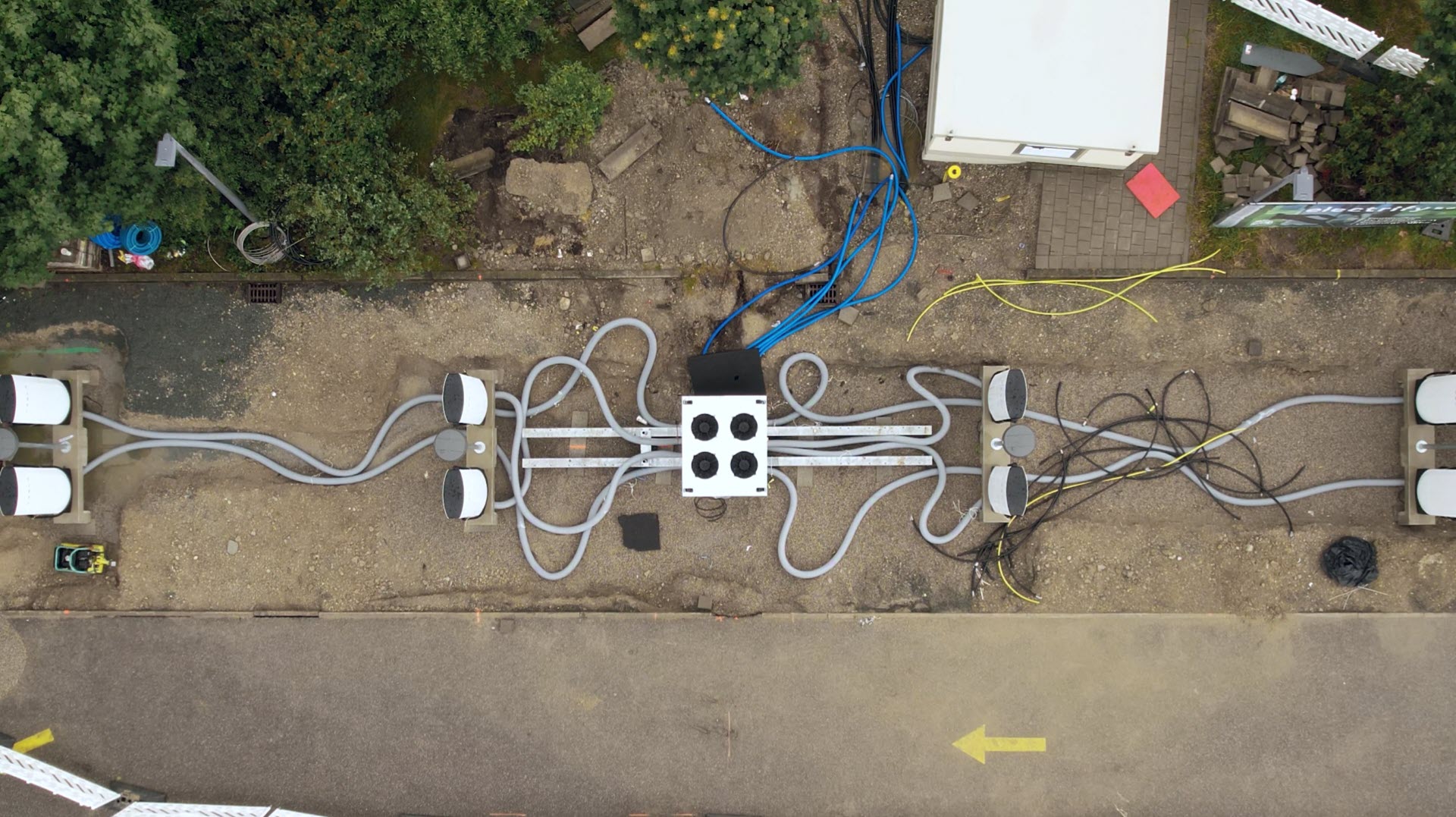
Upon arrival at the destination, site operators use heavy cranes or specialized machinery to lift the pre-wired equipment off the transport vehicle. Once positioned on the paved surface, the structural frame articulates and expands across multiple parking spaces in a manner resembling a traditional musical accordion. This continuous expanding structure establishes precise spacing between charging terminals with minimal manual assembly.
At the core of the system is Tesla’s latest V4 power cabinet architecture, which serves as the central energy distribution hub for the station. The high-capacity cabinet links directly to individual charging pedestals anchored to pre-engineered, prefabricated concrete bases. This integrated setup ensures that power delivery systems, internal busbars, and data control lines remain protected while enabling rapid utility interconnects.
Regional Regulatory and Electrical Code Challenges
Demonstration footage released alongside the product announcement confirmed that the initial Accordion Supercharger deployment took place at a European site. European regulatory environments often feature distinct civil engineering practices and parking lot geometries that align well with modular surface-mounted conduit solutions. Analyst reports note that demonstrating the system in Europe provides valuable operational data before expanding the concept globally.
Despite its successful European introduction, adapting the exact Accordion design for North American markets presents unique engineering challenges. Video of the installation revealed flexible surface conduits connecting the charging terminals together. In contrast, commercial electrical codes across North America typically mandate rigid metallic or heavy-duty non-metallic conduit buried underground or encased in concrete to satisfy strict safety standards.
Modifying the Accordion architecture to comply with North American electrical standards may require redesigned protective shielding or alternative structural mounting frames. While these adjustments are technically feasible, adding rigid tubing or heavy protective armor could increase overall weight and production costs. Industry filings suggest technical evaluations will determine whether the 20 percent installation cost savings can be fully maintained overseas.
Evolutionary Timeline of Modular Infrastructure
The Accordion Supercharger is the latest iteration in a broader lineage of rapid deployment concepts pioneered by the company. Previously, engineers introduced pre-assembled folding units mounted on unified concrete slabs, which allowed entire four-stall blocks to be set down simultaneously. These early designs proved that pre-fabrication could drastically reduce on-site civil works, paving the way for more dynamic structural configurations.
Standard pre-assembled Supercharger blocks have already demonstrated extraordinary speed in real-world rollouts. In several recent deployments, construction teams successfully positioned prefabricated pads, completed utility connections, and energized full charging stations in as little as four days. The new Accordion design builds upon these time savings, offering site hosts a method to activate high-capacity charging stalls with minimal downtime.
Lowering construction expenses and shortening deployment schedules are vital components of maintaining high margins on charging infrastructure. By cutting installation expenses by one-fifth, charging operators can reallocate capital toward acquiring prime real estate, expanding grid interconnect capacity, or building larger station footprints. These operational efficiencies directly lower the capital expenditure required per deployed charging stall across expanding global charging networks.
Strategic Impact on Global Network Expansion
As electric vehicle adoption expands beyond early adopters into mass markets, access to reliable fast-charging infrastructure remains a decisive factor for consumers. By lowering hardware installation barriers, property managers and commercial land owners can more easily retrofit existing parking facilities. Flexible installation mechanisms like the Accordion design allow high-density charging setups in locations previously deemed unfeasible due to complex subsurface utilities or strict space constraints.
Tesla’s continued refinement of prefabricated station designs sets a challenging benchmark for third-party charging networks worldwide. Competitors facing rising labor rates and protracted municipal permitting processes must seek similar industrial pre-assembly solutions to remain cost competitive. The introduction of the Accordion Supercharger underscores a broader industry shift toward treating charging stations not as custom civil engineering projects, but as standardized consumer products.
