
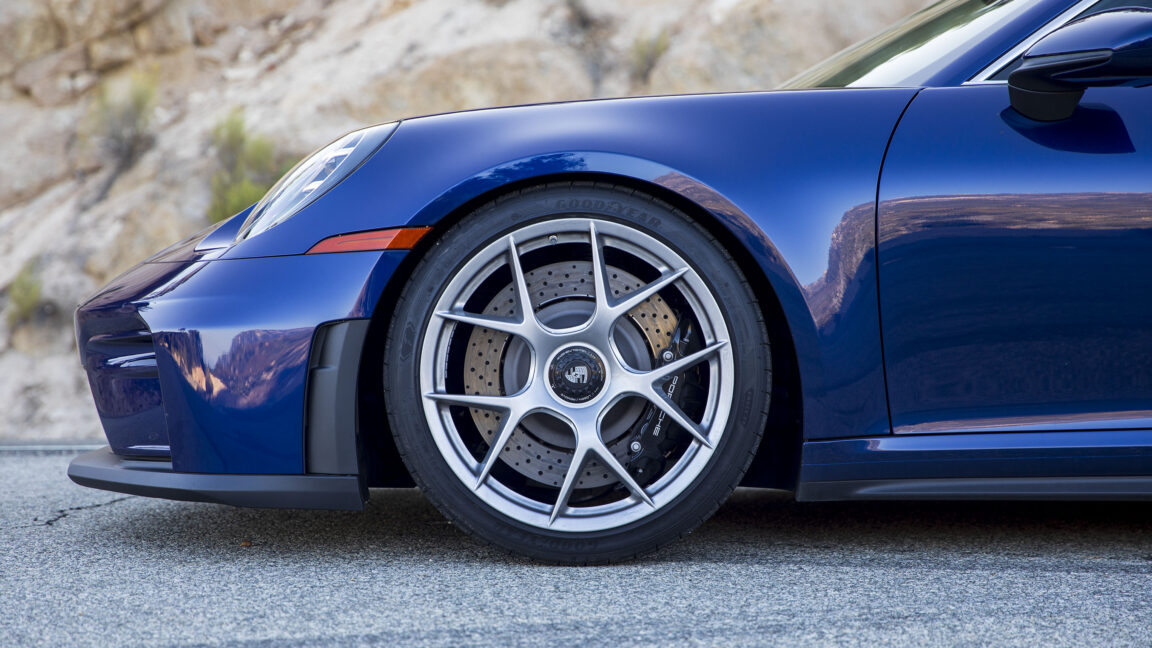
Porsche 911 GT3 Touring Blends Track Power With Stealth Looks
The Porsche 911 lineup has long catered to diverse driving desires, but the GT3 occupies a singularly pure position. While the range-topping Turbo S emphasizes overwhelming horsepower, luxury, and all-weather capability, the GT3 retains an elemental philosophy. It prioritizes lower curb weight, razor-sharp focus, and a finely tuned chassis designed explicitly to place the driver at the center of the experience.
Since the GT3 debut in 1999, Porsche has expanded this performance formula into distinct branches. The extreme GT3 RS arrived in 2003 for track perfectionists, followed by the more reserved GT3 Touring in 2017. The Touring premise remains refreshingly simple: retain the high-revving 4.0-liter flat-six engine and track chassis, but swap the fixed rear wing for a subtle deployable rear spoiler.
This design choice recaptures the classic 911 silhouette without sacrificing the underlying mechanical capability that defines the GT3 badge. Technical disclosures highlight how this discreet variant delivers track-grade engineering in a package tailored for high-speed road travel. With the arrival of the 992.2 mid-cycle refresh, Porsche continues to refine this balance between understated aesthetics and raw motorsport performance.
Powertrain Engineering Meets Modern Emission Standards
At the heart of the latest 992.2 GT3 Touring sits a naturally aspirated 4.0-liter flat-six engine that continues to rev to a screaming 9,000 rpm. The powerplant delivers 502 horsepower (375 kW) and sends output exclusively to the rear wheels. Drivers can select either a seven-speed PDK dual-clutch automatic transmission or an engaging six-speed manual gearbox for complete mechanical interaction.
However, meeting modern environmental mandates required clever mechanical workarounds. Stricter European emissions and noise regulations forced engineers to install two additional catalytic converters and two gasoline particulate filters within the exhaust system. This regulatory compliance created exhaust flow restrictions, dropping maximum torque output down to 331 lb-ft (449 Nm)—a decrease of 15 pound-feet compared to the outgoing 992.1 generation model.
To counteract this performance drop, Porsche engine builders retrofitted the engine with cylinder heads and camshafts directly borrowed from the extreme GT3 RS. Additionally, engineers shortened the final-drive ratio by eight percent. Industry filings indicate this gearing change trades a small portion of top-end speed to ensure harder acceleration, successfully retaining the visceral throttle response purists expect from the brand.
Gearing Adjustments Preserve Rapid Acceleration
The shorter gear ratios keep acceleration metrics matching the previous generation despite the slight reduction in peak torque. When equipped with the six-speed manual transmission, the GT3 Touring accelerates from zero to 60 mph in 3.7 seconds, reaching a top speed of 194 mph. The PDK-equipped model completes the 0-60 sprint in just 3.2 seconds and tops out at 193 mph.
In real-world driving environments, the revised final-drive ratio actually enhances driver engagement on public roads. The engine’s vast 9,000 rpm operating window becomes significantly easier to exploit out of tight corners without constantly pushing into velocity ranges that invite legal scrutiny. The active sport exhaust system simultaneously preserves the distinctive, mechanical flat-six soundtrack across the entire rev range.
Advanced Aerodynamics and Chassis Calibration
Beyond the updated engine hardware, the 992.2 mid-cycle update grants the Touring a distinct mechanical personality. Revised front and rear fascias update the exterior aesthetic, while aerodynamically optimized suspension trailing arms improve airflow underneath the chassis. Standard features retain heavy-duty braking components, responsive rear-axle steering, and specialized GT3 suspension setups designed to maintain high stability at speed.
Suspension engineers also integrated anti-dive suspension geometry adapted directly from the GT3 RS alongside newly calibrated steering software. This geometry prevents chassis pitch under heavy braking, allowing the car to maintain optimal balance entering sharp turns. Analyst reports suggest these chassis updates give the new GT3 Touring significantly sharper front-end precision and flatter cornering attitudes during spirited driving.
The Leichtbau Package Pushes Weight Reduction
While the standard manual GT3 Touring registers an already lightweight curb weight of 3,239 pounds (1,470 kg), Porsche now offers a specialized $37,310 option package named Leichtbau. German for "lightweight construction," this package swaps standard structural components for lightweight carbon-fiber parts, including the roof skin, anti-roll bars, drop links, and the rear-axle shear plate to shed unnecessary mass.
The Leichtbau treatment also replaces standard alloy wheels with forged magnesium wheels, trimming 19 pounds of rotating un-sprung mass to improve steering feel and suspension response. Inside the cabin, lightweight interior door panels replace heavier trim pieces, while manual-equipped models borrow the shorter gear lever from the limited-production 911 S/T, sharpening tactile feel during rapid gear changes.
Ride Compliance Tailored for the Open Road
Recognizing that Touring owners frequently travel on imperfect backroads rather than smooth circuit tarmac, Porsche updated the suspension bump-stop design for the 992.2 model. The revised bump-stops allow for increased spring travel compared to the outgoing car. This technical modification reduces wheel-load fluctuations when crossing uneven surfaces, effectively smoothing out sharp impacts and vertical chassis movement.
By softening the secondary ride characteristics, engineers significantly reduced the front end’s tendency to wander across rutted or cracked asphalt. Consequently, the GT3 Touring delivers improved high-speed tracking and enhanced confidence over rough pavement. This refined suspension calibration solidifies the Touring’s position as a uniquely capable sports car that seamlessly bridges raw motorsport dynamics with everyday road usability.
