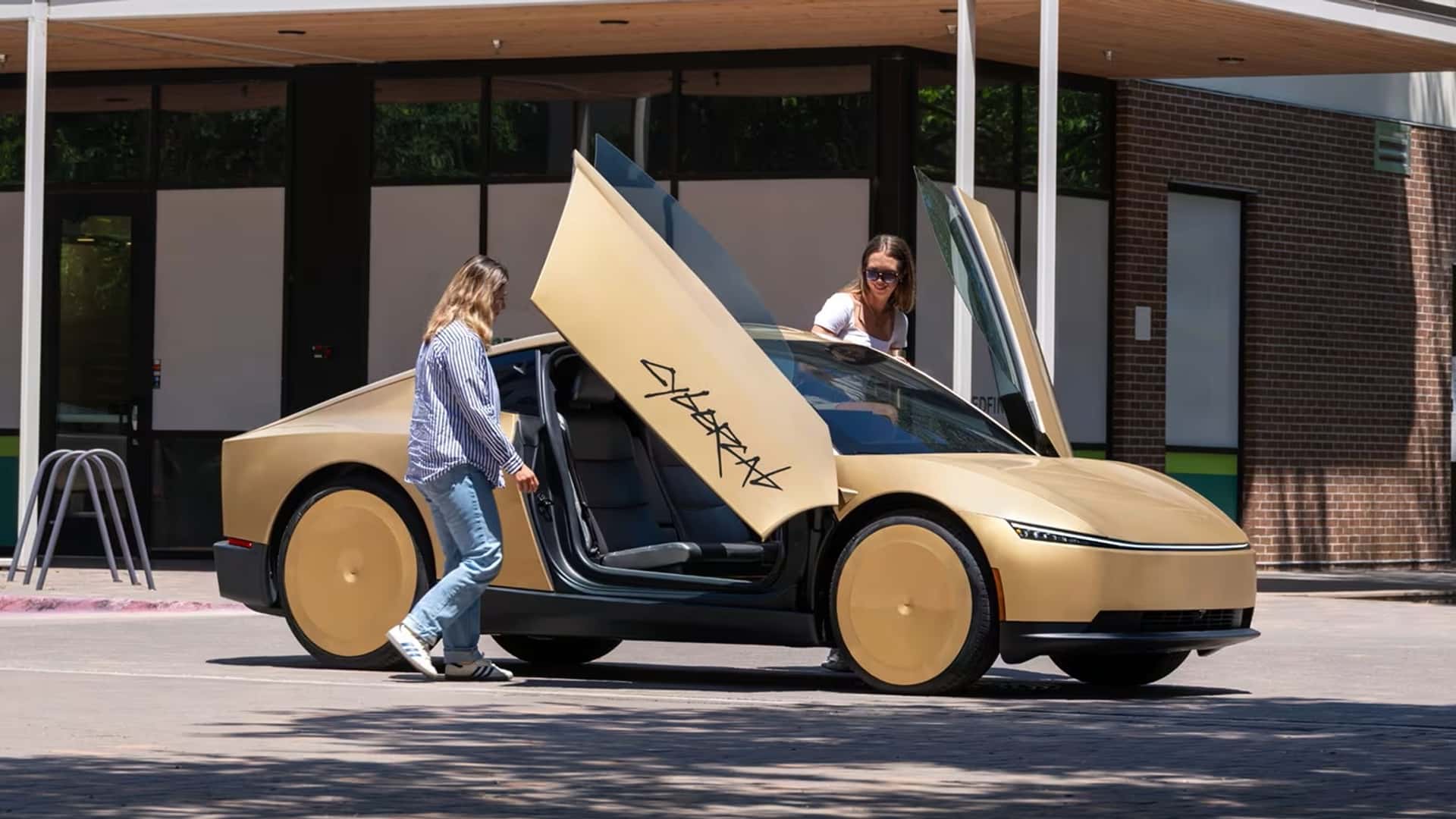
Tesla Cybercab Faces Federal Inquiry Over Missing Steering Wheel
Tesla officially unveiled its long-awaited Cybercab on the streets of Austin, Texas, marking a significant milestone for the electric vehicle manufacturer. The sleek, golden two-seater captured public attention by demonstrating fully autonomous rides in a controlled setting. However, the celebratory atmosphere surrounding the vehicle's public debut was quickly overshadowed by regulatory scrutiny regarding its unconventional cabin architecture.
Just hours after the unveiling event concluded, federal transportation safety officials signaled that the vehicle's design is undergoing immediate scrutiny. The core issue centers on the vehicle completely lacking traditional manual driver inputs. With no steering wheel, accelerator pedal, brake pedal, or physical side mirrors present, federal regulators are moving rapidly to determine whether the vehicle legally complies with established standards.
Federal Regulators Launch Immediate Cybercab Audit Query
The National Highway Traffic Safety Administration confirmed the initiation of an audit query focused specifically on Tesla's compliance strategy. Under federal law, automotive manufacturers are permitted to self-certify that their production vehicles meet Federal Motor Vehicle Safety Standards before hitting public roads. Federal inspectors are now formally evaluating the technical data and engineering assumptions Tesla utilized to grant itself that certification.
Regulatory disclosures reveal that the audit will closely examine the degree to which Tesla determined specific safety rules were inapplicable to a driverless pod. Investigators intend to review all technical documentation submitted by the automaker. This includes analyzing whether the absence of mechanical fallbacks compromises vehicle safety during unexpected software glitches, hardware failures, or complex edge-case driving scenarios.
In an official regulatory statement, federal officials stressed that all vehicle manufacturers seeking market access must strictly adhere to performance benchmarks. The agency reiterated that while self-certification grants initial deployment rights, federal oversight mechanisms trigger immediate enforcement actions whenever certified vehicles appear to bypass mandatory safety features. Regulators emphasized that rules apply universally until formal regulatory revisions are enacted.
Removing Physical Controls Raises Regulatory Alarm Bells
The primary point of contention for federal safety regulators is the Cybercab’s total elimination of physical driving hardware. Standard automotive regulations in the United States have historically been written under the fundamental assumption that a human operator is present. Mandates requiring steering columns, foot pedals, and adjustable exterior mirrors were established to guarantee emergency human intervention capability.
Tesla’s architectural philosophy for the Cybercab pivots entirely toward vision-based autonomous software, dispensing with redundancy components like side mirrors and mechanical steering linkages. While the company views this streamlined design as a technological triumph, regulatory analysts note that operating without manual overrides presents unresolved legal challenges. Without physical controls, passengers cannot manually steer or stop the vehicle during critical system breakdowns.
Automotive engineering experts point out that replacing mechanical backup systems with purely digital architecture requires extraordinary proof of reliability. Federal regulators remain cautious about allowing vehicles on public streets that rely exclusively on camera feeds without secondary physical backups. Consequently, the ongoing audit query will evaluate whether Tesla's vision-only safety suite provides functional equivalence to mandatory mechanical controls.
The Impact of Self-Certification Mechanisms
The self-certification process has long served as a cornerstone of American automotive regulation, allowing manufacturers to bring innovative vehicle designs to market efficiently. Unlike regulatory systems in Europe and Asia, which require prior type-approval from government agencies, the U.S. framework trusts automakers to validate their own compliance. However, this flexibility places significant legal liability on manufacturers when novel designs deviate from rigid safety definitions.
When an automaker self-certifies a vehicle lacking fundamental components specified under federal rules, regulatory intervention becomes almost inevitable. Industry filings indicate that federal auditors are examining whether Tesla misapplied standard compliance exemptions during its certification process. If regulators determine that the self-certification was invalid, the company could face forced operational halts or mandatory vehicle modifications.
Precedents and the Future of Autonomous Vehicle Rules
This federal inquiry into Tesla is not without precedent in the rapidly evolving autonomous vehicle sector. Regulatory records highlight a nearly identical investigation launched against another driverless technology firm that self-certified custom robotaxis lacking traditional controls. In that case, federal authorities conducted a multi-year audit before ultimately granting specific regulatory exemptions for controlled public road testing and commercial fleet operation.
Industry analysts suggest that Tesla’s Cybercab situation could follow a similar regulatory trajectory toward formal exemption requests. Federal safety agencies have openly acknowledged the need to modernize outdated safety standards that explicitly reference foot pedals and steering wheels. Regulatory task forces are actively drafting updated frameworks designed to accommodate purpose-built autonomous pods without compromising overall transportation safety.
Despite efforts to update legacy regulations, federal officials maintain an unyielding position regarding current compliance enforcement. Agency leadership reiterated that supporting autonomous vehicle development cannot come at the expense of ignoring existing legal statutes. Until official rule changes are finalized by federal authorities, every motor vehicle operating on public highways remains fully subject to active safety codes.
As the federal audit query proceeds, the automotive industry is closely watching how quickly Tesla resolves these regulatory hurdles. The outcome will set a vital legal benchmark for the commercial rollout of driverless transportation across the United States. Balancing rapid technological innovation with rigorous federal safety oversight remains the defining operational challenge for the next generation of autonomous mobility.