Seven-Seat Skoda Peaq Travels 582 Miles With A Catch
Breaking Official Efficiency Limits
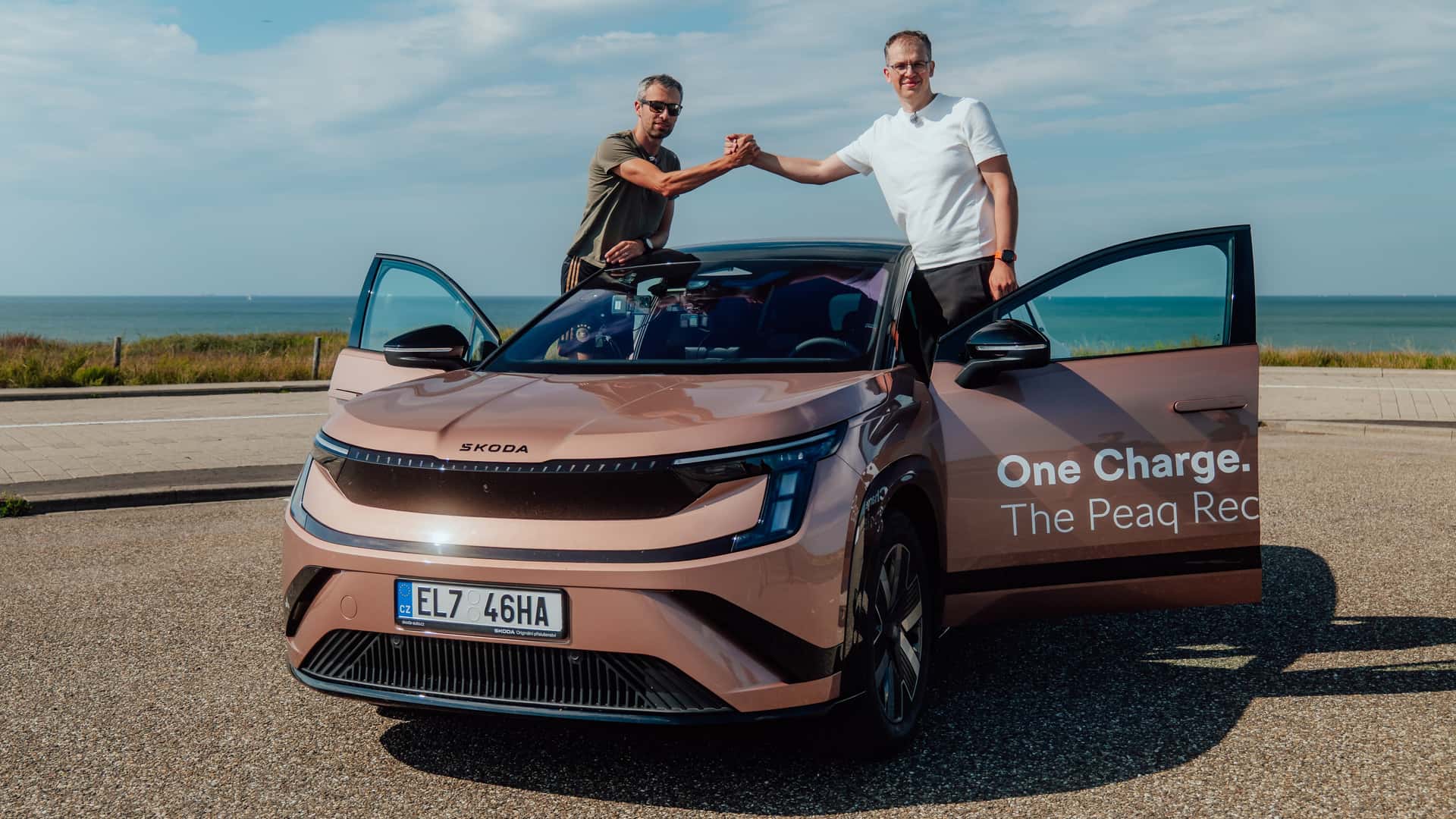
Official electric vehicle range estimates often serve as baseline guidelines rather than absolute guarantees for real-world driving. However, a recent extreme range test has demonstrated just how far battery technology can be pushed when driving conditions are optimized. A standard production-spec electric family SUV recently shattered expectations by traveling 582 miles on a single charge.
The vehicle accomplished this feat during a continuous efficiency demonstration, covering 936 kilometers without visiting a charging station. This distance represents a massive 45 percent increase—or 179 additional miles—over its official WLTP rating of 402 miles. Industry filings reveal that beating homologated range figures by such a wide margin requires eliminating nearly all energy losses.
Surprisingly, the test vehicle was not a lightweight prototype or a stripped-down experimental chassis. Drivers utilized a stock seven-seat Škoda Peaq 90 equipped with a factory 91-kilowatt-hour battery pack featuring 86 kWh of usable capacity. No mechanical modifications, specialized aerodynamic bodywork, or battery tweaks were applied, proving the vehicle’s hardware remained completely stock throughout the drive.
The Science Behind the Record Run
Reaching such extraordinary range required meticulous planning long before the vehicle turned its wheels. Engineers used artificial intelligence software to plot a specialized route starting from the assembly plant in Mladá Boleslav, Czech Republic. The digital mapping algorithms prioritized smooth route geometry and light traffic over travel speed, directing the vehicle across Western Europe toward the Netherlands.
The primary catch behind this record-setting journey lies in the complete avoidance of high-speed highways. Cruising at typical motorway speeds severely degrades battery range due to exponential aerodynamic drag. Instead, the test drivers navigated secondary roads and rural routes with light traffic, keeping speeds modest and allowing the electric powertrain to operate near peak efficiency throughout.
Beyond route selection, the driving style was tailored strictly toward hypermiling principles. Two company test drivers rotated shifts to maintain smooth momentum, avoiding hard acceleration, heavy mechanical braking, and complete stops. By anticipating traffic flow far down the road and maximizing regenerative coasting phases, the team minimized energy consumption required to keep moving forward.
Extreme Efficiency Numbers and Conditions
Telemetry logged during the journey revealed efficiency metrics rarely seen in production passenger vehicles. The large seven-seater averaged an astonishing energy consumption rate of 9.2 kWh per 100 kilometers, translating to roughly 6.8 miles per kilowatt-hour. For context, typical real-world consumption for family-sized electric SUVs usually hovers between 2.5 and 3.5 miles per kilowatt-hour during mixed driving.
Environmental factors also played a crucial role in enabling the achievement. Technical reports note that ideal dry weather prevailed throughout the drive, as wet pavement would have increased rolling resistance and made the result impossible. The trip began at noon on Tuesday and concluded Wednesday afternoon, incorporating an overnight rest stop to ensure driver safety over the prolonged run.
The original destination was set for Amsterdam, located approximately 530 miles from the starting line. However, because the battery depleted much slower than anticipated, the crew extended the route by another 28 miles to Zandvoort. During the final stretch along the coast, the instrument cluster registered zero percent charge, but the team drove until the SUV stopped.
How Hypermiling Compares Across the Industry
This journey highlights a growing trend among automotive manufacturers demonstrating the maximum limits of their battery management systems. Similar hypermiling tests have yielded astonishing numbers under controlled conditions. For instance, manufacturer tests involving a BMW iX3 covered 626 miles on country roads between Hungary and Germany, arriving with 2 percent remaining state of charge while keeping climate control turned off.
American automakers have also engaged in low-speed efficiency experiments to push range boundaries. In a notable trial, development engineers drove a Chevrolet Silverado EV over 1,000 miles on a single charge by keeping speeds below 25 miles per hour. These extreme tests clearly demonstrate that battery capacity is rarely the limiting factor when speed and air resistance are removed.
While these headline figures showcase peak engineering potential, analyst reports emphasize that hypermiling results do not reflect everyday consumer driving expectations. Standard highway speeds, passenger loads, traffic stoplights, and cabin heating or cooling demands significantly reduce real-world range. Nevertheless, hypermiling runs serve as valuable baseline benchmarks for software optimization and overall thermal efficiency under minimal stress conditions.
Essential Lessons for Real-World EV Drivers
For everyday electric vehicle drivers, the underlying lesson of hypermiling comes down to physics and speed management. Aerodynamic resistance increases exponentially as vehicle speed rises, meaning cruising at 75 mph consumes far more energy per mile than driving at 55 mph. Lowering highway speeds by even five to ten miles per hour yields noticeable range gains on road trips.
Smooth throttle inputs and proactive regenerative braking management also play key roles in extending battery range. Avoiding aggressive stop-and-go maneuvers prevents energy from being wasted as friction heat. Additionally, maintaining proper tire pressure, minimizing excess vehicle weight, and utilizing eco-mode settings can help drivers squeeze extra miles out of their battery packs during range-critical situations.
Ultimately, while few drivers will ever replicate a 582-mile journey without using highways or air conditioning, hypermiling demonstrations provide encouraging proof of modern battery capabilities. As electric vehicle architecture advances, improved powertrain efficiency will continue bridging the gap between extreme hypermiling records and practical daily usability for family electric vehicles worldwide.