
Why Hydrogen Aviation Faces Long Odds Despite New UK Push
The global push toward zero-emission commercial flight has gained measurable momentum as international regulatory authorities and leading aerospace manufacturers intensify real-world testing. The Civil Aviation Authority in the United Kingdom recently launched its latest regulatory challenge initiative, specifically focused on evaluating liquid hydrogen storage, airside logistics, and rapid aircraft turnaround procedures.
While these ongoing regulatory trials demonstrate genuine engineering commitment, updated industry evaluations indicate that the path toward widespread commercial passenger adoption remains exceptionally steep. Even when granting highly favorable development assumptions across individual technology components, the overall likelihood of a fully operational hydrogen passenger fleet operating at scale by 2050 remains under one percent.
Regulatory Momentum Gains Traction in the United Kingdom
The latest initiative by the Civil Aviation Authority focuses on pragmatic operational hurdles at regional hubs like London City Airport. Ground handling teams are actively evaluating cryogenic storage systems, specialized refueling protocols, and airside safety zones required for zero-carbon operations. These real-world turnaround tests are designed to uncover operational bottlenecks that could delay flight schedules during high-density airline operations.
These focused ground trials align with broader regulatory roadmaps targeting scaled hydrogen operations for small regional aircraft by 2035. Regulators recognize that establishing standard safety frameworks early is critical before manufacturers can transition from experimental prototype flight tests to scheduled commercial passenger routes across European flight corridors.
Real-World Engineering Progress Challenges Earlier Skepticism
Recent hardware developments show that earlier industry skepticism regarding hydrogen flight was somewhat oversimplified. Major engine manufacturers, including Airbus and MTU Aero Engines, are making steady progress on certifiable hydrogen fuel-cell propulsion systems capable of powering regional passenger aircraft. These developments demonstrate that core hydrogen powertrain engineering has advanced significantly beyond early theoretical concepts.
Simultaneously, aviation pioneers such as ZeroAvia have achieved tangible regulatory milestones, advancing certification efforts for 600-kilowatt electric powertrains with aviation authorities. Furthermore, modern airframe design research has proven that liquid hydrogen storage does not force engineers into a single, obviously impractical tank arrangement, opening up more flexible design pathways for future aircraft.
Modeling Commercial Feasibility Reveals Systemic Bottlenecks
Despite these technical corrections, updated analytical models show that component-level progress does not guarantee commercial deployment. Evaluating a standard commercial mission—a 150-passenger aircraft flying a 2,500-kilometer route with full passenger baggage and safety fuel reserves—highlights massive integration challenges across the entire vehicle architecture that must be solved simultaneously before deployment.
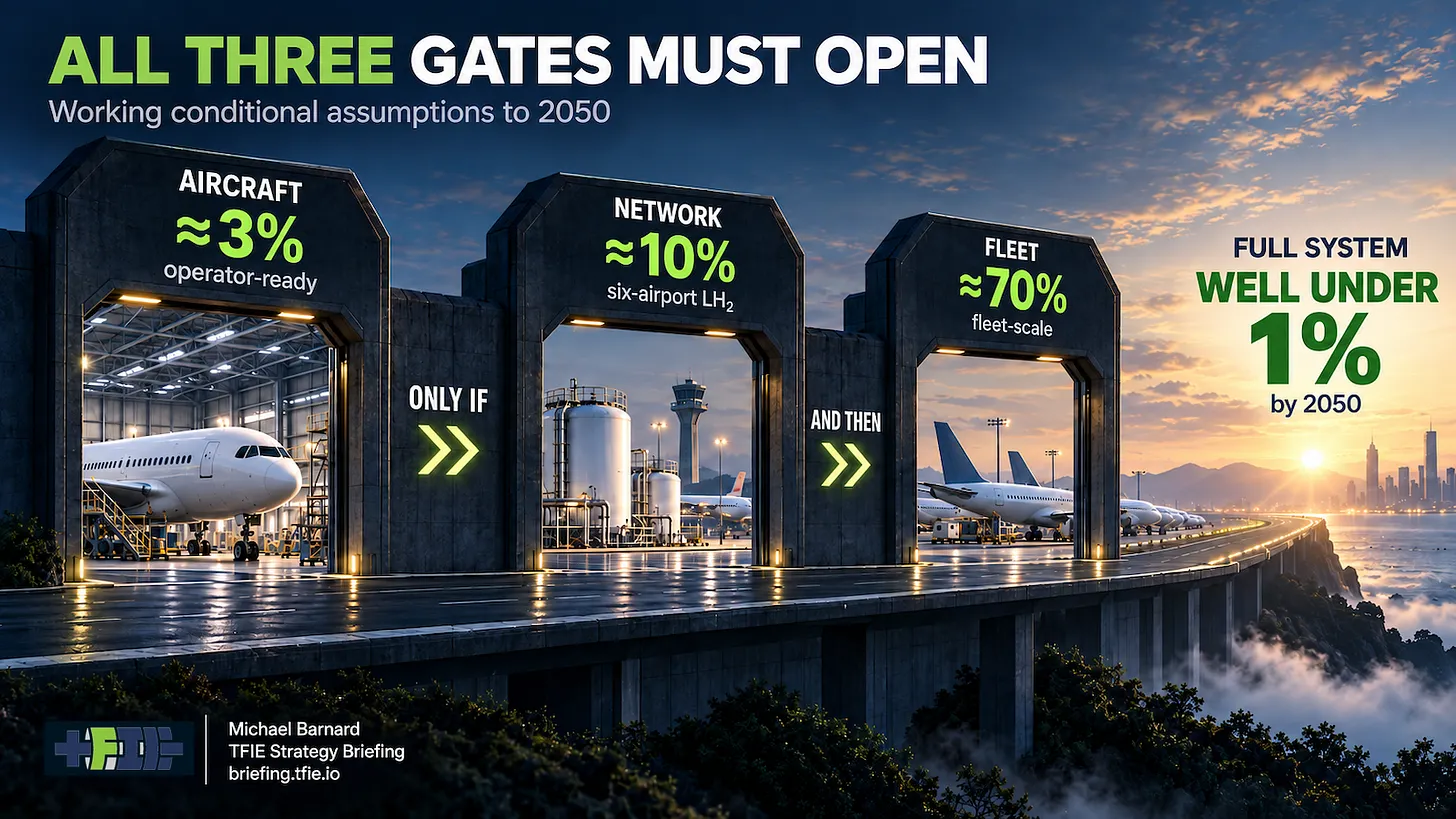
A commercially viable aircraft must accommodate heavy cryogenic tanks, thermal insulation, structural containment, piping, specialized propulsion systems, thermal management, and crash protection without sacrificing passenger cabin volume. Even when assigning generous 60 to 85 percent success probabilities to each downstream engineering gate, a clean-sheet hydrogen aircraft reaches only a three percent chance of commercial readiness by 2050.
Retrofitting existing commercial airframes or attempting novel blended-wing architectures yields even lower success probabilities under stringent international airworthiness constraints. The fundamental physics of cryogenic liquid hydrogen storage impose severe volumetric penalties, forcing heavy structural compromises that drastically reduce payload efficiency when compared directly to conventional jet fuels or drop-in synthetic options.
Airport Infrastructure Requirements Present Additional Barriers
Designing a certifiable aircraft is only half the battle; airport ground infrastructure presents an equally daunting set of interdependencies. Transitioning from small-scale ground demonstrations to scheduled commercial airline operations requires high-capacity hydrogen delivery pipelines, on-site liquefaction units, massive electric grid upgrades, and extensive fuel outage buffers to ensure operational reliability.
Industry disclosures highlight that ongoing testing at London City Airport provides valuable real-world data on turnaround logistics and airside refueling interfaces. However, scaling an airport network capable of delivering hundreds of metric tons of liquid hydrogen daily requires immense upfront capital investments long before a commercial fleet arrives to generate revenue.
Commercial Viability Depends on Integrated System Scale
When aircraft certification, airport network infrastructure, and fleet manufacturing timelines are combined into an integrated system model, the probability of establishing a viable medium-haul hydrogen passenger network drops below one percent by 2050. Recent analyst reports emphasize that fuel pricing remains strictly secondary to these underlying physical and structural realities.
While cheap green hydrogen would certainly improve operating economics for airlines, lower fuel costs cannot alter physical tank volume requirements, crashworthiness standards, certification timelines, or airport throughput limitations. An expensive but technically functional aircraft system might struggle commercially, but cheap hydrogen fuel simply cannot rescue an unbuilt or incomplete aircraft-and-airport operating ecosystem.
Across standard 2,500-kilometer commercial routes, hydrogen faces severe competition from drop-in sustainable aviation fuels, while ultra-short regional hops are increasingly targeted by battery-electric designs. Unless breakthrough technical disclosures demonstrate a radical reduction in storage tank weight or rapid airport infrastructure scaling, hydrogen passenger aviation will remain confined to small experimental fleets well past mid-century.
