
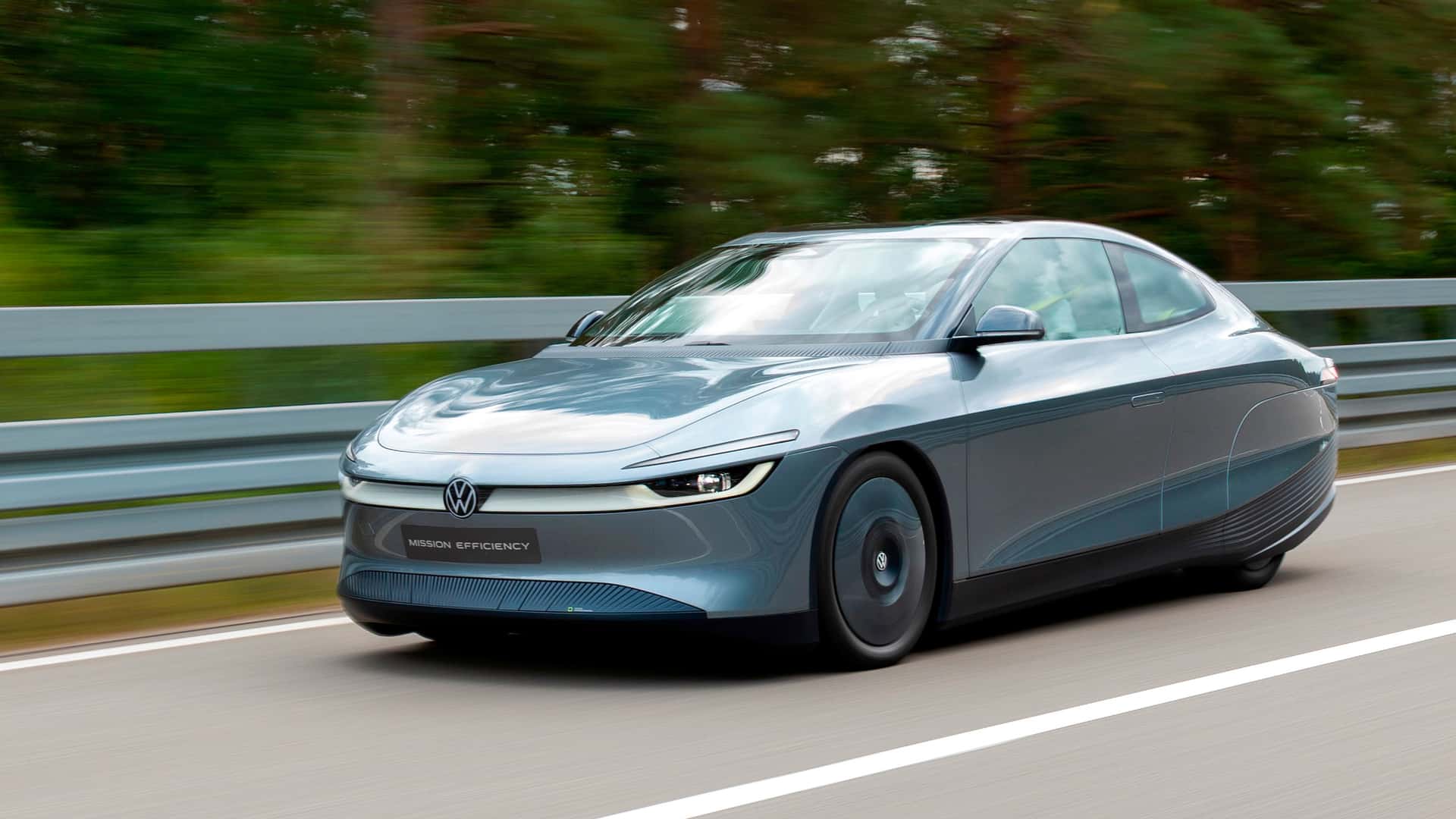
Volkswagen Unveils Record-Breaking Mission Efficiency EV
Volkswagen has unveiled a near-production electric vehicle concept designed to push energy efficiency to new heights. Dubbed the Mission Efficiency, this sleek two-door development model reimagines the iconic XL1 for a four-passenger layout. Built on the MEB+ platform, the vehicle demonstrates how aerodynamic optimization dramatically stretches battery range without needing heavy battery packs.
The engineering achievement focuses on lowering energy consumption during real-world driving. Technical disclosures reveal that the Mission Efficiency achieved efficiency figures exceeding nine miles per kilowatt-hour. That metric makes it one of the most frugally engineered road-legal electric vehicles ever constructed, outperforming existing commercial models and past hyper-efficient concepts by substantial margins.
Breaking Aerodynamic Boundaries with Extraordinary Design
Achieving extreme energy conservation required a radical approach to airflow management. The Mission Efficiency boasts an impressive drag coefficient of 0.158, making it the most aerodynamic road-legal car ever produced. This drag rating surpasses notable predecessors like the original XL1 at 0.186 and the Lightyear 0 concept, establishing a new benchmark for automotive aerodynamic drag reduction.
Engineers achieved this ultra-low drag coefficient by minimizing the vehicle's frontal area to 22.4 square feet. Active aerodynamic elements play a vital role, including three frontal cooling flaps opening in five configurations. Closing all three flaps yields the lowest drag setting. Special wheel deflectors also prevent air turbulence around covered rear wheel arches.
Underneath, a completely sealed underbody eliminates turbulence beneath the vehicle chassis. To further channel air smoothly around the rear end, designers narrowed the rear axle track by 6.7 inches compared to the standard ID. Polo hatchback. Bespoke Continental EcoContact 7 tires feature aerodynamically optimized sidewalls, combining low rolling resistance with minimal aerodynamic drag.
Real-World Endurance Testing Demonstrates Massive Range
To prove its capability, Volkswagen subjected the Mission Efficiency concept to a demanding long-distance road trip. Driving directly from the development center in Wolfsburg, Germany, the vehicle journeyed through Poznan, Poland, and Olomouc, Czechia, before arriving in Vienna, Austria. Covering 794 miles over public highways and city roads, the concept required only one intermediate charging stop.
Upon reaching Vienna, the EV still retained 102 miles of remaining driving range. These endurance test results project a theoretical total range exceeding 870 miles on a full battery charge and single top-up. The journey maintained a realistic average speed of 42 mph across varying terrain while reaching peak speeds up to 86 mph during highway driving segments.
Energy consumption data logged during the road trip highlights the extreme capability of the aerodynamic body. Factoring in grid charging losses, the vehicle logged an average consumption rate of 7.51 miles per kWh. When measuring net battery energy consumed directly on the road, efficiency reached 9 miles per kWh, demonstrating remarkable power management under operational conditions.
The engineering team pushed test parameters further during closed-course constant-speed evaluations. Maintaining a steady 42 mph on flat terrain with auxiliary climate systems powered off, the vehicle recorded an astonishing 9.58 miles per kWh. This landmark metric underscores how dramatically air resistance dominates energy usage at moderate highway speeds.
Unpacking the High-Efficiency Powertrain Architecture
Underneath its aerodynamic shell, the Mission Efficiency shares core mechanical hardware with the upcoming ID. Polo urban hatchback. Power comes from a single front-mounted APP290 permanent-magnet synchronous electric motor. Generating 133 horsepower and 195 pound-feet of torque, the electric motor delivers ample acceleration while keeping overall vehicle mass carefully balanced.
Energy storage relies on a nickel-manganese-cobalt battery pack rated at 54.9 kilowatt-hours of usable capacity. Software engineers unlocked an extra 2.9 kilowatt-hours of usable energy compared to the standard ID. Polo’s 52 kWh pack. This software optimization allowed the prototype to maximize its long-distance range potential without physically altering internal battery cell modules.
Charging capabilities remain practical and aligned with standard urban EV infrastructure. The vehicle supports up to 105 kW DC fast charging alongside 11 kW AC home charging capability. Because the ultra-sleek design drastically reduces energy demand, the 105 kW charging rate enables exceptionally rapid range replenishment during brief highway stops.
Functional Cabin and Integrated Solar Technology
Despite its futuristic exterior silhouette, the interior of the Mission Efficiency maintains practical daily usability. The cabin comfortably accommodates four passengers within an airy, minimalistic environment. Rather than fitting expensive, heavy digital touchscreens, designers incorporated a practical smartphone and tablet mounting system derived from the solution used in the e-Up! city car.
Adding to its energy harvesting credentials, the vehicle features a 370-watt solar panel array integrated into the glass roof and rear hatch assembly. This solar collection system harvests ambient sunlight to continuously power low-voltage auxiliary electronics, HVAC controls, and interior displays. By offloading auxiliary power demands, the solar panels further safeguard overall driving range.
What This Breakthrough Means for Future Urban Mobility
The Mission Efficiency highlights a pivotal shift in electric vehicle engineering philosophy. Rather than fitting larger, heavier, and more expensive battery packs to achieve extended driving range, Volkswagen demonstrates that radical aerodynamic refining delivers equivalent range gains. Reducing drag directly translates to smaller battery requirements, lower manufacturing costs, and lighter curb weights.
As automotive manufacturers work toward meeting stricter efficiency standards, technologies showcased in this near-production concept will filter into mainstream production lines. Features such as active cooling flaps, aerodynamic sidewalls, and optimized underbody paneling provide a clear roadmap for future electric vehicles. The Mission Efficiency proves intelligent engineering can deliver record-breaking efficiency without sacrificing real-world usability.
