
Volkswagen Builds Ultra Efficient Electric Vehicle Prototype
Volkswagen has officially revealed a new experimental electric vehicle prototype that demonstrates remarkable energy efficiency under real-world driving conditions. Designed as a showcase of lightweight engineering and low aerodynamic drag, the concept highlights how intelligent design can maximize battery range. The vehicle relies on existing componentry, signaling that extreme efficiency may not remain confined to futuristic science experiments for long.
To prove its capability beyond theoretical models, Volkswagen engineers conducted a long-distance road test from Wolfsburg, Germany, to Vienna, Austria. Covering approximately 794 miles (1,278 kilometers), the prototype required only a single charging stop during the journey. The vehicle arrived at its final destination with 104 miles of remaining range, translating to a remarkable energy consumption rate of 7.51 kilowatt-hours per 100 miles.
According to official company announcements, this equates to roughly 279 miles per gallon gasoline equivalent in real-world testing, with theoretical maximums reaching 323 MPGe. For comparison, the current efficiency leader among mass-production electric sedans achieves significantly lower relative economy metrics. Volkswagen achieved this feat by pairing a high-efficiency powertrain with an extremely streamlined chassis, prioritizing energy conservation over traditional luxury vehicle dimensions.
Sleek Aerodynamic Engineering Shapes the Exterior
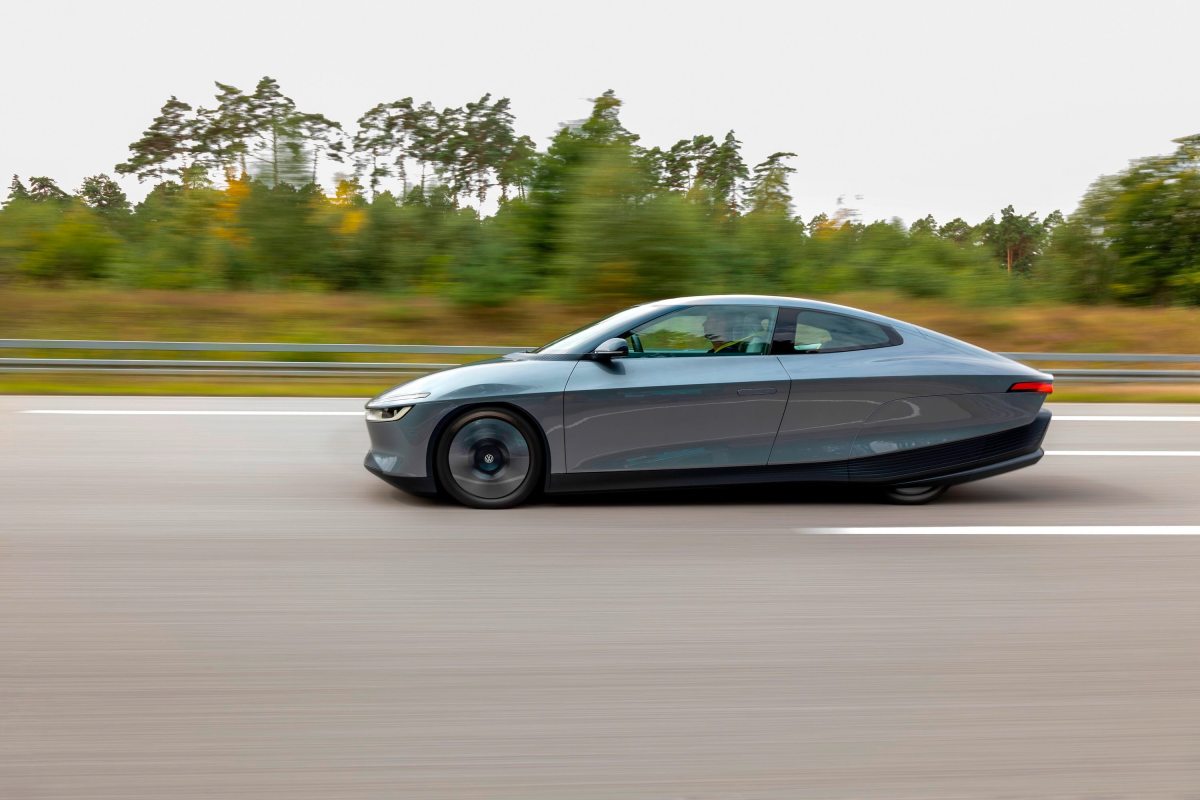
The vehicle achieves its astounding efficiency largely through an aggressive focus on aerodynamics. Featuring a classic teardrop profile with a sharp Kammback rear section, the bodywork tapers rapidly behind the front row. This specific shape minimizes wake turbulence behind the vehicle, allowing it to record a remarkably low coefficient of drag at 0.158 alongside a compact frontal area measuring just 2.08 square meters.
Engineers also redesigned the wheel enclosures to drastically minimize turbulent air pockets near the road surface. Because standard wheels and tires can account for up to a third of total aerodynamic drag, designers narrowed the space between the tire tread and the body panels. While this choice significantly smooths airflow along the lower body, it tightens suspension travel inside the wheel wells.
Interestingly, designers opted to keep conventional glass sideview mirrors rather than replacing them with digital camera systems. While cameras reduce exterior drag, standard mirrors provide superior depth perception without consuming auxiliary electrical power. To further boost energy collection, solar cells were integrated into the roof and trunk lid, supplying up to 18 additional miles of range during ideal sunny driving conditions.
Minimalist Interior Design Borrows Startup Ideas
Inside the cabin, Volkswagen adopted a ultra-minimalist philosophy inspired by recent trends among lightweight vehicle startups. Rather than installing heavy, power-hungry infotainment screens and built-in speaker systems, the prototype features a bring-your-own-device setup. Drivers rely on their own smartphones or tablets mounted on the dashboard, coupled with a removable portable Bluetooth speaker for media playback throughout the trip.
This approach eliminates substantial electrical draw and reduces overall vehicle curb weight, directly contributing to extended range. Lightweight structural materials are deployed throughout the interior, including simplified seating frames and trimmed dashboard components. By stripping away non-essential luxury features, the vehicle demonstrates how software-dependent accessories can be replaced with flexible, user-supplied technology to preserve battery capacity.
Balancing Extreme Efficiency with Daily Usability
Achieving such groundbreaking efficiency figures inevitably required compromises in cabin space and everyday practicality. The aggressive downward slope of the roofline creates a strict 2+2 seating configuration. Volkswagen noted that the rear seats are specifically sized for occupants shorter than 5 feet 3 inches, making the back row suitable primarily for young children rather than full-sized adult passengers.
Underneath the custom aerodynamic bodywork, the prototype borrows its core electric powertrain directly from the upcoming ID. Polo platform. Utilizing a standard 54.9-kilowatt-hour battery pack, the vehicle can theoretically travel over 400 miles on a single charge. By combining mass-market electric hardware with lightweight construction, Volkswagen demonstrates how standard battery chemistry can deliver exceptional range without needing massive battery packs.
The tighter wheel clearances and low-slung stance also present potential trade-offs for everyday ride comfort on uneven roads. Shorter suspension travel reduces the car's ability to absorb heavy road impacts without transferring energy into the structure. However, industry filings indicate that these compromises were deliberately accepted to evaluate the absolute upper limits of efficiency in near-production vehicle architecture.
Volkswagen Prototype Hints at Future Halo Vehicles
Industry analysts note that this experimental project follows a long history of efficiency-focused concept cars from the German automaker. Over a decade ago, Volkswagen released the ultra-aerodynamic XL1 diesel-hybrid halo car, producing 250 limited-edition units for consumers. That project served as a rolling laboratory for advanced manufacturing techniques and lightweight carbon-fiber construction that eventually informed standard production models.
While the automaker has not officially confirmed production plans for the new prototype, its use of standard electric motor components makes low-volume assembly technically feasible. Even if the model remains a technology demonstrator, its aerodynamic innovations and minimalist cabin solutions are expected to influence next-generation electric vehicles across the manufacturer's lineup in coming years.
As battery raw material costs fluctuate and charging infrastructure continues to expand globally, vehicle efficiency is rapidly becoming a key competitive differentiator. Volkswagen's latest experiment demonstrates that shrinking battery size while maximizing aerodynamic performance offers a compelling pathway forward for sustainable transportation, proving that high range does not always require heavier batteries.
