
Why SpaceX Completed a Non-Starlink Internet Network
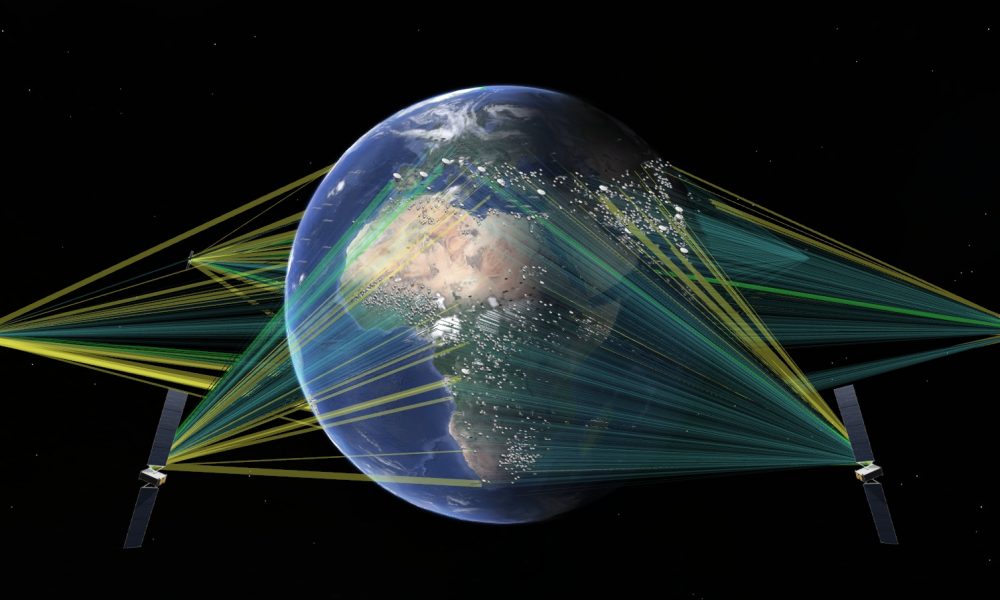
SpaceX successfully launched a Falcon 9 rocket from Cape Canaveral, carrying three final satellites to complete a lesser-known orbital internet constellation. The mission deployed spacecraft designated F11, F12, and F13 to finish the O3b mPower satellite network for global telecommunications operator SES. This launch represents the culmination of a multi-year effort to establish high-throughput satellite infrastructure designed specifically for commercial and government enterprises.
While SpaceX is best known for its massive direct-to-consumer Starlink broadband array, this latest mission highlights the company’s continuing role as a primary launch provider for third-party orbital systems. The completed 13-satellite constellation provides a distinct alternative to mega-constellations, relying on higher altitudes to deliver enterprise connectivity without requiring thousands of individual operational spacecraft across low Earth orbit shells.
Strategic Positioning in Medium Earth Orbit
The newly deployed O3b mPower satellites operate in medium Earth orbit at an altitude of approximately 5,000 miles above the planet. This position contrasts sharply with Starlink, which operates in low Earth orbit at roughly 340 miles, and traditional legacy telecommunications satellites situated in geostationary orbit over 22,000 miles high. Altitude selection dictates fundamental constellation design and network infrastructure economics.
By operating from medium Earth orbit, each O3b mPower satellite commands a significantly broader field of view across Earth's surface compared to lower-altitude units. Consequently, SES requires only 13 spacecraft to provide comprehensive global connectivity. This architecture balances propagation delay with broad coverage areas, offering low-latency broadband capabilities that bypass the massive physical infrastructure costs associated with managing thousands of low-orbit satellites.
Industry filings indicate that Boeing manufactured the high-performance satellites under a long-term development contract with SES. The completion of this 13-satellite fleet marks a crucial milestone for medium-altitude communications, validating a balanced approach between signal coverage and orbital latency. The network offers steady throughput essential for data-heavy corporate operations across challenging geographic locations worldwide.
Divergent Markets and Hybrid Infrastructure
Although both SpaceX and SES offer space-based broadband services, their underlying commercial models target fundamentally different customer bases. SpaceX engineered Starlink for high-volume markets, delivering direct consumer internet to residential homes, recreational vehicles, and small businesses. Although Starlink is expanding into commercial sectors, its primary operational infrastructure remains optimized for distributed mass-market deployment across the globe.
Conversely, SES designed the O3b mPower platform exclusively for high-demand enterprise environments. The system delivers dedicated, high-capacity bandwidth provisioned similarly to terrestrial fiber circuits. Key end-users include commercial airlines, major cruise lines, offshore energy installations, telecommunications firms needing mobile backhaul infrastructure, and government defense organizations requiring highly secure transmission channels worldwide.
Rather than competing exclusively, operators increasingly combine these distinct network architectures to optimize performance. Analyst reports highlight that major maritime operators employ hybrid connectivity packages blending Starlink’s rapid low-latency speeds with O3b mPower’s guaranteed throughput capacity. This multi-orbit strategy ensures seamless service delivery, allowing vessels to dynamically switch bandwidth resources based on operational needs at sea.
Reusability Milestones for Falcon 9
The launch highlighted SpaceX’s continued advances in booster reusability and operational reliability. The first-stage booster supporting the O3b mPower mission completed its 29th flight, reflecting unprecedented turnaround efficiency. Previous deployments for this specific core included two crewed Axiom missions to the International Space Station, the European Space Agency’s Euclid space telescope, and 22 routine Starlink constellation launches.
Following stage separation, the flight core executed a controlled descent, targeting a vertical landing aboard the autonomous droneship stationed in the Atlantic Ocean. Regulatory disclosures reveal that this touchdown attempt represented the 661st successful Falcon booster recovery in company history. Such recovery milestones demonstrate how structural reusability has fundamentally lowered the baseline economics of commercial space transportation over the past decade.
With SpaceX having surpassed 11,000 launched Starlink satellites earlier this year, predominantly via internal manifest flights, missions like O3b mPower confirm that the company maintains substantial launch capacity for external clients. Commercial launch services remain a cornerstone of SpaceX’s core business model, ensuring steady revenue while driving further launch cadence efficiencies.
The Future of Multi-Orbit Satellite Networks
The completion of the O3b mPower fleet highlights an evolving landscape where specialized satellite constellations co-exist alongside mass-market low Earth orbit arrays. As demand for resilient global data networks surges across aerospace, maritime, and defense sectors, multi-orbit integration is becoming standard industry practice rather than an exceptional hardware setup.
SES’s fully operational constellation provides essential infrastructure redundancy and dedicated bandwidth for enterprise entities requiring strict service-level agreements. With the final three satellites in orbit, the telecommunications market enters a mature phase where medium Earth orbit networks offer targeted, reliable capacity alongside sprawling low-orbit arrays.
