
Tesla has officially unlocked commercial-scale manufacturing for its dry electrode 4680 battery cells, marking a monumental turning point for global electric vehicle production in 2026. According to recent official company disclosures, high-volume production lines at Giga Texas have surpassed target efficiency benchmarks after years of intense development. This manufacturing milestone resolves a critical bottleneck that previously restrained the automaker’s ambitious cell deployment plans.
The breakthrough centers on mastering the dry-coating process for both the anode and the cathode chemistry within large-format cylindrical cells. Industry analysts confirm that stabilizing cathode dry coating was the final technical hurdle preventing mass commercialization across high-volume automotive platforms. With yield rates now matching legacy wet-slurry methods, the company is positioning itself to drastically lower vehicle assembly costs.
Engineering data released during recent technical symposia indicates that factory line yields for the updated 4680 cell have surged past ninety-five percent. This operational advancement eliminates the severe scrap rates that plagued early production trials, ensuring a continuous supply of uniform energy storage units. Consequently, vehicle assembly plants can now ramp up output without facing structural battery pack shortages.
Solving the Cathode Dry Coating Bottleneck
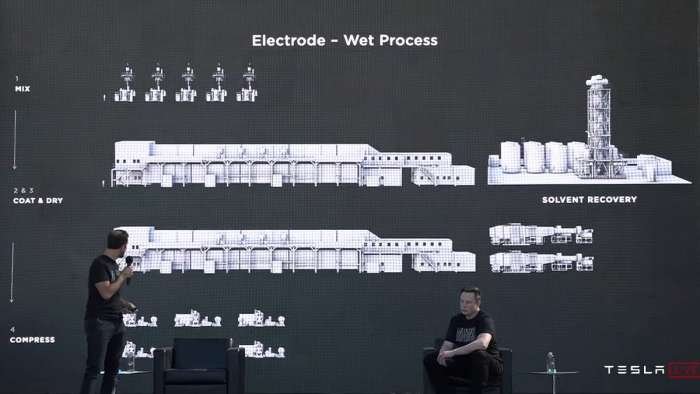
Traditional battery manufacturing relies heavily on toxic liquid solvents to create an active material slurry, requiring massive drying ovens that span hundreds of meters. According to regulatory filings, removing toxic solvents from the cathode line reduces factory floor space requirements by more than seventy percent per gigawatt-hour. The simplified physical process also reduces thermal conditioning steps, streamlining overall material throughput across manufacturing facilities.
The primary obstacle in dry cathode production involved compressing dry powder mixtures onto current-collector foils without causing micro-tears or binder agglomeration. Engineering data demonstrates that new high-precision roller presses combined with specialized polymer binders solved these structural defects entirely. This technical achievement yields a remarkably uniform electrode film capable of sustaining high energy densities over thousands of rapid discharge cycles.
Industry analysts note that high-speed vision inspection systems and artificial intelligence controls now monitor powder deposition in real time on the assembly line. By immediately adjusting roller pressure and speed at sub-millimeter scales, line operators prevent waste before material defects propagate down the line. Consequently, operational uptime on the dry coating equipment has surpassed legacy cell manufacturing benchmarks for the first time.
Industrial Scale and Cost Reduction Dynamics
Official company disclosures highlight a substantial reduction in cell-level unit economics following the dry process integration. Battery production costs are projected to fall by up to thirty percent compared to traditional 2170 cells, creating an unprecedented margin advantage for next-generation electric vehicles. This cost optimization directly enhances profitability across both consumer vehicle offerings and energy storage product lines globally.
Capital expenditure requirements for new cell production facilities have also dropped sharply under the refined architecture. Regulatory filings indicate that capital outlay per gigawatt-hour of capacity is down nearly fifty percent, primarily due to the complete removal of massive solvent recovery systems. Lower initial build costs allow for much faster factory expansion schedules in key regional automotive manufacturing hubs.
From an environmental compliance standpoint, the dry electrode method slashes factory energy consumption during the cell assembly phase by roughly ten-fold. Engineering data confirms that eliminating high-temperature solvent drying ovens dramatically reduces grid draw per cell produced. This reduction lowers the embedded carbon footprint of each battery pack, satisfying stringent global environmental standards implemented across major markets.
Vehicle Integration and Performance Metrics
The stabilization of dry electrode 4680 cell production provides an immediate boost to vehicle delivery programs, including the expanded Cybertruck lineup and upcoming lower-cost vehicle models. Official company disclosures reveal that all newly assembled long-range vehicle variants are transitioning to the improved dry-cathode cell chemistry. Vehicle architectures designed specifically around structural pack integration will reap the greatest range and weight efficiency gains.
Engineering data shows that gravimetric energy density for the refined 4680 cell now exceeds two hundred and eighty watt-hours per kilogram at the cell level. In addition to mass reduction, internal resistance improvements enable faster DC fast-charging curves without accelerating lithium plating or thermal degradation. Consequently, owners can expect shorter charging pitstops during long-distance highway travel without sacrificing long-term battery longevity.
Industry analysts emphasize that securing raw material inputs for dry processing requires closer collaboration with chemical suppliers providing dry-form active cathode powder. Refining regional supply chains has minimized shipping delays and reduced logistics costs associated with precursor transport. Furthermore, domestic processing facilities are expanding to supply the required high-purity nickel and synthetic graphite powders for high-volume manufacturing lines.
Long-Term Competitive Landscape
This manufacturing breakthrough re-establishes technological differentiation in an increasingly crowded global EV sector where battery costs dictate market dominance. Industry analysts note that rival automakers attempting to commercialize dry electrode technology remain years away from achieving comparable volume yield rates. The resulting cost gap will likely force competing OEMs to accelerate joint ventures with dedicated battery suppliers or alter strategic electrification roadmaps.
According to official company disclosures, the dry 4680 cell architecture will be replicated across global production hubs in Nevada and Europe throughout 2026 and 2027. Scaling production across multiple continents ensures localized battery supply for regional assembly operations while safeguarding against tariff fluctuations. This international manufacturing rollout sets a formidable new benchmark for sustainable energy scaling across the entire transportation ecosystem.
