
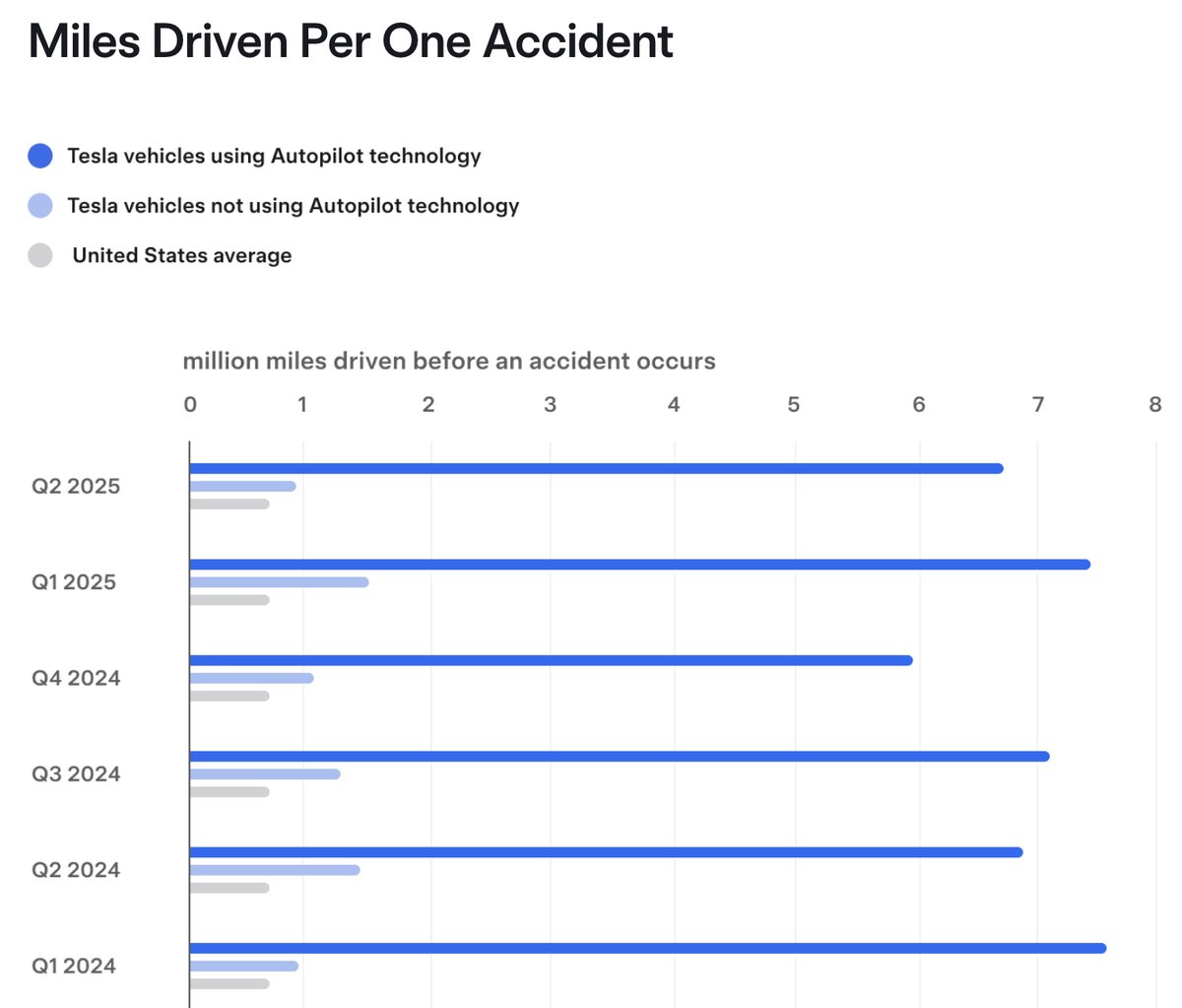
Official company disclosures published for the third quarter reveal a significant expansion in the distance driven between recorded crash events for vehicles operating on automated assistance systems. Drivers utilizing active safety features logged millions of miles per incident, outpacing traditional human-driven benchmarks across North America. This trajectory reflects continuous refinements in real-time sensor processing and predictive trajectory modeling under varied highway scenarios.
According to official company disclosures, vehicles engaged in Autopilot recorded one crash for every seven million miles driven during the third quarter. In contrast, nationwide transportation data indicates an average of one crash every six hundred thousand miles for unassisted passenger cars. This vast statistical margin highlights the structural safety advantages delivered by integrated collision avoidance features.
Engineering data demonstrates a notable year-over-year safety increase when comparing current third-quarter figures against identical timeframes from previous deployment cycles. The newly released metrics illustrate a double-digit percentage improvement in collision avoidance reliability during high-density traffic conditions. System optimization efforts continue to reduce false phantom braking incidents while improving lane-centering precision across complex multi-lane expressways.
Comparative Analysis Across Prior Year Performance
Analyzing historical third-quarter datasets provides critical context regarding long-term autonomous platform maturity and algorithmic reliability. Previous Q3 reports recorded significantly lower mileages between safety-critical disengagements, demonstrating how iterative software builds enhance operational security over time. Recent architectural overhauls replacing legacy code with end-to-end neural networks have directly contributed to these measurable efficiency gains.
Industry analysts note that third-quarter driving patterns typically feature optimal weather conditions alongside increased long-distance summer travel volumes. These favorable environmental factors generally allow optical vision algorithms to operate at peak efficiency with minimal camera occlusion from snow or heavy slush. Consequently, quarterly comparisons must adjust for seasonal variables to accurately evaluate true baseline software capability across differing climates.
Regulatory filings reveal that even when Autopilot is disengaged, vehicles equipped with active safety features demonstrate superior crash prevention statistics compared to fleet averages. Automatic emergency braking, forward collision warning, and active lane departure avoidance remain operational in the background to mitigate human error. This multi-layered active safety architecture helps maintain a robust defense against common roadway hazards.
Hardware Suite Evolution and Neural Network Scaling
Engineering data confirms that the wider rollout of advanced AI hardware suites played a pivotal role in boosting Q3 safety performance. Upgraded high-resolution camera sensors paired with higher computing capacity enable the system to perceive distant obstacles with unprecedented visual clarity. This expanded sensing range allows onboard computers to execute smoother braking inputs and predictive steering maneuvers well in advance.
The transition toward end-to-end neural network architecture has replaced millions of lines of hard-coded C++ rules with pure machine learning models. Official company disclosures indicate that this transition allows the vehicle to process complex driving scenarios by learning directly from vast fleets of real-world human driving data. As a result, software disengagements caused by unpredictable construction zones have dropped substantially.
Industry analysts emphasize that fleet-wide data collection accelerates the resolution of edge cases that previously triggered unexpected system disengagements. Every minor disengagement captured across millions of active customer vehicles feeds into centralized training supercomputers to refine future firmware builds. This continuous feedback loop ensures that local roadway anomalies encountered in Q3 inform safety updates deployed worldwide within weeks.
Regulatory Oversight and Real World Benchmark Testing
Regulatory filings highlight ongoing government scrutiny surrounding driver-monitoring efficacy and automated system operational design domains. Federal safety agencies continue to request granular telemetry regarding disengagement triggers and driver attentiveness metrics during active system operation. In response, recent software updates have implemented stricter cabin camera monitoring routines to prevent misuse and ensure driver engagement.
Industry analysts frequently point out the structural challenges in comparing automated driving safety figures directly against generic national transportation registries. National crash databases often log minor fender benders, whereas vehicle telemetry typically registers events severe enough to trigger airbag deployment or active restraint pretensioners. Standardizing safety report methodologies across all vehicle manufacturers remains an essential objective for global automotive regulators.
Engineering data indicates that real-time interior monitoring systems have dramatically reduced driver distraction rates during automated highway cruising. By monitoring eye gaze patterns and hand torque on the steering wheel, onboard algorithms quickly escalate visual and audible warnings when attentiveness drops. These proactive safety interventions ensure that human oversight remains effective whenever semi-autonomous modes are active.
Industry Implications for Autonomous Vehicle Adoption
Official company disclosures emphasize that these quarterly safety milestones establish a foundation for transitioning from supervised driving toward fully autonomous commercial fleets. Sustained safety improvements in third-quarter benchmarks reinforce investor confidence in scalable urban mobility services and unmanned taxi operations. Automakers competing in the high-tech EV landscape are under increasing pressure to match these verified mile-per-incident performance metrics.
As automated driving technologies mature through 2026, transparent safety disclosures remain vital for building public trust and securing broader regulatory approvals worldwide. Engineering data proves that combining advanced computer vision with fleet-scale machine learning yields measurable reductions in traffic collisions and severe injuries. Continuous verification across consecutive third-quarter cycles demonstrates that semi-autonomous driving assistance is rapidly redefining modern automotive safety standards.
