
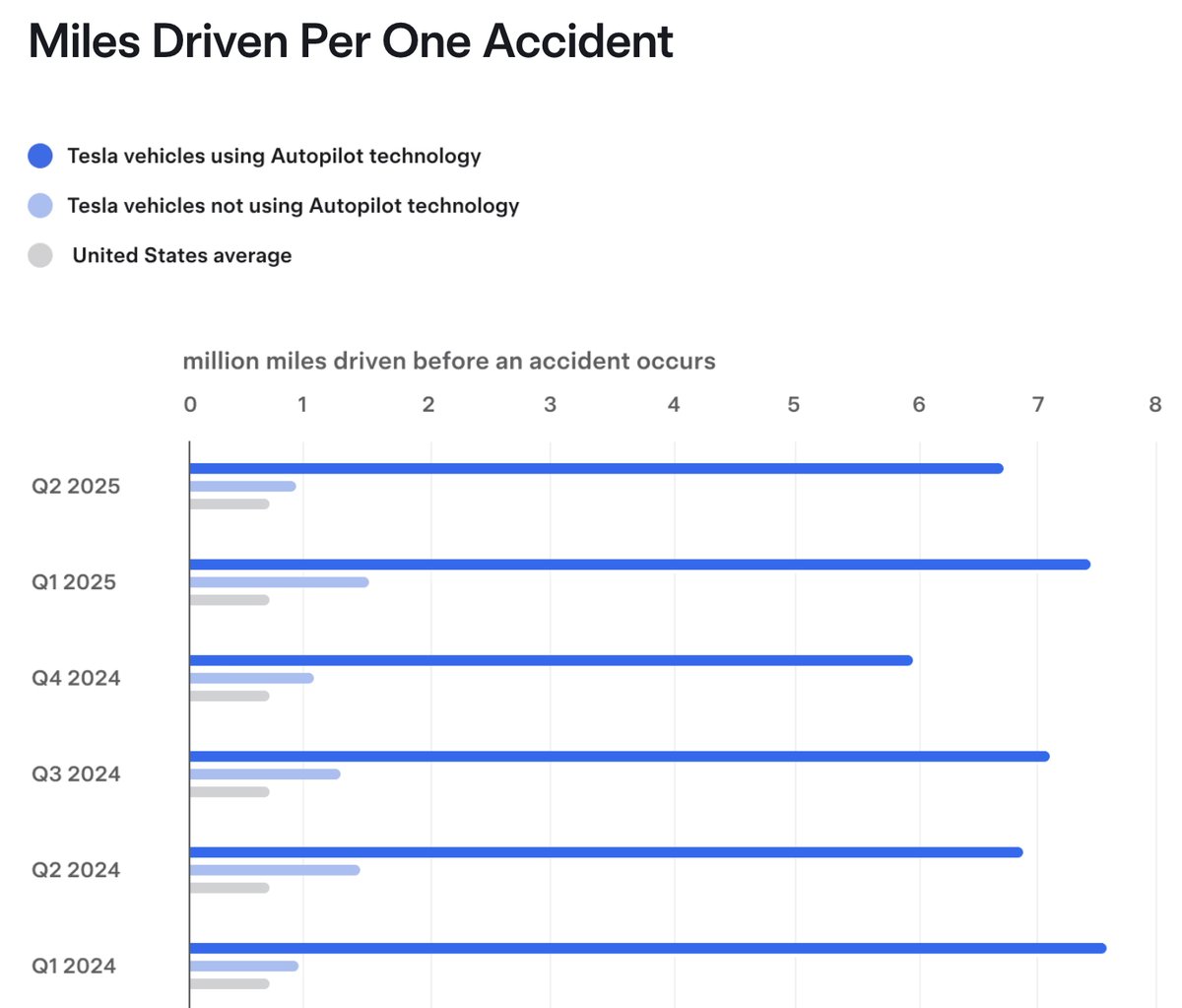
Freshly released official company disclosures reveal a notable shift in automated driving safety performance for the third quarter. The latest report compares real-world telemetry across millions of driven miles, highlighting critical trends in collision frequency when driver-assist features are active versus unassisted human driving. These findings provide vital insight into the evolving reliability of advanced autonomous vehicle technology.
Industry analysts note that third-quarter evaluation periods present unique environmental variables due to peak seasonal travel and shifting weather patterns. By evaluating quarterly telemetry against historical baselines, automotive experts can better determine whether safety gains stem from software optimizations or operational environment variations. The initial figures suggest structural improvements in safety hardware play a substantial role.
Third Quarter Driver-Assist Safety Benchmarks
According to official company disclosures, vehicles operating with active driver-assist technology logged one crash for approximately every seven million miles driven in the third quarter. This figure demonstrates a measurable expansion in distance traveled between incidents compared to previous quarters. It highlights how refined control algorithms continue to reduce low-speed and highway collisions during routine operational conditions.
Conversely, telemetry collected from vehicles operating without automated assist systems recorded one collision for every 1.5 million miles driven. Engineering data reveals that even when assistance software is disengaged, passive safety measures such as automatic emergency braking continue to mitigate crash severity. This stark divergence underscores the underlying safety benefits conferred by active hazard detection architectures.
Comparative Metrics Across Annual Cycles
Comparing the latest third-quarter results against identical quarters from prior years reveals a steady upward trajectory in safety performance. Regulatory filings indicate that miles driven per crash under automated supervision increased by more than twelve percent year-over-year. This year-over-year gain reflects progressive software updates designed to handle complex edge cases and heavy traffic congestion more gracefully.
Seasonal analysis remains essential when interpreting driver-assist metrics because third-quarter conditions typically offer daylight advantages and clearer road surfaces. Engineering data confirms that while winter quarters traditionally experience higher crash frequencies across all vehicle classes, third-quarter baseline improvements remain consistent across diverse regions. Consequently, the relative safety margin between automated and manual driving modes continues to widen.
Engineering Upgrades and Hardware Evolution
A major contributor to the third-quarter performance enhancement is the accelerated rollout of upgraded onboard compute units and high-resolution optical cameras. Official company disclosures emphasize that enhanced visual processing enables vehicles to detect vulnerable road users, such as pedestrians and cyclists, at far greater distances. This processing speed improvement reduces reaction latencies during emergency braking scenarios significantly.
Furthermore, software architecture transitions toward end-to-end neural networks have fundamentally altered vehicle decision-making processes. Engineering data shows that replacing explicit rules-based code with deep learning systems allows vehicles to anticipate unpredictable driver behaviors more effectively. These neural network iterations process vast streams of spatial telemetry simultaneously, resulting in smoother disengagement-free navigation across urban intersections.
Fleet learning mechanisms also play a critical role in refining these neural algorithms continuously. Fleet-wide disclosures demonstrate that billions of miles of real-world driving data are processed using centralized supercomputing clusters to train driver-assist systems against rare driving anomalies. As the global fleet expands, the speed at which safety patches and behavioral adjustments reach consumer vehicles increases exponentially.
Regulatory Scrutiny and Independent Validation
Despite optimistic quarterly figures, industry analysts point out that comparative safety reporting requires rigorous external oversight. Regulatory filings show that federal authorities continue to refine their assessment frameworks to evaluate driver engagement monitoring systems. Critics argue that safety statistics must account for road type selection, noting that driver-assist features are predominantly engaged during low-risk highway cruising.
To address these methodology concerns, updated safety reports incorporate localized control data to compare driver-assist performance directly against human drivers on identical road types. Official company disclosures state that even when normalizing for freeway usage versus surface street navigation, automated systems retain a statistically significant safety advantage. Independent automotive engineers continue to analyze these normalized datasets to confirm these conclusions.
International safety regulators are simultaneously establishing standardized testing protocols for driver monitoring systems. Regulatory filings reveal that interior cabin cameras are now utilized more aggressively to enforce driver attention during assisted operation. By reducing instances of driver misuse and over-reliance, these safety interlocks contribute directly to lower collision counts during long-distance automated trips.
Market Impact and Long-Term Autonomous Trajectory
The quarterly metrics arrive at a pivotal juncture for commercial autonomous transport initiatives. Industry analysts believe that sustained safety gains in third-quarter reports bolster investor confidence regarding the commercialization of fully driverless ride-hailing fleets. Demonstrating superior safety relative to human operators remains the fundamental regulatory prerequisite for removing safety drivers from urban commercial operations entirely.
Looking ahead, automotive manufacturers face the dual challenge of scaling autonomous production while maintaining stringent safety standards. Official company disclosures signal that future software builds will integrate multi-modal AI models to further boost contextual decision-making. As third-quarter telemetry highlights steady progress, the automotive sector advances closer to achieving scalable, verifiably safe fully autonomous transportation systems globally.
