
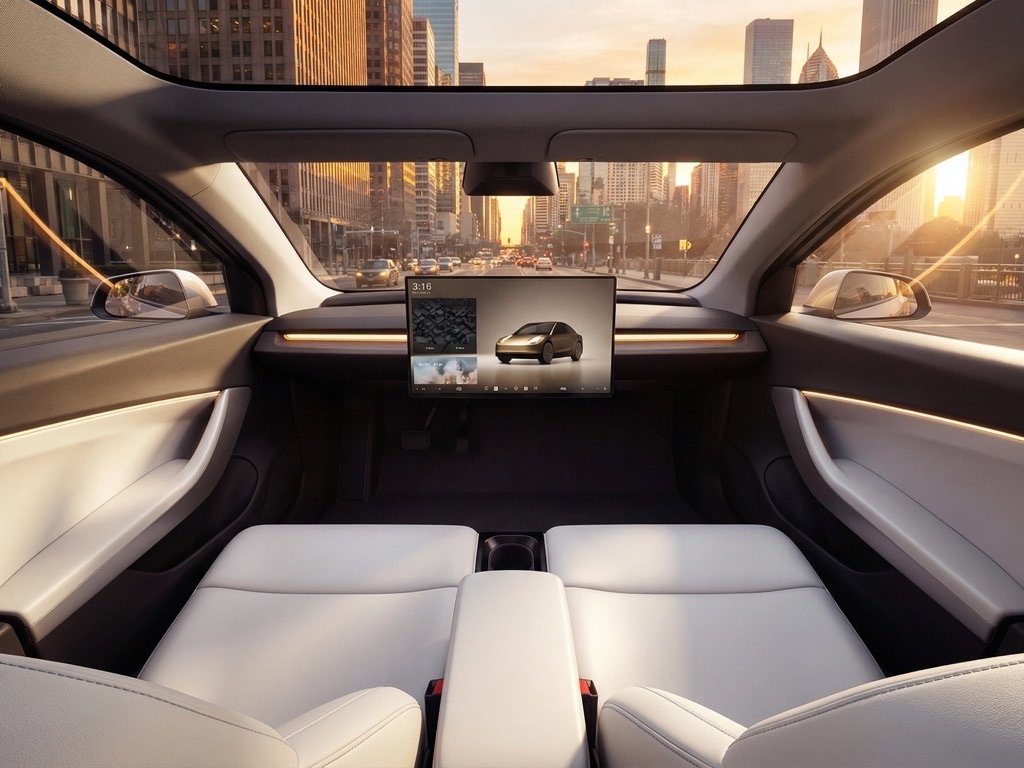
Official company disclosures have finally detailed the production interior specifications for the Tesla Cybercab as initial assembly lines gear up in 2026. The purpose-built autonomous vehicle completely abandons traditional driver controls in favor of an ultra-clean, utilitarian cabin designed strictly for passenger transport. Engineering data confirms that this radical layout maximizes internal space while drastically reducing vehicle manufacturing complexity and component count.
By removing the steering wheel, brake pedal, and accelerator assembly, the cockpit creates unprecedented legroom for front occupants. The minimalistic dashboard extends continuously across the width of the front bulkhead, featuring a single prominent display screen mounted directly in the center. According to industry analysts, this unencumbered architecture represents a fundamental shift away from human-driven ergonomics toward pure passenger comfort.
Next-Generation Cockpit Architecture
The structural dashboard is built around a single molded composite panel that integrates invisible climate control vents across its upper ledge. Official company disclosures indicate that the HVAC system uses vectoring air slots to direct airflow silently without mechanical vanes or visible registers. This monolithic design approach eliminates squeaks and rattles over time while delivering seamless heating and cooling throughout the entire cabin module.
Materials throughout the cockpit emphasize durability and sustainability, pairing synthetic vegan leather with high-grade recycled thermoplastic substrates. Engineering data reveals that the front dashboard structure acts as an integral cross-car beam, enhancing lateral stiffness and side-impact protection. By merging interior trim with structural reinforcement, engineers successfully stripped substantial dead weight out of the vehicle chassis.
Acoustics within the cabin rely on hidden exciter speakers embedded directly behind the dashboard panel surfaces instead of traditional speaker grilles. Engineering data details how these actuators excite the interior panels to create rich, spatial audio throughout the cockpit space. Industry analysts highlight that this speakerless acoustic array reduces manufacturing steps while providing an immersive sound system for passengers.
Display Technology and Passenger Interface
At the core of the minimalist interior is a massive 21-inch high-definition central touchscreen positioned centrally between the front seats. Regulatory filings describe an advanced anti-reflective, fingerprint-resistant glass coating engineered to maintain legibility under harsh ambient sunlight without requiring a protective gauge cluster shade. The display boasts an ultra-thin bezel design, running at a high refresh rate to deliver seamless visual responsiveness.
Powering this interface are dual redundant hardware compute nodes located securely directly beneath the main dashboard structure. Engineering data indicates that these primary and backup processors manage cabin climate, media streaming, route navigation, and real-time autonomous vehicle tracking simultaneously. This redundant hardware architecture ensures uninterrupted display operation and passenger communication, even in the event of an isolated computing hardware fault.
The passenger interface ditches traditional car menus, presenting an intuitive ride-hailing dashboard centered on journey progress, estimated arrival times, and customizable entertainment media. Official company disclosures highlight software features allowing riders to sync personal profiles instantly via mobile connectivity. Passengers can customize lighting themes, temperature presets, and multimedia playback before the autonomous vehicle even arrives at their location.
Spatial Efficiency and Passenger Amenities
The total removal of instrument clusters, steering columns, and center console gear selectors drastically improves cabin volume. Engineering data shows that front legroom increases by over forty percent compared to conventional sedan platforms of similar exterior dimensions. The open floor layout creates a continuous flat surface, making entry and exit remarkably effortless for passengers of varying mobility needs.
Beneath the central display lies an integrated console deck featuring dual high-speed wireless charging pads and high-wattage USB-C delivery ports. Official company disclosures highlight dynamic ambient light strips embedded along the lower edge of the dashboard structure. These light elements adjust color automatically to signal vehicle status, incoming alerts, door unlock confirmations, and overall ride progress to occupants.
Storage solutions inside the cockpit lean heavily into open, highly accessible spaces rather than enclosed, latching compartments. Regulatory filings reveal that the traditional dashboard glovebox has been eliminated entirely to streamline cabin assembly and eliminate potential impact injury zones. Instead, deep storage trays and bag hooks are built into the lower structural bulkhead, safely securing personal items during transit.
Safety Innovations and Regulatory Approvals
Re-architecting the front interior required major redesigns of safety systems, particularly front passenger airbag deployment mechanics. Engineering data confirms that novel full-width curtain airbags deploy downward from the upper windshield header and upward from the dashboard seam. This creates an inflatable protective pillow across the entire front spatial zone, meeting federal motor vehicle safety standards without steering column installation.
Maintainability for autonomous robotaxi operations is another core design pillar governing the dashboard and cabin design. Official company disclosures highlight antimicrobial coating treatments on all high-touch surfaces, alongside integrated short-wave ultraviolet sanitation lights within the headliner. According to industry analysts, these automated cleanliness systems operate between ride bookings to maintain cabin hygiene automatically without requiring constant manual intervention by service crews.
Fleet Economics and Industry Outlook
The extreme simplification of the interior architecture directly drives down per-unit manufacturing expenses for the upcoming fleet rollouts. Regulatory filings indicate that removing traditional gauge clusters, physical switches, steering mechanisms, and pedal assemblies saves thousands of dollars per vehicle built. Industry analysts view this minimal dashboard layout as the benchmark for cost-effective, scalable autonomous fleet production moving forward.
