
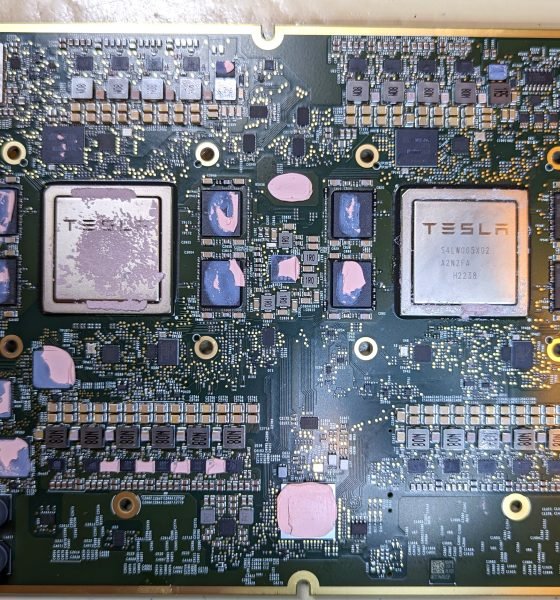
Tesla has initiated a significant server-side and onboard compute architecture overhaul for its Hardware 4 platform, unlocking unprecedented processing speeds across its global vehicle fleet. Newly released engineering data confirms that refined firmware optimizations combined with revised silicon instruction sets have yielded a dramatic reduction in neural network latency. This leap in performance positions the electric vehicle pioneer to accelerate its fully autonomous driving capabilities throughout 2026.
The automotive industry has closely watched the evolution of vehicle computing as software-defined architecture becomes the primary differentiator for modern electric transportation. Recent regulatory filings indicate that Tesla’s updated system achieves up to five times the raw processing speed of legacy computing nodes. Industry analysts suggest that this performance expansion allows real-time evaluation of high-resolution sensor streams without compromising energy efficiency or system longevity.
Architecture Redesign and Raw Processing Gains
According to official company disclosures, the Hardware 4 computer utilizes custom system-on-chip designs fabricated on advanced semiconductor nodes. The processing upgrades focus heavily on multiplying matrix mathematical operations per second, which form the back-bone of deep learning perception. By unlocking previously reserved silicon pipelines, the central processing board can process multiple high-megapixel camera inputs simultaneously while maintaining substantial thermal headroom.
Engineering data reveals that memory bandwidth across the board has been expanded to support rapid context switching between perception modules. This structural modification eliminates computational bottlenecks that previously limited the execution speed of complex spatial occupancy models. Consequently, the vehicle’s central computer interprets environmental changes in fractions of a millisecond, establishing a new baseline for reaction response times in real-world driving environments.
Industry analysts note that raw compute throughput directly influences how effectively an autonomous vehicle handles edge cases. With the newly activated clock speeds, the computer processes multi-camera spatial video grids at higher framerates than ever before. This throughput ensures that motion prediction algorithms receive uninterrupted telemetry, significantly enhancing path planning accuracy during high-speed highway maneuvers and congested urban navigation.
Neural Network Latency and Vision Pipeline Improvements
The vision processing pipeline has undergone a fundamental transformation alongside the hardware clock speed adjustments. Official company disclosures highlight that photon-to-control latency—the duration between a camera capturing light and the computer commanding an actuation—has been cut nearly in half. This speed acceleration directly benefits object detection, lane tracking, and dynamic obstruction avoidance under challenging weather and low-light conditions.
Industry analysts emphasize that reduced latency enables more sophisticated end-to-end neural network models to run locally without server tethering. Rather than relying on simplified heuristic code to bridge processing delays, the Hardware 4 computer executes end-to-end vision models directly on native silicon accelerators. This structural shift allows for smoother vehicle control, eliminating abrupt braking or jerky steering behaviors previously caused by computational queue delays.
Furthermore, engineering data shows that higher processing speeds facilitate real-time 3D reconstruction of surrounding environments. The system constructs detailed vector maps continuously, incorporating height variations, road debris, and pedestrian trajectories with pinpoint spatial precision. This continuous mapping capability represents a vital foundation for unsupervised autonomous operations, providing redundancy and high confidence levels during complex driving scenarios.
Thermal Efficiency and Board Power Optimizations
Achieving faster processing speeds often introduces elevated thermal output and power consumption challenges in electric vehicles. However, regulatory filings confirm that Tesla incorporated micro-channel liquid cooling infrastructure and dynamic voltage scaling across the Hardware 4 assembly. These design enhancements allow the dual system-on-chip configuration to sustain peak processing frequencies without triggering thermal throttling or compromising vehicle battery range.
Official company disclosures emphasize that power delivery channels were reworked to isolate neural processing units from general vehicle telemetry components. This isolation ensures stable voltage delivery during sudden spikes in computational load, such as navigating high-density traffic nodes. Industry analysts view this electrical engineering refinement as a major step toward automotive-grade computing durability, establishing standard operating protocols for high-performance mobile silicon.
Fleet Deployment and Autonomous Driving Roadmap
The rollout of the speed upgrade is taking place via over-the-air software updates across newly manufactured and existing Hardware 4 equipped vehicles. Regulatory filings indicate that safety regulators have approved the altered compute parameters, following extensive validation testing in diverse geographic environments. Drivers are already reporting more responsive driver-assist performance, quicker path visualization rendering, and noticeably smoother speed adjustments in dynamic traffic conditions.
According to official company disclosures, this software-enabled performance unlock is an essential prerequisite for releasing fully unsupervised self-driving features scheduled for later in 2026. The elevated compute speed ensures that redundant validation safety loops can execute in parallel with primary navigation models. By running real-time cross-checks without performance penalties, the computer provides dual-layer fail-operational assurance required for driverless passenger operations.
Competitive Landscape and Industry Implications
The automotive sector is paying close attention to how onboard processing capability reshapes competition in the luxury and mainstream electric vehicle segments. Industry analysts observe that legacy automakers face mounting pressure to upgrade their central domain controllers to keep pace with Tesla's rapid software iteration speed. The ability to deploy compute enhancements via over-the-air updates sets a challenging benchmark for rival manufacturers relying on fragmented supplier chips.
Engineering data indicates that specialized silicon integration will dictate auto industry market share over the next decade. As full vehicle autonomy moves from theoretical design to commercial reality, processing throughput, chip latency, and power efficiency remain paramount. Tesla’s latest Hardware 4 processing upgrades solidify its position at the forefront of automotive computing, establishing a high technical threshold for self-driving technology in 2026.
