
Hyundai Delays Tesla FSD Rival To 2029 For Advanced AI System
Strategic Realignment for Next-Generation Driver Assistance
Hyundai Motor Group has officially revised its autonomous driving roadmap, postponing the rollout of its fully in-house automated driving system to late 2029. Rather than rushing an incomplete software stack to market, company leadership selected a deliberate pause. The shift represents a major strategic recalibration as the global automotive sector aggressively pursues end-to-end artificial intelligence solutions.
Executive statements from official company briefings indicate that launching a mediocre product today would jeopardize long-term competitiveness. Hyundai aims to leapfrog current supervised systems rather than settling for an incremental software update. Delaying the rollout by approximately two years ensures the automaker can deliver a robust platform capable of navigating complex real-world driving environments.
By leveraging its massive global manufacturing footprint of over seven million vehicles annually across nearly 190 markets, Hyundai plans to harvest immense volumes of driving data. This expansive fleet will serve as a foundational engine to train, refine, and validate machine learning models, ensuring rapid software evolution ahead of the revised 2029 commercial launch window.
A Phased Rollout Built on High-Performance Hardware
To bridge the technical gap leading up to 2029, Hyundai Motor Group is implementing a structured two-phase deployment framework. The initial phase focuses on launching a supervised Level 2 platform powered by Nvidia architecture across upcoming production vehicles starting in late 2028. This foundation ensures immediate technological parity with existing market solutions while in-house software matures.
Central to this first stage is the integration of the Nvidia Drive Hyperion 10 compute architecture. Designed to process immense sensor payloads, the hardware suite supports everything from basic driver assist functions up to unsupervised Level 4 operational capabilities. Hyundai joins several premium global automakers adopting this high-performance computing platform to establish baseline functional reliability across new models.
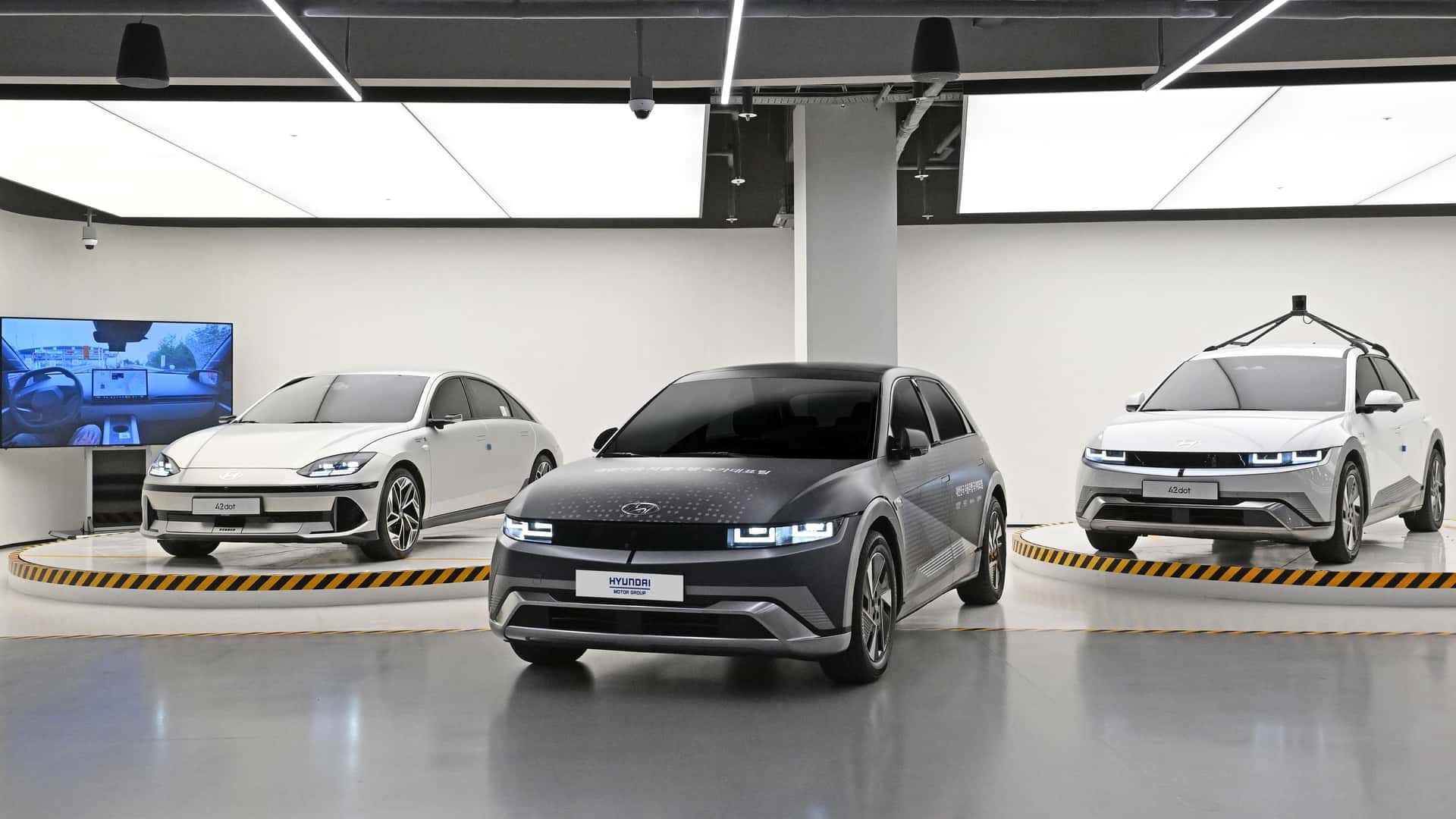
Crucially, this hardware baseline will establish technical standardization across both Hyundai and Kia model lineups. Furthermore, it aligns software pipelines between internal engineering groups and autonomous mobility subsidiaries, including robotaxi developer Motional and software unit 42dot. Unified computing architecture will streamline over-the-air updates and significantly accelerate algorithmic development cycles across all connected corporate divisions.
Camera-Centric Architecture and Real-World Validation
In line with modern driver-assistance design philosophies, Hyundai’s initial system relies primarily on an integrated array of vision cameras, radar sensors, and ultrasonic modules while omitting costly lidar hardware. Although lidar may eventually return for higher-tier Level 3 automated driving applications, executives confirmed that camera-based vision remains the primary pillar for mainstream supervised driver assistance.
Demonstration videos released during official technical showcases illustrated the system's capabilities in extreme conditions. A modified Ioniq 5 electric crossover successfully navigated the dense, high-traffic corridors of Seoul’s Gangnam District. Operating under human supervision, the vehicle seamlessly handled complex lane changes, crowded intersections, and unpredictable pedestrian traffic patterns without disengaging its automated driving modes.
Achieving smooth autonomous navigation in urban centers requiring rapid decision-making highlights the progress of Hyundai’s software stack. The test demonstrated that while mass production remains several years away, the underlying perception algorithms are already capable of managing chaotic metropolis traffic environments with high confidence and minimal driver intervention required.
Atria AI and the End-to-End Neural Network Shift
The ultimate destination of Hyundai’s autonomous initiative is the proprietary Atria AI platform, scheduled to arrive in the second half of 2029. Classified internally as a Level 2++ system, Atria AI represents a complete departure from traditional rules-based robotics code. It relies instead on end-to-end neural network architecture that mimics human cognitive processing during complex driving tasks.
In an end-to-end machine learning framework, raw sensor input feeds directly into a unified artificial intelligence model, which outputs steering, acceleration, and braking commands simultaneously. This approach eliminates hand-coded logic barriers, allowing the software to generalize driving behaviors more effectively when encountering novel road obstacles, non-standard traffic patterns, or adverse environmental conditions.
According to technical leadership statements, the long-term competitive edge in autonomous software hinges on the speed of continuous machine learning loops. Hyundai’s operational data flywheel constantly feeds real-world corner cases back into server clusters. This continuous cycle of training, testing, and edge-case resolution ensures that Atria AI will iteratively improve far faster than traditional software stacks.
Escalating Competition in the Autonomous Vehicle Sector
Hyundai’s delayed timeline reflects broader industry shifts as legacy automakers pivot away from fragmented software suites toward unified AI platforms. Competitors across North America, Europe, and Asia are similarly recalibrating their autonomous roadmaps. Automakers like Toyota have announced parallel efforts to release advanced supervised driving platforms by 2028, underscoring the fierce international race.
By choosing patience over premature commercial release, Hyundai aims to avoid customer frustration with underperforming technology. The modern automotive market demands seamless automated features, and delivering an unfinished product risks damaging consumer trust. Utilizing Nvidia’s established processing infrastructure provides an immediate, reliable baseline while internal software teams perfect the Atria AI system.
Ultimately, highly automated driving capability is evolving into a core vehicle metric alongside range, power, and safety ratings. Hyundai’s strategic multi-year investment positions the automaker to contend directly against industry benchmarks upon Atria AI’s release in 2029. The calculated delay demonstrates that in the software-defined vehicle era, long-term technical excellence far outweighs short-term market speed.
