
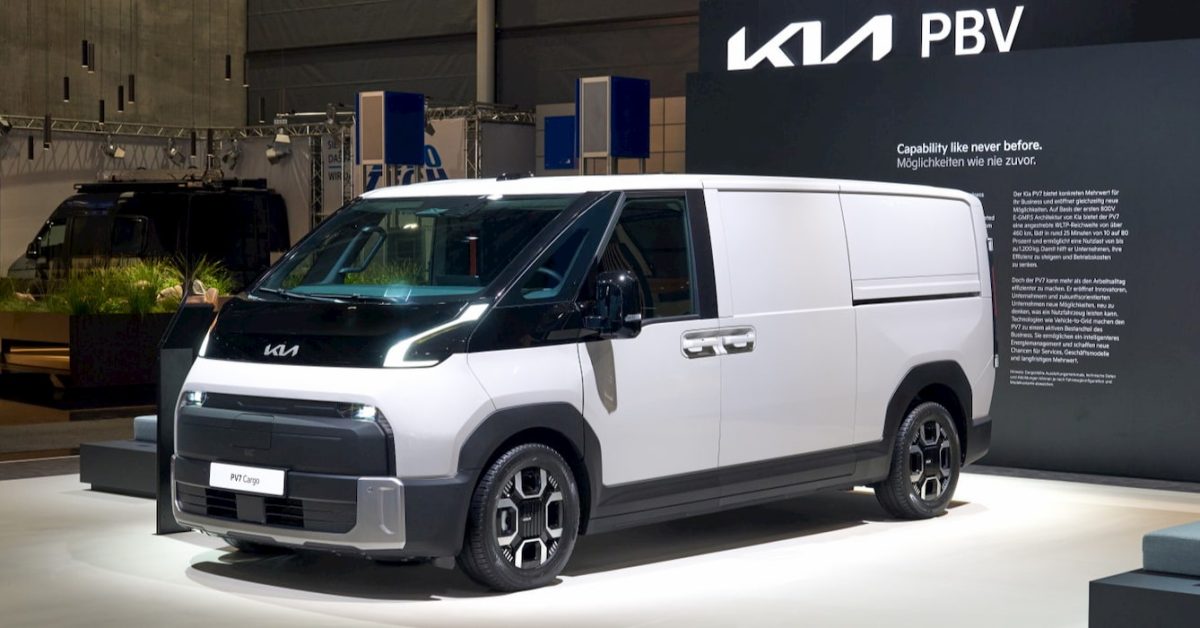
Kia Targets 250,000 Commercial EV Sales With Larger Vans
Kia is pivoting its commercial vehicle strategy, placing greater reliance on its upcoming mid-size and full-size electric vans to fulfill global sales ambitions. Following the public introduction of its latest Platform Beyond Vehicle concept at the IAA Transportation event, corporate leadership confirmed that larger models will form the primary pillar of the company’s long-term commercial electrification blueprint through 2030.
The South Korean automaker maintains an overarching target to deliver 250,000 purpose-built electric commercial vehicles annually by the end of the decade. However, internal volume projections have shifted notably compared to early investor disclosures. Rather than relying predominantly on its smaller entry-level van, Kia now anticipates that its larger platform models will collectively outpace mid-range variants in total customer deliveries.
Under updated strategic estimates, the smaller PV5 is expected to generate approximately 120,000 unit sales by 2030. In contrast, the larger PV7 and upcoming flagship PV9 platforms are projected to account for a combined 130,000 units. This marks a rebalancing from earlier strategic frameworks, which had originally slated the compact segment to drive up to 150,000 annual deliveries alongside 100,000 mid-size units.
Strategic Realignment Towards Mid-Size Electric Platforms
The decision to lean heavily into larger electric vans stems from commercial dynamics in key international markets, particularly across Western Europe. Automotive industry filings highlight that the mid-size light commercial vehicle sector represents the core volume driver in European commercial transport, boasting an annual market size of roughly 800,000 units across cargo and passenger fleet applications.
Kia initially launched its smaller PV5 model to establish a solid footprint in a less crowded vehicle segment. Executive statements noted that entering the compact commercial tier allowed the brand to validate its purpose-built platform while preparing manufacturing logistics for the aggressive competition defining the mid-size van ecosystem, where established global fleet operators demand rigorous range, payload, and durability standards.
The strategy achieved early validation as the PV5 rapidly captured commercial market share in key European territories following its rollout. Regulatory disclosures reveal that the compact van secured a 37 percent share of the regional electric small van segment during the first half of 2026, even commanding over half of all new electric C-segment commercial vehicle sales across five individual national markets.
Robust Fleet Demand Drives Pre-Launch Negotiating Momentum
Building on that initial momentum, Kia is engaging in aggressive pre-launch commercial negotiations prior to rolling out its larger architectures. Statements from executive briefings confirm that the automaker is actively negotiating fleet supply agreements with over 300 prospective corporate clients worldwide. Early commercial interest has already yielded significant commitments ahead of full-scale series assembly.
Current commercial reservations include notable enterprise contracts across Europe. Scandinavian technical services firm Bravida has agreed to acquire approximately 400 units of the mid-size PV7. Meanwhile, UK fleet manager Motability and Finnish elevator giant Kone have each committed to taking delivery of over 300 units, demonstrating immediate enterprise appetite for multi-purpose commercial electric vans.
In aggregate, Kia’s commercial vehicle division currently manages roughly 4,000 units on firm standby orders across its expanding fleet lineup. Furthermore, ongoing contract negotiations represent more than 17,000 additional units currently in advanced pipeline discussions, establishing a strong foundation of commercial fleet orders before series production and regional customer deliveries commence.
Dimensional Upgrades and Modular Platform Flexibility
The upcoming PV7 represents a significant physical step up from the initial PV5 architecture, offering expanded cargo volume and specialized utility configurations. Official technical specifications indicate the PV7 Passenger and Cargo variants measure 5,350 mm in total length, 1,995 mm in width, and 1,990 mm in height, riding on a generous 3,500 mm wheelbase designed for heavy payload carrying capacity.
By comparison, the smaller PV5 Passenger model features a total length of 4,695 mm, a width of 1,895 mm, and a height of 1,915 mm, supported by a 2,995 mm wheelbase. The substantial increase in dimensions allows the PV7 to directly target high-density urban logistics, regional parcel distribution, and specialized vocational conversions across private enterprise fleets.
To address diverse commercial applications, Kia plans to engineer up to 23 distinct variants of the PV7 platform over its lifecycle, spanning cargo configurations, multi-seat shuttles, and custom body styles. The model is scheduled to officially enter commercial sale in South Korea and Europe during the second half of 2027, followed by a phased rollout to additional international markets.
Regional Expansion Strategy and North American Market Omission
Despite recent sightings of development prototypes undergoing road testing within North America, executive leadership confirmed that the PV7 is not presently slated for a United States launch. Industry reports attribute this market exclusion to geographic and operational constraints, as long average driving distances and lower battery-electric fleet conversion rates among American commercial haulers create challenging market conditions.
Instead of entering North America immediately, Kia is concentrating its commercial vehicle expansion across region-specific markets equipped with favorable electrification policy frameworks and high urban delivery density. The company is actively preparing commercial distribution pipelines across the Middle East and Asia-Pacific regions, where demand for modular zero-emission transport solutions continues to experience steady structural growth.
As Kia prepares to scale its commercial vehicle manufacturing capacity, the realignment toward larger vehicles highlights a mature understanding of global commercial fleet needs. By backing up its 2030 target of 250,000 units with robust mid-size offerings, the brand is positioning itself to become a dominant global player in zero-emission commercial transport.
