
Volkswagen Unveils Mission Efficiency EV With 1000 Mile Range
Volkswagen has officially revealed the Mission Efficiency, a bold new electric vehicle concept designed to push the boundaries of energy economy. Purpose-built to showcase the potential of mass-market EV components, the prototype reimagines ultra-frugal personal transport. Rather than relying on massive, expensive battery packs, the German automaker focused on hyper-streamlined design and extreme engineering optimization to maximize every kilowatt-hour of available energy.
Under real-world evaluation, the Mission Efficiency completed a continuous 1,278-kilometer (794-mile) drive from Wolfsburg to Vienna on a single charge, finishing with 164 kilometers of remaining estimated range. Official testing validated by Record Institute Germany confirmed three distinct world records in the near-production everyday EV class. The results prove that extreme efficiency can unlock near 1,000-mile real-world capability without requiring exotic cell chemistries.
The concept car achieves these remarkable figures by drawing power from a modest 54.9 kWh net usable battery paired with a single 99 kW (135 horsepower) electric motor driving the front wheels. Rather than chasing raw acceleration, the engineering team prioritized functional efficiency, achieving an unprecedented average energy consumption rate of just 6.89 kWh per 100 kilometers during long-distance real-world trial runs.
Breakthrough Aerodynamics and World Record Efficiency
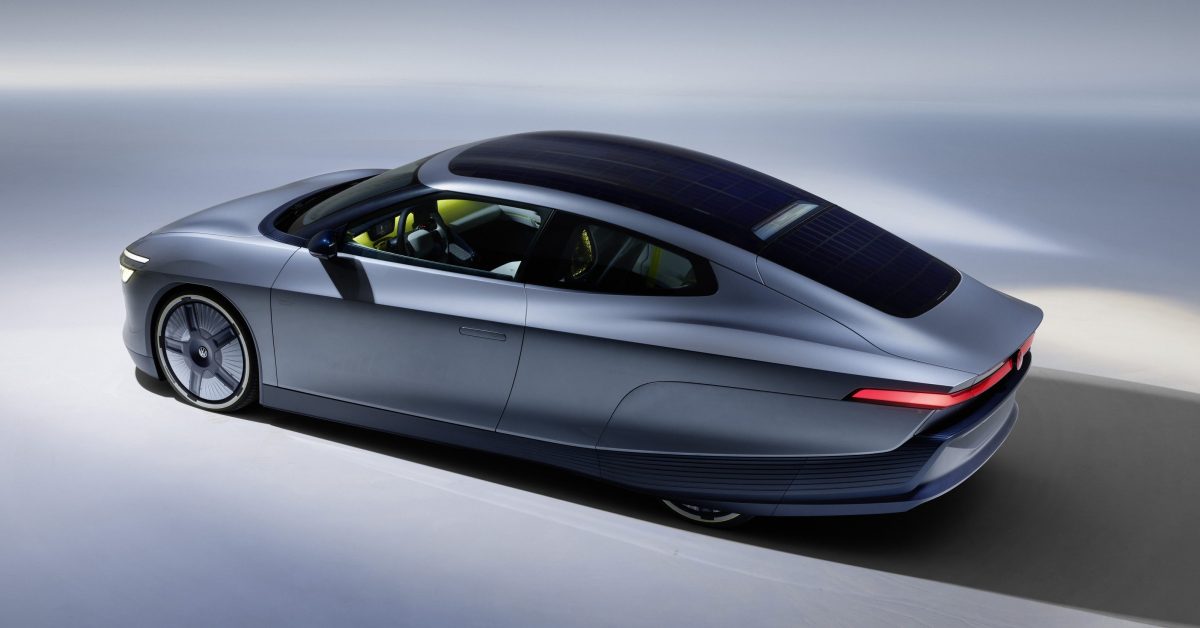
Translated to North American metrics, the vehicle operates at roughly 110 watt-hours per mile, delivering over 9 miles per kilowatt-hour. That translates to an equivalent fuel efficiency well exceeding 300 MPGe, vastly outperforming current production electric vehicles. The primary catalyst behind these figures is an exceptionally streamlined teardrop silhouette that achieves a drag coefficient of just 0.158, establishing a record for road-legal automobiles.
The aerodynamic package features fully clad rear wheel arches, an enclosed flat underbody, flush door handles, frameless side windows, and active cooling flaps that adjust according to thermal demand. According to internal engineering statements, the car consumes 30 percent less energy than a standard compact hatch at speeds above 80 km/h. At 140 km/h, its power draw matches what a standard compact car requires at just 100 km/h.
Turbulence control extends to specialized patented wheel deflectors and flow-optimized hubcaps. The vehicle rolls on custom low-resistance tires developed by Continental, which boast a rolling resistance rating of 4.9 kilograms per tonne. This benchmark sits roughly 25 percent below the threshold required to achieve the European Union's highest "A" efficiency rating, eliminating crucial parasitic rolling drag on open highway routes.
Radical Weight Reduction Meets Mass Production Tech
To minimize chassis mass without inflating production costs, Volkswagen constructed the Mission Efficiency on its scalable MEB+ platform, borrowing core components from the upcoming ID. Polo. The self-supporting structure combines lightweight aluminum with strategic carbon-fiber and aramid reinforcements. This hybrid construction delivers high structural rigidity while keeping total mass remarkably low, proving high-tech materials can be integrated into high-volume vehicle architectures.
The minimalist philosophy carries directly into the cabin, which offers a functional 2+2 seating layout alongside 481 liters of usable cargo space. Interior designers eliminated traditional heavy components, replacing standard infotainment hardware with a streamlined "bring your own device" smartphone mount. Ambient audio relies on a removable Bluetooth speaker, while lightweight composite interior panels further reduce unnecessary weight across the passenger compartment.
Smart Energy Harvesting and Frictionless Engineering
Beyond aerodynamic shaping and chassis lightness, the Mission Efficiency integrates advanced energy recovery systems to extend driver range daily. A 370-watt solar panel array is seamlessly embedded within the vehicle's glass roof and rear boot lid. Under favorable sunlight conditions, this auxiliary solar harvest can generate up to 30 kilometers of supplementary driving range per day without drawing power from the main traction battery.
Mechanical efficiency receives an equal amount of attention under the skin. The rear axle features an advanced electromechanical braking system that entirely dispenses with traditional hydraulic fluid and fluid lines. By replacing heavy hydraulic assemblies with direct electronic actuators, engineers eliminated residual pad drag against the rotors and trimmed overall curb weight, ensuring maximum energy remains dedicated solely to forward movement.
Echoes of the Legendary XL1 for the Electric Era
Industry analysts quickly drew comparisons between the new concept and Volkswagen's iconic 2013 XL1. That earlier ultra-efficient vehicle featured a teardrop body with a 0.189 drag coefficient and achieved 0.9 liters per 100 km using a two-cylinder diesel plug-in hybrid drivetrain. However, the XL1 was limited to just 250 expensive units priced over $140,000, serving primarily as an exclusive technology demonstration project.
The Mission Efficiency evolves that spirit into a modern, fully electric format tailored for potential mass manufacturing. While beating the XL1’s aerodynamic record, it replaces exotic custom running gear with standardized, affordable electric drive components. By demonstrating high efficiency on accessible architecture, the concept proves that hyper-frugal mobility no longer requires unmanageable retail price tags or hyper-exclusive carbon-monocoque production runs.
A Signpost for the Future of Production Electric Vehicles
Despite its impressive real-world range records, Volkswagen currently classifies the Mission Efficiency strictly as a technology demonstrator rather than a confirmed commercial product. Executive statements emphasize that the concept serves to showcase what high-volume EV platforms can achieve when optimized for absolute aerodynamic purity. Key design cues and efficiency innovations are slated to filter into future series-production electric models.
As automakers navigate battery supply constraints and weight penalties in modern EVs, the Mission Efficiency highlights an alternative development path. By prioritizing drag reduction, low rolling resistance, and smart weight saving over massive battery packs, future electric cars can achieve unprecedented driving range. This concept provides a tangible blueprint for affordable, extreme-range electric mobility across the global automotive landscape.
