
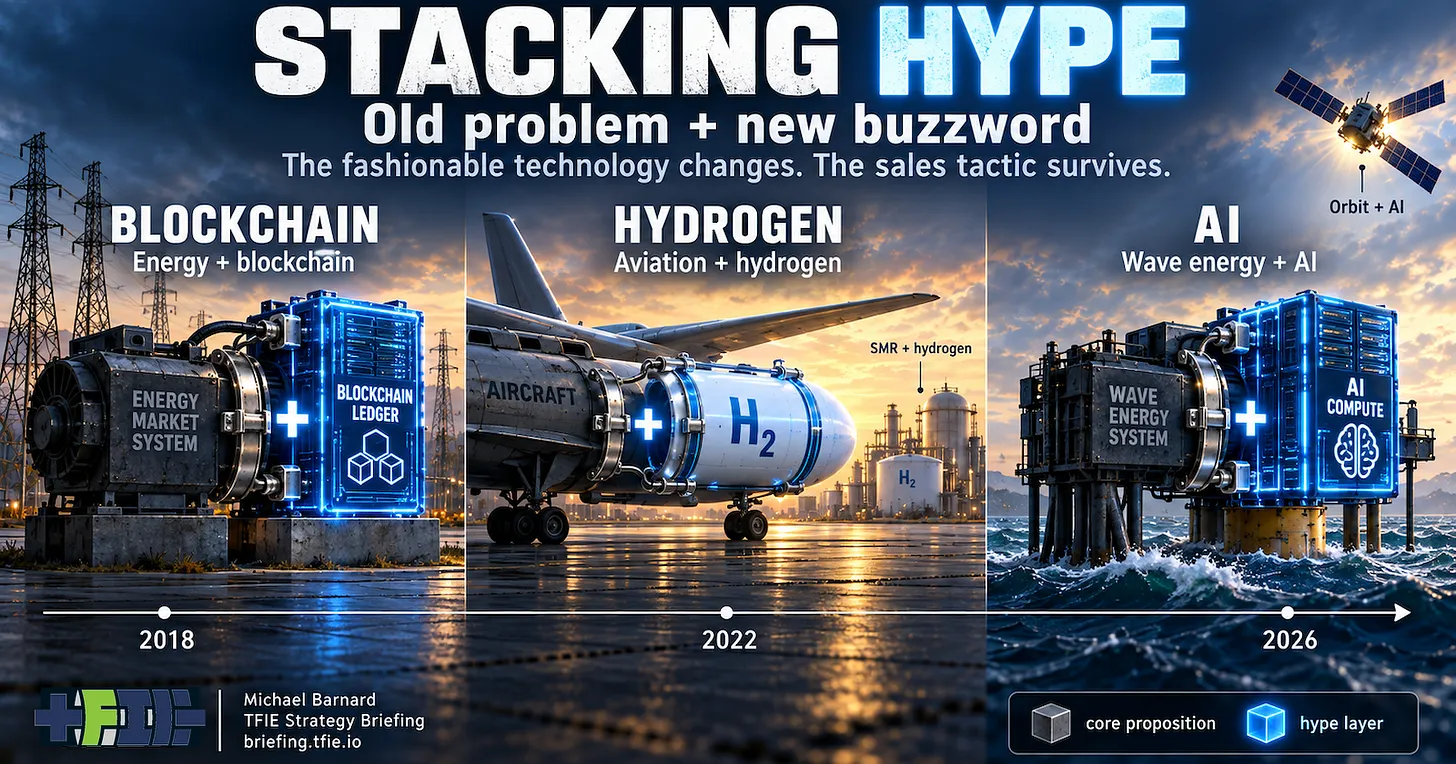
Why Adding AI Does Not Fix Fundamental Engineering Problems
The Rise of AI as a Novel Hype Layer
The artificial intelligence revolution has ignited an unprecedented demand for electrical power, land, and cooling infrastructure across the globe. As traditional terrestrial data centers face severe grid interconnection bottlenecks, venture capital is increasingly funding radical power concepts. Among the newest propositions are wave-powered ocean compute platforms, orbital data centers, and off-grid high-density processing facilities designed to bypass local utility constraints.
Yet, placing a high-value AI narrative over complex physical hardware projects rarely eliminates their underlying engineering hurdles. Industry observers note that while compute demand is undeniably real, relocating high-performance computing hardware to unconventional environments introduces significant new operational trade-offs. The core commercial challenge remains building reliable, cost-effective physical systems that can survive demanding physical conditions over long operational lifespans.
Offshore Compute and the Constraints of Wave Power
Consider the ambitious venture Panthalassa, which raised $140 million this year to construct autonomous ocean platforms. The company aims to generate electricity directly from wave movement and utilize that energy on-site for high-density AI inference tasks. By co-locating the computing payload alongside the wave generator, the platform side-steps a traditional wave energy friction point: the costly installation of subsea transmission cables.
With fresh capital secured, the company plans to build a pilot manufacturing plant and begin deploying its Ocean-3 floating systems. However, eliminating the subsea cable does not resolve the historical economic and physical challenges of wave power. Equipment operating at sea must continuously endure extreme saltwater corrosion, relentless mechanical fatigue, intense storm cycles, and complex offshore maintenance procedures.
Furthermore, placing high-value graphics processing units, delicate power conditioning hardware, and satellite communication systems on ocean platforms introduces major vulnerability. Ocean-based computing platforms do not compete against a theoretical land facility with zero power access. Instead, they must directly compete against terrestrial data centers supplied by established regional power grids, utility solar installations, wind farms, and battery storage systems.
Distinguishing Material Solutions from Added Dependencies
This pattern of wrapping emerging software trends around challenging hardware engineering propositions is becoming increasingly common across climate technology. Because artificial intelligence is genuine, exceptionally valuable, and attracting immense investment, it offers a compelling story for unproven physical platforms. Industry filings indicate a recurring pattern where complex hardware concepts adopt trending technology layers to secure speculative funding.
A vital diligence framework must be applied when evaluating these multi-layered hardware propositions. Market analysts emphasize determining whether adding a secondary technology eliminates a primary material constraint or simply adds another costly dependency. When novel technological pairings increase total system complexity without establishing a clear unit-economic advantage, the core business remains constrained by original physical limitations.
Case Studies in Pivot and Commercial Survival
The commercial paths of previous high-profile climate hardware startups offer useful insights into how stacked dependencies play out. European aerospace developer Destinus initially captured headline attention with plans for liquid-hydrogen supersonic passenger aviation. That ambitious concept bundled together cryogenic hydrogen storage, novel hypersonic propulsion systems, unbuilt fueling infrastructure, and unprecedented civil aviation regulatory approvals into a single operational roadmap.
Rather than succumbing to these accumulated dependencies, the enterprise strategically realigned its commercial model around immediate market needs. Industry reports confirm the company pivoted its core focus toward autonomous flight technology, advanced propulsion components, and defense systems. In April 2026, the firm agreed to establish a defense joint venture with Rheinmetall to develop specialized missile systems.
This commercial pivot does not validate the original promise of civil hydrogen supersonic flight. Instead, it demonstrates that specific underlying capabilities—such as high-speed flight mechanics, autonomous navigation, and specialized manufacturing—can secure paying customers when detached from an overly complex technology stack. Identifying defense buyers willing to pay for speed and range proved far more viable.
Evaluating the Future of Hardware and Energy Synergy
A similar dynamic regarding stacked technical dependencies is visible in the solar mobility space with Aptera. The company’s specialized lightweight vehicle features body-integrated solar panels that effectively harvest sunlight to add daily battery range. Under favorable real-world conditions, such as driving between unsheltered surface parking lots in sunny suburban environments, the integrated solar array contributes helpful supplementary energy.
However, generating supplemental solar power does not solve the fundamental hurdle of manufacturing and selling novel vehicles at scale. Recent financial filings indicate the company still requires approximately $40 million to $45 million in capital to complete tooling and validation for low-volume production. Scaling its existing manufacturing site to reach an annual target of 20,000 units requires an additional $140 million to $160 million.
These sector outcomes reveal that while AI, hydrogen, and solar integrations are legitimate technological advancements, they cannot bypass fundamental manufacturing and environmental realities. Combining computational workloads with alternative energy generation creates attractive market narratives, but long-term success requires solving core engineering economics. True value emerges when underlying hardware stands on its own merits rather than relying on novel hype layers.
